
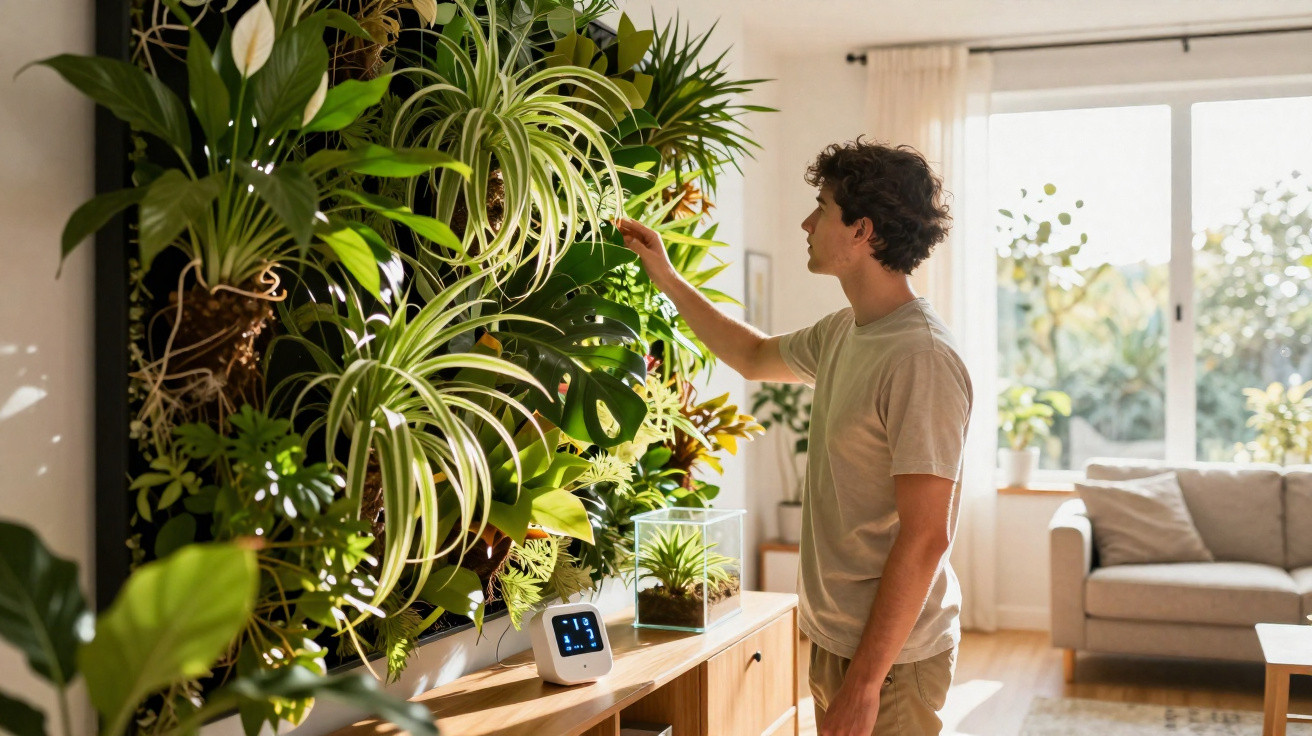
Vertical gardens indoors?
It may sound like decoration, but it could radically change everyday life – especially in schools, offices and homes.
When people think of polluted air, they tend to picture fine particulate matter on busy roads. Yet the real danger zone is often right under our noses: at home or in the office. A new study from Spain now shows just how effectively certain plants in so-called “green walls” can clean indoor air – and the figures are striking.
Invisible risk: why indoor spaces can be more toxic than the street
Modern buildings contain countless sources of pollutants. Most cannot be seen, some are barely detectable by smell, and almost all are accepted in everyday life without much thought.
- Paints and varnishes on walls and furniture
- Plastic surfaces, chipboard and laminate
- Air fresheners, perfumes and cleaning products
- Heating systems and candles
- Cigarette smoke and fumes from cooking
All of these release volatile organic compounds (VOCs), including formaldehyde and acetone. There are also gases such as nitrogen dioxide from exhaust fumes and sulphur dioxide. These substances can cause headaches, tiredness and irritation to the eyes and airways, while noticeably reducing concentration.
Health authorities group such symptoms under the term “sick building syndrome”. It describes spaces in which people consistently feel unwell, even though there is no immediately obvious cause.
Spanish experiment: green walls in a glass chamber
Researchers at the University of Seville set out to establish whether planted indoor walls could substantially reduce these pollutants – and, if so, how rapidly. To do this, they created a relatively simple but clearly defined experiment.
- A sealed glass chamber replicated an indoor space.
- Vertical planting modules – a “green wall” – were fitted to one wall of the chamber.
- The researchers then deliberately introduced different pollutants into the air.
- Measuring devices tracked changes in concentration at short intervals.
After 24 hours, pollutant levels in the chamber were 96 to 98 per cent lower – effectively an almost complete purification of the air.
The substances tested included:
- Nitrogen dioxide (NO₂)
- Sulphur dioxide (SO₂)
- Formaldehyde (a VOC considered carcinogenic)
- Acetone, found for example in solvents and some household products
Importantly, the effect did not take many hours to begin. Pollutant readings had already fallen significantly after just 15 minutes.
How quickly plants really work indoors
An assessment of the measurements reveals how rapidly the plants begin to act.
Just 15 minutes after the pollutants were introduced, levels had dropped by 24 to 40 per cent, depending on the gas.
In practical terms, this means these walls do not work only over the long term: they may make a noticeable difference shortly after cooking, painting or cleaning. Plants absorb these substances not only through their leaves, but also through the growing medium and the microorganisms living within it. The root zone contains countless bacteria that break down these compounds.
Which plants performed best in the test
For the trials, the team used five common houseplant species that can also be grown in living rooms or offices:
- Spathiphyllum wallisii (peace lily)
- Tradescantia zebrina (inch plant)
- Philodendron scandens (heartleaf philodendron)
- Ficus pumila (creeping fig)
- Chlorophytum comosum (spider plant)
The results revealed clear differences between species and between the individual pollutants.
Peace lily: highly effective against nitrogen dioxide
The peace lily, known in many offices as an easy-care plant, proved especially effective against nitrogen dioxide in the experiment. Within a single hour, it reduced this irritant gas by around 60 per cent. NO₂ is produced primarily by combustion, including traffic, heating systems and gas cookers.
Spider plant: rapid support against formaldehyde
The spider plant was particularly efficient at breaking down formaldehyde, one of the most problematic indoor pollutants. Formaldehyde can be emitted by chipboard furniture, flooring, adhesives and textiles, and is suspected of causing cancer.
In the test, the spider plant broke down formaldehyde faster than the other species examined – a strong argument for using it in new or recently refurbished rooms.
Philodendron, creeping fig and inch plant also contributed to lower levels of different pollutants, although their strengths varied according to the gas involved. This mix of species is precisely what makes green walls so interesting: they can be assembled specifically to tackle the broadest possible range of gases.
Not a miracle solution, but a valuable addition to ventilation and filters
The researchers stress that planted walls are not a replacement for conventional ventilation systems. Fresh-air supply, filtration equipment and sensible heating practices remain the foundations of healthy indoor environments.
However, the data suggest that plant walls could become an effective additional tool – particularly where windows are difficult to open or where many people work or study in a confined space.
- Open-plan offices with air conditioning
- Schools and nurseries with heavily occupied classrooms
- Homes in highly polluted inner-city locations
- GP surgeries, waiting rooms and public buildings
In addition to air purification, plants can have psychological benefits: people generally find planted spaces more pleasant, report less stress and feel more balanced.
How these green walls are constructed
Professional systems generally consist of modular units fixed to a wall. These modules hold growing-medium inserts or pots in which the plants grow. An integrated irrigation system automatically supplies the plants with water and nutrients.
| Component | Function |
|---|---|
| Support module | Holds the plants on the wall and provides stability |
| Growing medium | Anchors the roots and retains water and nutrients |
| Irrigation | Provides automatic watering and prevents drying out |
| Plant mix | Determines which pollutants are broken down particularly effectively |
For private homes, simplified options are available, such as planting panels or modular systems that hang on the wall like a shelf. Choosing the right species and providing reasonably consistent care remain crucial.
What this study could mean for everyday life
Anyone seeking to make their home or office healthier does not need to plant an entire wall. Even a few larger plants, selected deliberately and placed near typical problem areas, can make a difference – for example, close to a desk, in the bedroom or beside furniture that is still releasing emissions.
One possible approach:
- Peace lily in rooms with limited fresh-air supply or near heavily trafficked roads
- Spider plant in rooms containing lots of new furniture or laminate flooring
- Philodendron and creeping fig as additions to living rooms and offices
Despite the strong results from the glass chamber, one point remains important: a real home is not a laboratory. Airflows, open doors, changing temperatures and ventilation habits all affect performance. The figures from Seville nevertheless show very clearly how much potential there is in a carefully planned planting concept.
Background: how plants remove pollutants from the air
Plants use their leaves and stomata – tiny openings – like small filters. Gases enter, settle on the leaf surface and partly pass into the plant itself. Microorganisms in the growing medium convert many of these substances into less harmful compounds.
The larger the leaf area and the denser the planting, the greater the surface in contact with the air. This is where vertical gardens excel: they accommodate a vast amount of foliage on only a few square metres of wall space.
This creates new possibilities for architectural practices, developers and local authorities. Schools, for example, could combine planted corridors with mechanical ventilation. Businesses could improve meeting rooms with high CO₂ and pollutant levels using plant walls, rather than relying solely on more powerful air-conditioning systems.
One thing is clear: the study from Seville provides solid data showing that vertical planting systems are far more than an aesthetic gimmick. They can become one element in the fight against poor indoor air quality – while also creating spaces where people prefer to spend time.






Comments
No comments yet. Be the first to comment!
Leave a Comment