
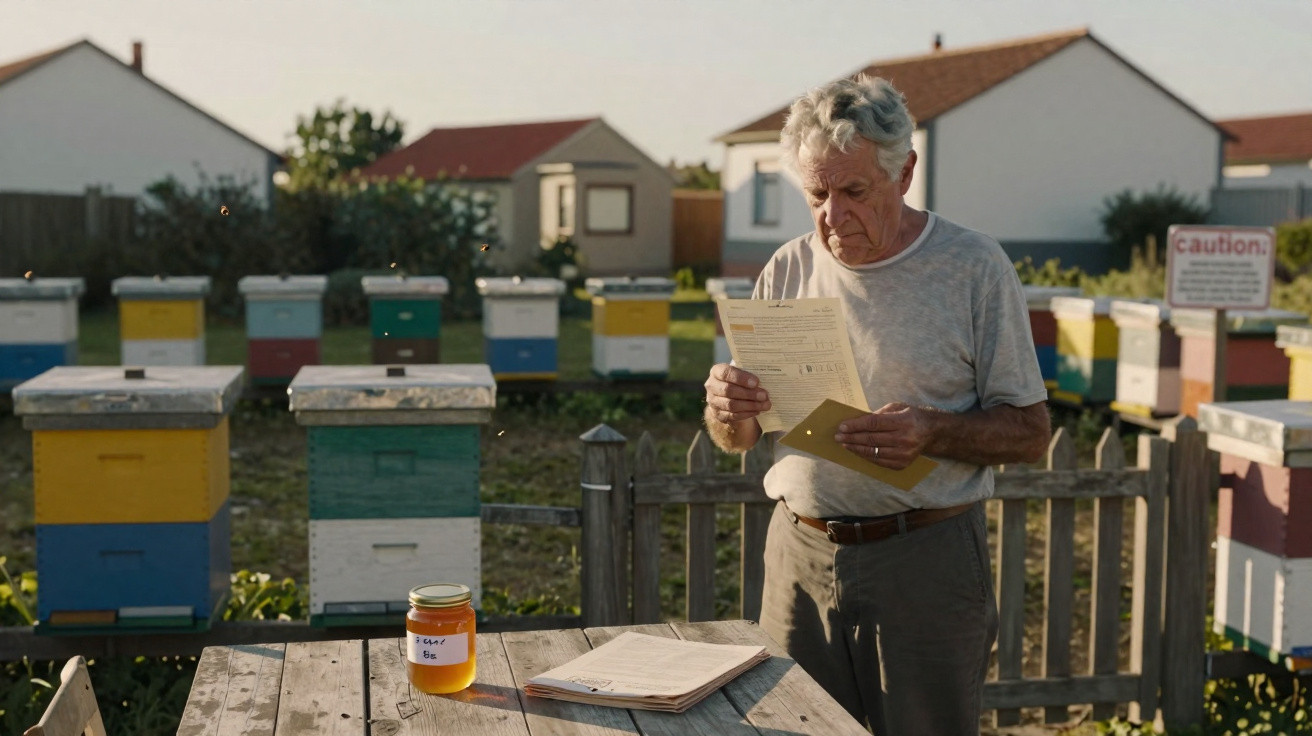
The plot looks nothing like a business. It looks like somewhere to retire. It is a sloping piece of ground on the edge of a peaceful village, with wind-flattened semi-wild grass, several fruit trees and a tidy line of pastel beehives buzzing in the sunshine. For Jean*, a 68-year-old former mechanic, it was supposed to be straightforward: a vegetable garden, a shed and room to unwind after four decades in a loud workshop.
Then a young beekeeper from the neighbouring town knocked at his door. He had nowhere to keep his hives, he explained. Could he use a small corner of the plot, simply to help the bees survive? Jean agreed. To him, it seemed no more significant than lending someone a garden hose.
Several months later, it was the tax office that came calling, and its message was very different. The honey, officials said, amounted to agricultural activity. Agricultural activity, in turn, meant tax. That is where this story starts.
When kindness becomes “economic activity”
In practical terms, Jean’s life had barely altered. The beekeeper placed eight hives at the foot of the land. There was no rent and no contract: only a handshake and a loose promise of a few jars of honey once the season ended. Neighbours were intrigued, the bees remained placid and the fruit trees appeared to benefit from the additional pollinators. It was all summer scents and good will, not accounts and inspections.
A letter then arrived. It was dry, official and difficult to get through without pausing for breath after every line. The land, previously recorded as ordinary undeveloped property, had been reclassified for agricultural use. This brought a new tax demand, higher than the previous one and based on a rate that seemed absurd to a man who had never sold even one tomato. The beekeeper’s presence, recorded during a routine inspection, had prompted the alteration. Honey meant farming. Farming meant business. Business meant tax.
The impact was not solely financial, although the figures were painful on a pension. It also felt morally wrong. To Jean, and to many people who encountered his account online, the tax seemed to penalise a modest act of generosity. It was the sort of quiet local assistance that would normally involve no paperwork at all. One retired man, one young beekeeper and a handful of bees had somehow brought the state between them, counting jars and square metres. It prompted an uncomfortable question: are simple gestures that hold communities together gradually being taxed?
How to stop a good deed backfiring
The first takeaway from Jean’s experience is painfully clear: before allowing anyone to use part of your land, even where the arrangement seems harmless, ask some questions. What exactly will take place there? Will there be livestock, hives, cultivation or storage? Will the user sell what they produce? A conversation lasting five minutes can make a substantial difference. Not in romantic terms, but legally. It may lead to a brief written note, even on a sheet of notebook paper, confirming that this is a free loan for personal use rather than a commercial tenancy.
We all know the moment: saying, “Don’t worry about it, it’s nothing” because we do not want to sound distrustful or difficult. When land is involved, that reaction can cause problems. Looking excessively careful for ten minutes is preferable to disputing matters with a tax officer six months later. The point is not to involve solicitors in every favour between neighbours. It is to understand, broadly, when a well-intended arrangement could be seen as the beginning of an economic activity. That boundary is unclear, and the uncertainty is where the anxiety lies.
The second lesson is less technical and more personal. People such as Jean feel let down not merely by the bill, but by the sense that they have made a mistake without anyone explaining the rules. The plain truth is: the state rarely explains the game before sending the score. This is why local groups, mayors and online forums are often the first sources people approach. They put legal rules into everyday terms. They can explain, “Yes, your hives count as farming” or “No, three chickens won’t turn your garden into a commercial poultry farm.”
When beehives meet the rulebook
Usually, a case of this sort begins without drama. It may stem from a routine cadastral inspection, a satellite image showing installations on land meant to be “unused”, or a straightforward comparison between a registered beekeeper’s declared sites and the land register. No one is creeping through hedges or hiding behind gates. The process happens through screens, databases and officials who have never sat at the kitchen table listening to a beekeeper say “Thank you, you’re saving my bees.”
When hives or another activity have been identified, the administrative process begins. Officials categorise the use as personal, semi-professional or professional. If the beekeeper sells honey at markets, declares earnings or has enough hives to qualify as a farmer, the land accommodating them may be reclassified. The owner is then sent a notice, often in wording that resembles a foreign dialect, packed with codes and references to little-known articles. For a person who merely lent some ground behind the toolshed, it can feel like a slap in the face.
In truth, nobody studies tax legislation before agreeing to help a neighbour. That is exactly why stories of this kind spread so rapidly online. They reflect a broader concern: that every action, favour and shared resource will eventually create an entry on a tax return. There is another, deeper unease too: that rules written for industrial farming or major landowners are being imposed without sensitivity on retirees, hobbyists and people whose only aim was to help bees survive another summer affected by pesticides.
Protecting your land without closing the gate to others
There is a balanced option between unquestioning trust and suspicious refusal. It begins with one simple habit: put the arrangement in writing. A straightforward “loan of land” agreement, even one obtained from a council website or consumer association, can alter how officials understand the arrangement. It can confirm that there is no rent, no commercial partnership and no shared profit. It should set out the duration, the exact area concerned and the activity permitted. With two signatures and a date, you are no longer simply the “owner associated with agricultural use”; you have a clear written account.
A further practical step is to seek advice from appropriate sources rather than relying on rumours. Councils, local tax offices, farmers’ unions and beekeeping clubs often understand the real-world thresholds: the number of hives that may make an operation professional, the declaration a beekeeper needs to submit and whether your property classification could be affected. A ten-minute discussion may save months of worry. Empathy is important here. Retirees like Jean do not begin the day intending to evade the system. They want to live quietly, without feeling that every apple tree could become a tax hazard.
At times, the greatest error is saying nothing. That might mean not asking the beekeeper whether the hives have been declared, not contacting the tax office for fear it will “discover something”, or not speaking to neighbours who may have faced the same issue. Silence encourages imagined worst-case scenarios, and those are invariably worse than reality. Discussing the matter can uncover shared answers. Perhaps the beekeeper could formally rent a small agricultural parcel instead. Perhaps part of the land could receive a different classification. Perhaps no substantive change is needed beyond recording the arrangement properly.
“We thought we were just helping each other out,” Jean told me, turning the tax letter over and over in his hands. “Now I feel like I have to think like a businessman every time I say yes to something. That’s not the retirement I imagined.”
- Before saying yes: Find out what will happen on the land and whether the person sells their produce.
- Put things in writing: A simple free-loan agreement, with no rent and explicit limits, can affect how the arrangement is interpreted.
- Check local rules: Councils, associations and tax offices can clarify when an activity is considered “agricultural”.
- Talk to others: Neighbours, relatives and online groups may have first-hand experience that makes legal jargon easier to understand.
- Keep the spirit of kindness: Helping others need not end; it simply needs to be arranged so that it does not work against you.
A country that wants bees, but taxes the hives
The irony is clear to everyone. Campaigns urge us to “save the bees”, petitions against pesticides are widely shared and urban beehives on city rooftops are applauded. Yet small rural acts that assist those same bees can run into tax classifications drafted for a different age. The disconnect between public messaging and private experience creates a restrained anger. It can be heard in village cafés, online discussions and family meals: the feeling that rules made far away fail to recognise the details of real life.
But Jean’s story exposes something else too, something less obvious yet equally powerful. People still want to support one another. Landowners continue to lend barns to young farmers, clearings to campers and garages to mechanics who are starting out. Beekeepers still knock on doors, slightly embarrassed, asking whether they can place several hives in a sunny corner. Most of the time, everyone just wants things to go well. The issue is whether our systems can accommodate that quiet, determined generosity without trapping it beneath layers of forms.
For the moment, the argument remains unresolved. Should the tax office take a softer approach to these small-scale situations? Should there be a de minimis threshold for the “kindness use” of land? Or must we accept that, in a world where everything is measured, even bees need a box on a declaration form? Societies must draw a boundary between preventing abuse and protecting everyday solidarity. Where they place it will reveal much about the kind of later life they wish to offer people like Jean - and how much they truly value small, unassuming acts of care.
| Key point | Detail | Value for the reader |
|---|---|---|
| Clarify land use early | Discuss what will be done on the land and whether it involves sales or professional status | Reduces the risk of surprise tax reclassification |
| Use a simple written agreement | Free loan contract stating no rent, limits, and non-commercial intent | Provides a tangible story if authorities ask questions |
| Seek local guidance | Contact town hall, tax office, or associations before hosting hives or other activities | Turns vague anxiety into clear, actionable information |
FAQ:
- Question 1: Can keeping a few beehives on my land genuinely alter its tax classification?
- Question 2: What document should I sign with a beekeeper to safeguard my position?
- Question 3: Does the situation differ if the beekeeper does not sell the honey?
- Question 4: Who should I contact locally if I fear my land could be reclassified as agricultural?
- Question 5: How can I continue helping young farmers or beekeepers without jeopardising my retirement?

Comments
No comments yet. Be the first to comment!
Leave a Comment