
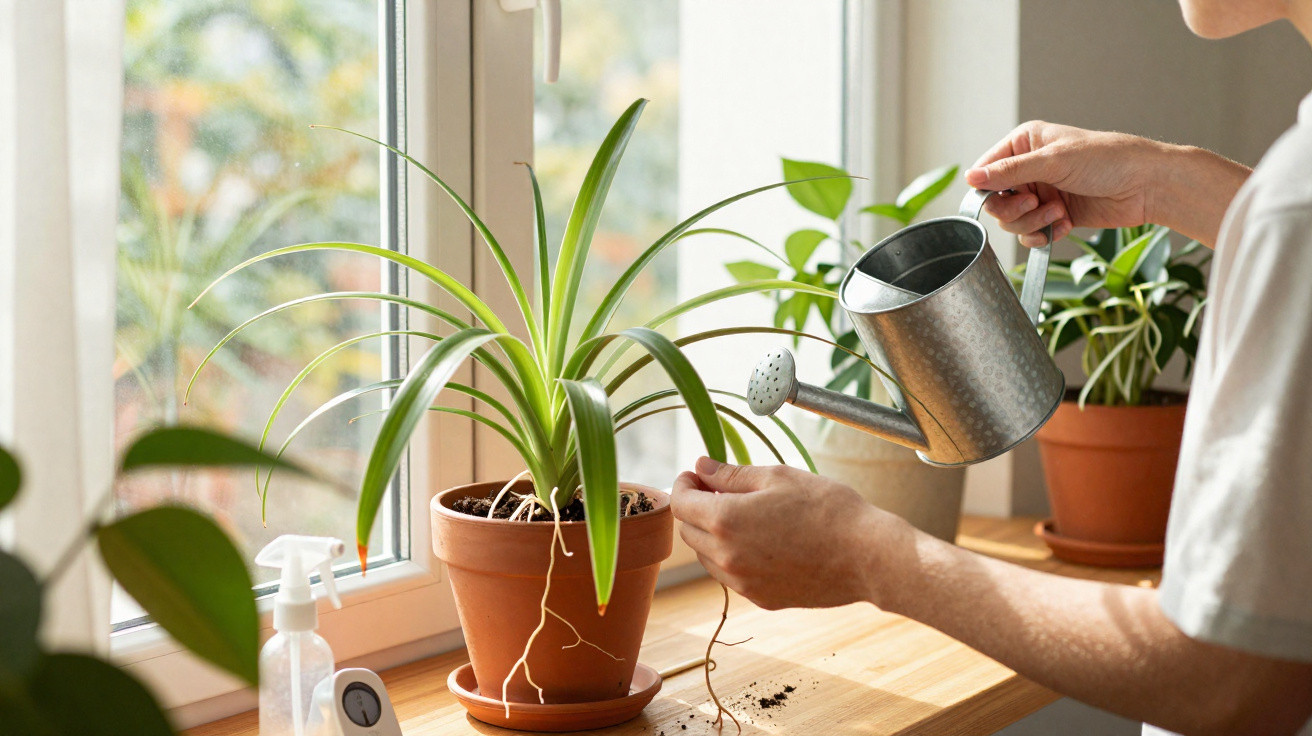
Behind the chaos in the pot, there is almost always a clear clue.
Many owners regard spider plants as virtually indestructible houseplants. That is precisely why it can be so alarming when their usually elegant “fountain of leaves” suddenly has kinks, breaks and yellowish patches. In many cases, this is not down to a lack of gardening skill, but to a few common care mistakes – particularly involving watering and placement.
What a genuinely healthy spider plant looks like
At its best, the spider plant, botanically known as Chlorophytum, has a very distinctive appearance: long, narrow, bright green leaves, often edged in white, arching outwards from the centre like a fountain. The leaves should be flexible and firm-looking, without feeling stiff.
When you run a finger along a leaf, it should feel smooth and springy. There should be no sharp crease or indentation that remains in place. Even strongly curved leaves should form a gentle arc, especially along their central rib.
“A kink with a distinct edge, a soft spot or discolouration almost always indicates that water transport is no longer working properly in that part of the leaf.”
A leaf with genuine damage can be identified by three signs:
- a pronounced angle rather than a smooth curve
- soft, yellowish or brownish areas around the kink
- dry, brittle sections that snap immediately when bent lightly
Once you have consciously compared these differences, you will quickly be able to tell whether the plant has simply grown a little crookedly or has suffered more serious damage.
Mechanical damage or a care mistake? The first check
Before blaming the watering can, inspect the plant’s surroundings. Spider plants often sit on windowsills, shelves and sideboards – exactly the places where minor accidents occur:
- the pot was knocked while cleaning
- a leaf became trapped between the pot and the wall
- a cat jumped onto the windowsill and landed in the middle of the plant
- a child pulled a long leaf “because it bounces so amusingly”
If only a few older leaves are bent while the rest of the plant looks vigorous, an isolated incident is often the explanation. It becomes more concerning when several new leaves appear distorted or the pattern continues for weeks. In that case, the damage is rarely caused by one knock; the underlying care routine is usually not right.
What bent or broken spider plant leaves reveal about watering
Spider plants respond surprisingly clearly to watering mistakes, and their leaves make the signs visible. A closer look can provide a useful diagnostic guide.
| What you see | What is usually causing it | What you should do |
|---|---|---|
| Many bent, yellowing leaves; compost feels heavy and remains wet | too much water, waterlogging in the pot | leave longer between waterings; only water once the top 5 cm is dry |
| Leaves are dry and brittle, tips feel straw-like, and compost has pulled away from the pot edge | too little water; the root ball is severely dried out | soak the pot thoroughly once, then water more regularly but moderately |
| Leaves are soft and floppy, and the plant leans easily to one side | damaged roots, often following prolonged waterlogging | inspect the root ball, remove rotten sections and use fresh compost |
| The plant visibly leans towards the window, while leaves remain thin and dull | insufficient light; unsuitable position | move it closer to a window, but keep it out of intense midday sun |
A consistent routine is especially useful where overwatering is concerned. Many experts recommend watering again only when roughly the top two finger-widths of compost feel dry. If you are unsure, a simple moisture meter can show the condition in deeper layers of the compost as well.
Stressed roots: when the problem starts below the surface
If the leaves remain soft despite adjusted watering, or an increasing number look unattractive, the issue is usually deeper down in the roots. Carefully lift the plant from its pot and inspect the root ball closely.
Healthy roots are firm, pale to slightly brown, neutral-smelling and well distributed throughout the pot. Warning signs include:
- very dark, mushy roots
- an unpleasant, rotten smell
- a root ball that feels wet and heavy despite not having been watered for days
This usually points to root rot. In that situation, decisive action is needed:
- Gently loosen the root ball from the old compost.
- Use clean scissors to remove every rotten, soft section of root.
- Repot the plant in fresh, free-draining compost, optionally mixed with a little sand or expanded clay.
- Water only moderately and remove any excess water from the saucer.
“A weakened spider plant can recover despite root rot – provided that watering habits and the pot are right after the rescue operation.”
What to do with leaves that are already bent
A leaf that has been sharply creased or broken will not straighten again. Its internal transport vessels have been damaged, so the injury is permanent. While this is mainly an aesthetic annoyance, it also represents an energy loss for the plant.
For that reason, remove these leaves consistently. With clean scissors or a sharp knife, cut them off directly at the base. It may look drastic at first, but a healthy spider plant quickly produces fresh leaves and can again form a full, unbroken fountain.
Leave in place only leaves that are slightly misshapen but remain green and stable overall. They will still support the plant until new growth has emerged.
Typical environmental factors: air, light and position
As well as water, the surrounding conditions strongly influence whether leaves remain sturdy or break more easily.
Humidity and central-heating air
Dry air from central heating is especially difficult for many spider plants during winter. Leaf tips dry out, the rest of the foliage loses flexibility and the leaves become more prone to kinking.
Helpful measures include:
- placing a bowl of water or a pebble tray filled with water beneath or beside the pot
- moving the plant away from direct proximity to a radiator
- lightly misting it with room-temperature water when the air is very dry, but not in strong sunlight
Light and temperature
Spider plants prefer bright conditions without direct, harsh midday sun. An east- or west-facing window is often ideal. Corners that are too dark encourage soft, elongated and unstable leaf growth.
Sudden temperature changes also play a part. Draughts from a window in winter, windows repeatedly left ajar, or icy cold tiles beneath the pot all put the plant under stress. Placing the pot on a cork or wooden mat and avoiding draughts helps prevent these extremes.
Simple care tips to restore the fountain of leaves
You do not need a complicated care plan to bring a spider plant back into shape. A few straightforward routines are often enough:
- make a rough note of watering days and link them to the dryness of the top compost layer
- choose a pot with a drainage hole and do not leave the saucer permanently full of water
- hang the plant or position it higher up so that nobody constantly knocks into it
- repot every one to two years if the root ball has become heavily root-bound
- feed lightly every few weeks in spring and summer so new leaves grow strongly
Gradually, the familiar appearance will return: a dense clump of foliage that arches elegantly outwards without creasing or snapping.
Why spider plants are so forgiving – and what you can learn from them
The good news is that spider plants are among the more resilient houseplants. Even after clear care mistakes and numerous misshapen leaves, they still have reserves. Anyone who changes course in time will be rewarded with fresh, sturdy foliage.
What is particularly interesting is that this plant is ideal for “calibrating” your own watering habits. By consciously observing compost moisture, leaf colour and leaf firmness, you gradually develop a good sense of water requirements – knowledge that can be applied directly to other houseplants.
In the end, a few bent leaves can become a kind of crash course in plant care, resulting in a much more vigorous spider plant – and probably a little more calm the next time an apparent “plant drama” unfolds on the windowsill.

Comments
No comments yet. Be the first to comment!
Leave a Comment