
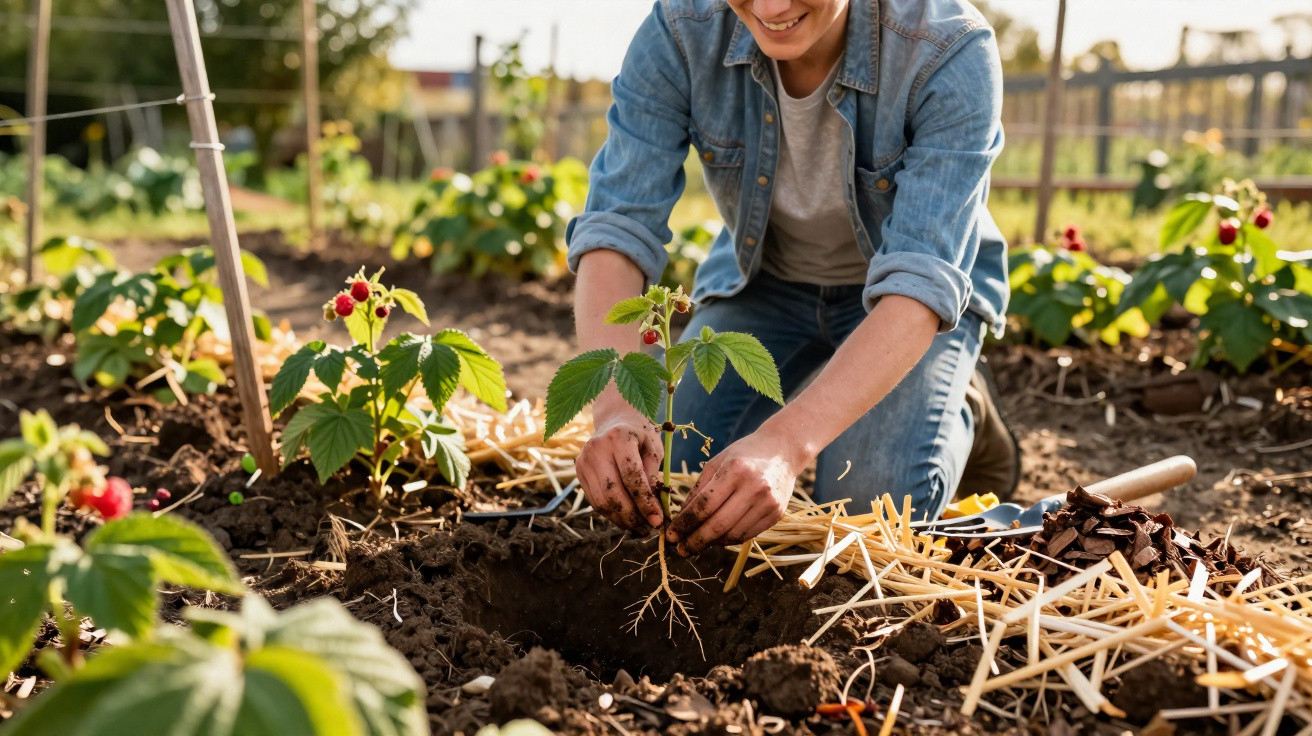
Plant them properly once, and these bushes will fruit abundantly every year: one simple rule determines whether your raspberry bed becomes a berry-producing powerhouse – or a disappointment.
Many amateur gardeners plant raspberries with enthusiasm, only to be puzzled by meagre harvests after two or three years. Others reliably pick bowlfuls for a decade. The difference is not expensive varieties, but one golden rule for planting – along with several straightforward steps that can determine success or failure as early as the first autumn.
The golden rule: prepare the soil before planting the bush
Anyone who simply drops raspberries into a hole as if they were any ordinary shrub is sacrificing yield. Their long-term performance depends directly on how thoroughly the soil is prepared before planting.
The rule of thumb is this: spend at least as much time preparing the soil as you do planting – and raspberries will reward you with up to ten years of harvests.
Raspberries are shallow-rooted plants. They are sensitive to waterlogging, compacted ground and nutrient shortages. Loosening the soil deeply before planting and enriching it generously with organic matter creates the foundation for vigorous, long-lived canes.
Why this preparation delivers yields for years
- Well-loosened soil lets fine roots spread in every direction.
- Humus and compost provide slowly available nutrients over several years.
- Improved water management prevents both waterlogging and severe drying out.
- Robust plants are far less susceptible to fungal diseases.
This is precisely what separates plants that lose vigour after four years from beds that produce heavily for a full decade.
The ideal planting time: do not wait for spring
In theory, raspberries can be planted for much of the year, provided the ground is neither frozen nor extremely hot. However, anyone planning for the long term should use one clearly preferable planting window.
Autumn planting gives raspberries a head start
Bare-root plants are best planted between October and March, with autumn offering the greatest advantage. Although container-grown plants can be planted throughout the year, autumn remains the stronger choice for them too. The reason lies below ground: while temperatures above the surface are already falling, roots continue growing in soil that is still warm.
Planting in autumn gives raspberries a six-month head start for root growth – and that pays off in stronger canes and earlier, heavier crops.
Spring planting also works, but it requires more watering and offers little forgiveness during dry spells. Autumn is therefore the safer option, particularly in regions affected by heat.
Choosing the site: sun, shelter and loose soil
Alongside planting time, the garden position will shape the next ten years. Raspberries may look tough, but they are particular about where they grow.
Assessing light and microclimate correctly
- Light: Full sun to bright partial shade; in very hot areas, light afternoon shade is welcome.
- Wind: Choose a sheltered spot behind a hedge, fence or shed so canes do not dry out or snap.
- Air movement: A gentle airflow is beneficial, whereas stagnant, humid air encourages fungal problems.
Raspberries do not tolerate heavy, wet ground. The ideal soil is loose, rich in humus and slightly moist, but never waterlogged. If your garden has only sticky clay or stony rubble soil, improvement is especially important.
Preparing soil for raspberries: the practical step-by-step rule
- Clear the area thoroughly of perennial root weeds such as ground elder, couch grass and bindweed.
- Loosen the soil to a depth of 30–40 cm, breaking up clods and removing stones.
- Work in plenty of organic matter: well-rotted compost or aged farmyard manure.
- For very heavy soil, mix in sand or fine gravel to prevent waterlogging.
- If desired, create a thin drainage layer of coarse sand or grit at the base of planting trenches.
If this stage is rushed, the consequences are not usually visible in the first year but emerge gradually: watery fruit, weak canes and frequent disease.
How to plant raspberries that last for a decade
Spacing and planting layout
Raspberries naturally spread by suckers. Allowing enough room makes maintenance easier and prevents an impenetrable thicket from forming.
| Element | Recommendation |
|---|---|
| Plant-to-plant spacing | approx. 80 cm |
| Row-to-row spacing | approx. 1.20 m |
| Planting hole size | 40–50 cm deep and wide |
In smaller gardens, a narrow berry hedge along a fence works well. This means the bushes cast little shade over other beds, can be tied in easily and remain readily accessible.
Planting and watering correctly
- Soak the roots: Place bare-root plants in water for around an hour before planting.
- Check planting depth: The base of the canes, or root collar, should sit exactly at soil level, not lower.
- Spread the roots out: Do not force them downwards in a compressed bundle; fan them out loosely instead.
- Firm the soil well: Eliminate air pockets so the roots make contact with soil throughout.
- Water thoroughly: Even when the soil is damp, allow one large watering can per plant.
The ground often settles a little after watering. Add some more growing medium afterwards if necessary, so that no hollow remains where water could later collect.
Mulching: the overlooked boost for raspberries
Alongside soil preparation, the second key measure is a permanent mulch layer. It is almost more important than any fertiliser.
Keeping the root area mulched throughout the year ensures even moisture, fewer weeds and vigorous, long-lasting plants with dependable yields.
Materials that work well
- Straw or hay, applied sparingly enough to prevent rotting
- Woodchips or bark mulch in a thin layer
- Coarsely shredded leaves from deciduous trees
The layer should be five to ten centimetres deep, while keeping the base of the canes clear. As mulch decomposes, it further improves the soil – a natural slow-release fertiliser delivered exactly where the fine roots are located.
Care in the first few years: little effort, major results
Careful work at the start saves considerable trouble later. Ongoing maintenance is manageable, yet it makes a substantial difference to yields.
Watering, feeding and pruning: the essentials
- Watering: During dry periods, water deeply once or twice a week rather than giving a light daily sprinkling.
- Feeding: Every spring, incorporate a wheelbarrow of compost or a thin layer of well-aged manure.
- Pruning:
- Summer-fruiting varieties: remove spent brown canes close to ground level immediately after harvesting.
- Autumn-fruiting varieties: cut all cropped canes back just above ground level in late winter.
- Checking plant health: Monitor the leaves, and act early if grey mould appears or aphid infestations become severe.
Pruning in particular separates mediocre results from excellent ones. Those who clearly distinguish between old and young canes every year keep the bed airy and low in disease – producing large, flavoursome fruit rather than small, dry berries.
Common mistakes that cause harvests to decline after a few years
Many issues do not appear immediately, but only after three to five years. At that point, people are quick to say, “The variety is no good.” In practice, other causes are usually responsible.
- Persistent waterlogging caused by compacted soil or inadequate drainage.
- Weedy rows that compete with raspberries for water and nutrients.
- Overcrowded growth because old canes have not been removed regularly.
- No organic top-up feeding, so the soil gradually becomes depleted.
- No mulch, leading to major fluctuations in temperature and moisture.
Keeping these points in mind allows the same planting to be productive for many years, without the need to replant constantly.
Practical additions: variety choice, companion planting and risks
For an uninterrupted harvest, combine early, mid-season and late varieties, ideally mixing summer- and autumn-fruiting raspberries. This extends the season from June into October.
Raspberries work well at the edge of vegetable beds, provided they do not cast permanent shade over them. Vigorous suckers can be controlled with a root barrier or by regularly cutting them out. Gardens used by children are better suited to low-thorn varieties – they reduce scratches and make picking straight from the bush more appealing.
Some risk always remains: fungal diseases such as grey mould can occur in exceptionally wet summers even with good care. In that case, thin the canes more heavily and remove affected fruit consistently rather than allowing it to rot. In tight urban gardens with limited air movement, it is therefore worthwhile creating a particularly open framework using support wires.
Anyone who follows the golden rule – perfecting soil and site before planting, then managing the bed with mulch, water and a clear pruning routine – can realistically expect to harvest raspberries for ten summers without having to remake the bed each time. Every careful spadeful of work in the first autumn will then repay itself year after year in brimming bowls of aromatic berries.
Comments
No comments yet. Be the first to comment!
Leave a Comment