
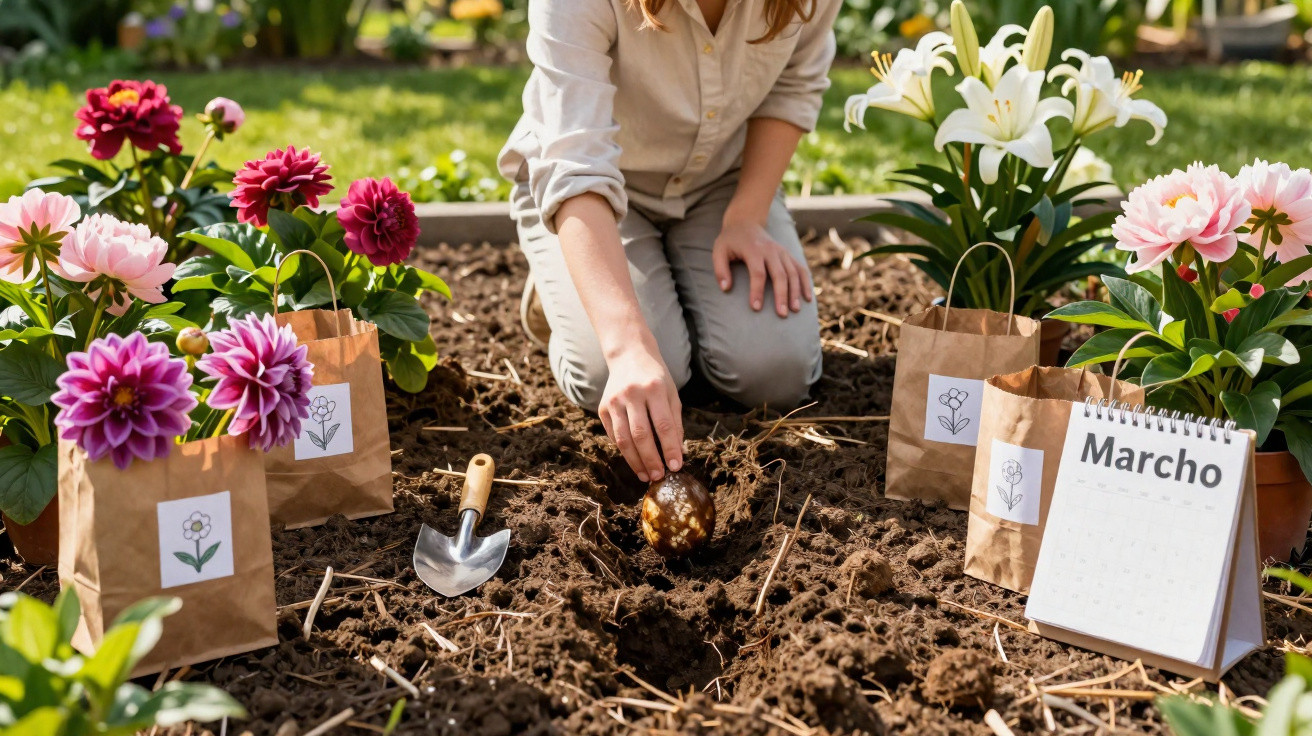
Anyone who does not act now will be looking at empty beds in early summer.
Many amateur gardeners know the pattern: the first spring flowers shine in March, everything still looks attractive in April – then suddenly there is a long pause. The tulips have disappeared, roses and summer flowers take their time, and the beds can look deserted in the brightest sunshine. This gap is surprisingly easy to fill if four particular bulb and tuber plants go into the ground in March.
Why March determines summer flowering
The calendar means little in the garden – plants respond to temperatures and soil conditions. For most summer-flowering bulbs and tubers, March is the ideal starting point, as the soil gradually warms up and hard frosts ease in many areas.
“If you postpone planting summer bulbs from March until late April, the first flowers often move from June to July – leaving you with drab beds for weeks.”
Put simply, planting early brings earlier flowers. Planting late means extending the wait and seeing green but barely colourful areas during the first warm days. Once daffodils and tulips have faded, this can quickly create a visual lull.
For this reason, experienced gardeners deliberately put four types into the ground, or start them under cover, as early as March. They begin growing at different speeds, complement one another in height and colour, and together ensure that something is flowering from early summer well into autumn.
Dahlias: colour-packed flowers with a March head start
Dahlias are among the most rewarding summer-flowering plants, but they need time to make their display. Anyone who puts their tubers into the bed only in late April or May loses valuable weeks.
A smart approach is to start the tubers in pots in March under protection, such as in an unheated greenhouse, beneath a canopy or on a bright windowsill in a cool room. This allows the plants to develop roots and their first shoots before moving outside.
- Planting time: from early to mid-March in pots; plant into beds after the last frosts
- Position: sunny to partially shaded
- Soil: loose, humus-rich and free-draining
- Flowering: depending on the start, from June onwards, often until October
Dahlias come in countless forms, from small pompons and simple star-shaped blooms to enormous double flower heads. Their striking appearance makes them perfect for bridging the “dead period” after the spring flowers. Many gardeners place them in the second row of a border, in front of tall perennials or behind low, cushion-forming plants.
Important: lay the tuber shallowly in the pot, cover it only lightly with compost and water sparingly until the first shoots appear. Dahlias rot easily if kept too wet and cold.
Begonias: long-flowering plants for shady corners
While dahlias love sunshine, begonias deal with the difficult parts of the garden: shaded balconies, north-facing areas and corners by the house where hardly any flowering plant lasts. Starting their tubers in March provides weeks of floral coverage even without full sun.
Garden centres stock tuberous begonias bred specifically for outdoor growing. In March, place them in trays or pots of loose, lightly moist compost with the flat side facing upwards. They can be kept in a bright place, but must be protected from frost – a cool conservatory, sheltered balcony or bright stairwell all work well.
“Begonias are ideal when a balcony receives very little sun – they will still flower all summer if the rootball is never allowed to dry out completely.”
Three basic rules help the plants keep going:
- Water regularly, but do not soak the compost until it becomes waterlogged.
- Remove faded flowers so that new buds can follow.
- Before winter, lift the tubers or remove them from containers, dry them and store them somewhere frost-free.
Following this method lets you use favourite varieties for several years in succession, saving money at the garden centre.
Lilies: fragrant spires that fill the flowering gap
Almost everyone knows supermarket lily bouquets. In the garden, however, the plants are even more impressive: they add height and their fragrance can turn an entire seating area into a naturally scented space. Bulbs planted in March grow rapidly through spring.
Planting depth is particularly important for lilies. A useful rule is to plant each bulb at around two to three times its own height. The soil needs to be loose and dependably free-draining. Lily bulbs quickly rot in heavy, wet ground, so a layer of sand or fine gravel in the planting hole can help.
| Type | Approximate flowering time | Special feature |
|---|---|---|
| Asiatic lilies | from May/June | little fragrance, but many colours |
| Oriental lilies | July/August | strong scent, large blooms |
| LA and OT hybrids | June to August | robust, long flowering period |
A well-planned border combines early and late lilies. The area then remains interesting for weeks while other perennials are still getting going.
Peonies: March is the starting point for future years
Peonies – often simply called paeonies in everyday use – do not always solve the immediate flowering gap in their first year. In a new position, they commonly need two and sometimes three years to settle in. Even so, March is one of the best times to establish them for the long term.
The plants reward patience with remarkable longevity: a peony planted well can remain in the same spot for decades and becomes more impressive year after year. Planting depth is crucial. If the buds sit too deeply, the plant will flower poorly or not at all.
“For herbaceous peonies, the bud-like ‘eyes’ should be covered by only one to two centimetres of soil – bury them deeper and you will often wait in vain for flowers.”
Choose a sunny to lightly shaded spot; protection from wind is an advantage because the heavy flower heads can otherwise topple over quickly. In March, the usually bare-root young plants can be placed in the ground easily, as it is neither frozen nor too hot and the roots can establish quietly.
How these four plants fill the flowering gap together
The key is staggering their displays. These four “March plants” begin at different times and complement one another visually:
- Lilies often take the lead from late spring into early summer.
- Dahlias begin from June/July and continue into autumn.
- Begonias fill shaded gaps from June until October.
- Peonies provide large, rounded blooms in late spring in subsequent years.
Planning in March ideally means thinking in time periods: what will flower in May and June, what will perform in high summer, and what will still bloom in early autumn? This removes the typical lean spells when borders are green but entirely without colour.
Practical tips for planting in March
Before putting the first tuber into the ground, it is worth checking the chosen position. Waterlogging is a risk for all four plants, especially during wet springs. One simple solution is to raise beds slightly and work in coarse sand or grit so excess water can drain away.
Another consideration is voles. In many gardens, they relish fresh bulbs and tubers. Metal baskets or plastic planting baskets prevent unwelcome surprises, particularly with more expensive lily or peony varieties.
Those using tubers and bulbs for the first time can begin on a small scale: one pot of dahlias, one container of begonias, or two to three lilies along the edge of a border. Experience builds gradually without having to redesign the entire garden at once.
Why early planning pays off in several ways
A garden that flowers from spring to autumn without long breaks does not simply look better. It also gives insects such as bees and butterflies a reliable food source. Dahlias and some lily types, in particular, attract many pollinators when they have single, easily accessible flowers.
March can also make financial sense: bulbs and tubers are often cheaper at this time than ready-grown potted plants in May. Stored and cared for correctly, they can be used for several years. Begonia tubers and dahlias in particular can be lifted after the season, overwintered dry and started again the following spring.
Over time, this creates a system: in autumn, the dormant tubers move into boxes, and in March they are started again. After following this routine for a few seasons, it soon becomes clear how the formerly grey gap between spring and summer flowering gets smaller and smaller – until the garden eventually shows colour almost continuously from March to October.




Comments
No comments yet. Be the first to comment!
Leave a Comment