
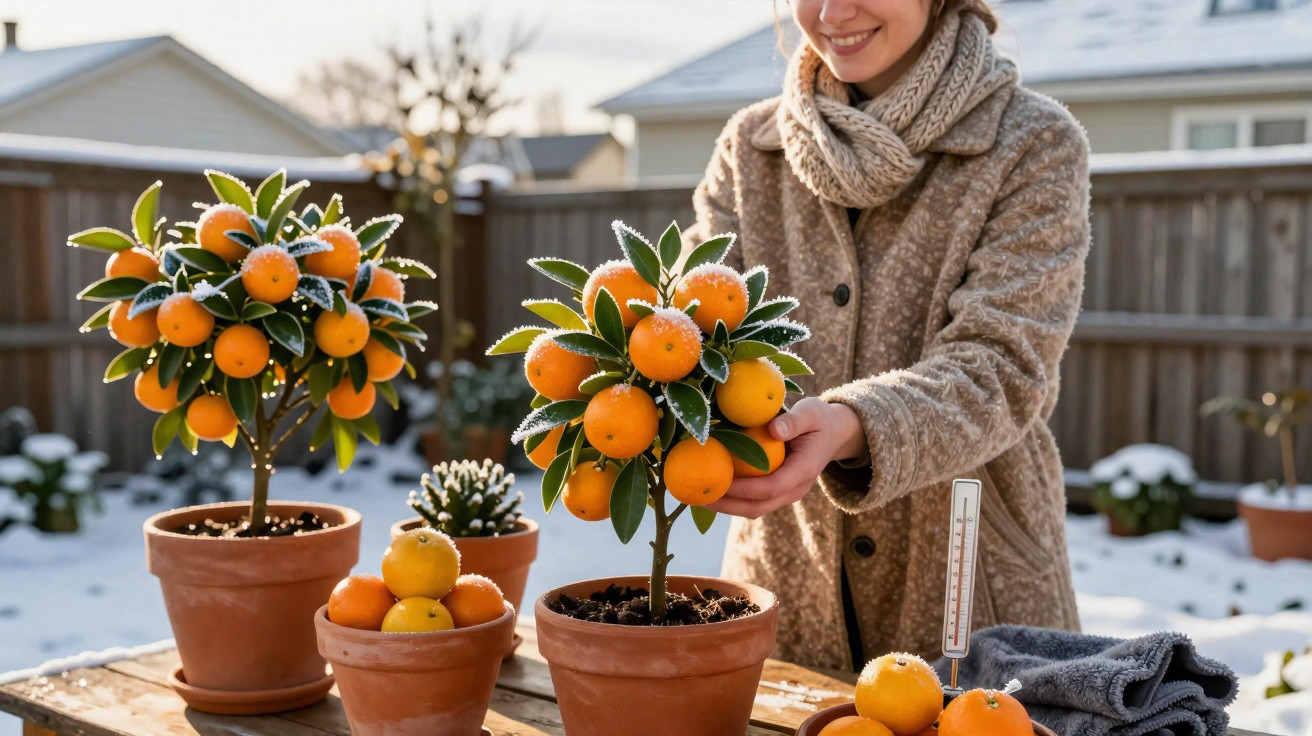
A touch of the Mediterranean in your own garden – even when the thermometer drops well below zero.
Impossible? Not with the right citrus varieties.
Many amateur gardeners know the scenario: they enthusiastically buy a lemon tree in summer, hurriedly plant it out in autumn, and after the first frosty night it has turned completely black. Conventional lemon trees need warmth. Yet there are remarkably hardy citrus varieties that can withstand biting cold and remain in the garden, while an ordinary lemon tree has to move to its winter quarters.
What frost ratings for citrus plants actually mean
Plant labels often state something along the lines of “hardy to –12 °C”. While reassuring, this can easily be misleading. As a rule, such a figure applies to:
- a mature tree
- with a deep, well-established root system
- growing in free-draining soil without waterlogging
- during a short, dry frost
It is also important to remember that wood, leaves and fruit do not react to cold in the same way. A Yuzu shrub may survive a winter at –12 °C, while its fruit has long since turned soft and mushy. With kumquat, fruit damage can appear at around –5 °C even though the plant itself is still alive.
Frost hardiness primarily refers to the plant’s survival, rather than flawless foliage or fruit.
Broadly, citrus plants can be divided into three groups:
- Very hardy varieties – cope with around –15 °C, with some lines tolerating as low as roughly –20 °C when the soil drains well.
- Cold-tolerant varieties – generally manage temperatures down to about –10 to –12 °C.
- Heat-loving classics – suffer noticeable damage from –3 to –5 °C onwards; the typical lemon tree belongs in this group.
The unsung hero: the exceptionally hardy bitter orange tree
Probably the most frost-hardy representative is Poncirus trifoliata, often known as bitter orange or the trifoliate bitter orange tree. It usually grows to three to five metres tall and two to four metres wide, and features:
- thorny, bare shoots
- deciduous leaves divided into three leaflets
- yellow, very bitter fruits in autumn
Although related to citrus, this plant is chiefly used as rootstock for grafting. It offers two major benefits for the home garden:
- It withstands cold down to around –20 °C, provided the soil is loose and free-draining.
- It works as an indicator plant: if this shrub freezes to death in winter, no other citrus plant has a realistic chance of succeeding outdoors in that spot.
Its fruit is scarcely suitable for eating raw, but can be used to flavour jam or syrup. Visually, its green bark and yellow fruits create an unusual, almost exotic focal point in a bare winter garden.
Edible citrus varieties that cope surprisingly well with cold
Anyone wanting not only decoration but also aromatic fruit has several choices that perform well in protected parts of Germany.
Yuzu: the fashionable citrus fruit for cold locations
Yuzu (Citrus junos) originated in East Asia and has become a favourite in high-end gastronomy. For home gardeners, it is particularly appealing because it:
- tolerates frost down to about –12 °C
- develops into a densely branched, bushy shrub
- bears strongly scented yellow to orange fruits in winter
The flesh is fairly tart, but the juice is intensely aromatic. In the kitchen, Yuzu works well in dressings, desserts, cocktails and to enhance fish dishes. In sheltered courtyards, mild wine-growing regions or urban gardens, Yuzu can remain permanently planted in the ground.
Ichang lemon: the resilient juicing citrus
The Ichang lemon is regarded as a cross involving Poncirus, which gives it its robust nature. Its typical characteristics include:
- tolerating harsh winters with brief lows below –10 °C
- producing large yellow fruits containing plenty of juice
- being usable in cooking much like a lemon
Its flavour is somewhat sharper than that of a supermarket lemon, but the plant is considerably more reliable when grown outdoors.
Satsuma mandarins: sweet, seedless and cold-resistant
The Satsuma mandarin tree (Citrus unshiu) is among the most proven varieties for areas with cold winters. It:
- withstands temperatures of around –11 °C
- produces seedless mandarins
- usually ripens in autumn, before the worst frosts arrive
The fruit has a mild to sweet flavour and is excellent eaten fresh. Satsuma mandarins perform far better than many other citrus varieties in wind-sheltered courtyards or against a house wall.
Kumquats and finger limes: small but resilient
Kumquats are considered the snack-sized fruits of the citrus world. Once well rooted, the ‘Meiwa’ variety can cope with roughly –8 to –9 °C. The fruits are eaten whole, including their slightly sweet peel, while the flesh is more acidic.
Certain finger lime hybrids are also worth considering. Their frost hardiness varies greatly according to variety: some lines manage temperatures of approximately –10 °C, whereas others collapse in the first hard frost. Without a specific variety name on the label, choosing one is a gamble.
Anyone expecting harvest-ready citrus fruit in the garden should specifically look for frost-suitable variety names such as Yuzu, Satsuma or Ichang lemon.
How much cold can mandarins, clementines and lemons really take?
Garden centres are particularly tempting when they offer classic varieties laden with decorative fruit. However, these are only conditionally suitable for outdoor growing in colder regions.
- Standard mandarins tolerate about –8 °C, only briefly and only once plants are established.
- Clementines generally cope with around –7 °C, again only in mild coastal areas without prolonged severe frost.
- Typical lemons, oranges and grapefruits sustain serious leaf and shoot damage from –5 °C onwards.
In inland Germany, these classic citrus plants overwinter much more safely in large containers. In autumn, they can then be wheeled into a bright, cool garage, conservatory or unheated stairwell.
Protection strategies: helping citrus plants survive sharp winters
Anyone wishing to leave citrus plants in a border must choose the site carefully and follow a few useful measures:
- Location: Choose a sunny, sheltered position, such as in front of a south-facing wall. Avoid cold-air pockets in the garden.
- Soil: It must drain well; ideally, improve it with gravel or coarse sand. Waterlogging encourages winter root damage.
- Root protection: A deep mulch layer of leaves, straw or bark chippings protects the root zone.
- Protecting the canopy: When a cold spell is forecast, wrap the canopy in horticultural fleece or create a lightweight polythene tunnel.
- Watering: Water sparingly in winter so that the soil remains relatively dry.
- Feeding: Stop applying nitrogen fertiliser from late summer so shoots can mature and become woody.
Avoiding late fertiliser applications makes a considerable difference: soft, fresh shoots freeze much faster than properly ripened, woody growth.
Which citrus varieties suit which location
| Citrus variety | Frost tolerance (approx.) | Recommended use |
|---|---|---|
| Poncirus trifoliata | down to –20 °C | Hedge, rootstock, ornamental shrub |
| Yuzu | down to –12 °C | Outdoor growing in mild locations, aromatic cooking |
| Ichang lemon | around –12 °C | Outdoor growing in sheltered gardens, juice |
| Satsuma mandarin | around –11 °C | Outdoor growing in wine-growing regions, snacking fruit |
| Kumquat ‘Meiwa’ | –8 to –9 °C | Container growing or very sheltered borders |
| Classic lemon | –3 to –5 °C | Container growing, winter quarters |
Common mistakes when growing citrus outdoors
Many losses are caused not by frost alone but by a combination of factors:
- The wrong soil: Heavy, wet ground leads to root rot, after which even a mild frost can be enough to cause failure.
- Too much water in winter: Full water butts positioned directly beside the plant result in permanently wet roots.
- Late feeding: Heavy fertilising in September encourages soft shoots that have not matured.
- An unsuitable variety: A classic lemon tree in an exposed, windy lowland border has very little chance of survival.
A gradual approach is sensible: first trial a hardy variety such as Poncirus or Yuzu, gain experience, and then perhaps introduce more sensitive varieties.
Practical examples: what a “citrus garden in the north” can look like
In an urban garden in Hamburg, for example, the following combination works rather well: a Poncirus creates a tall, thorny backdrop, with a Yuzu shrub and Satsuma mandarin tree planted in front of it. A kumquat in a large container completes the display and is moved into the hallway only during prolonged frost.
In southern German wine-growing regions, gardeners can plan more boldly. Yuzu, Ichang lemon and Satsuma can even form small hedges there, provided they are placed against a warm house wall and receive some horticultural fleece during extreme frosts. This creates the impression of a Mediterranean garden without the need to move large containers every year.
Why frost-hardy citrus varieties are worth considering
Robust citrus plants offer several advantages. They free up space in winter quarters, reduce maintenance and make an attractive garden possible throughout the year. Many of these varieties also provide intriguing flavours that are rarely found in supermarkets, from Yuzu’s intense character to the sharper taste of Ichang lemon.
Anyone seriously exploring the subject soon encounters terms such as “rootstock” and “grafting”. This means that the frost-hardy base, such as Poncirus, is “grafted” with a choice fruiting variety. This combines hardiness in the root area with high-quality fruit production in the canopy. For a home garden, it is worth asking specialist nurseries about such grafted plants.
With suitable variety selection, some knowledge of frost limits and straightforward protective measures, the dream of a personal “citrus garden with a winter bonus” is much more achievable than many people think – entirely without tropical greenhouses.




Comments
No comments yet. Be the first to comment!
Leave a Comment