
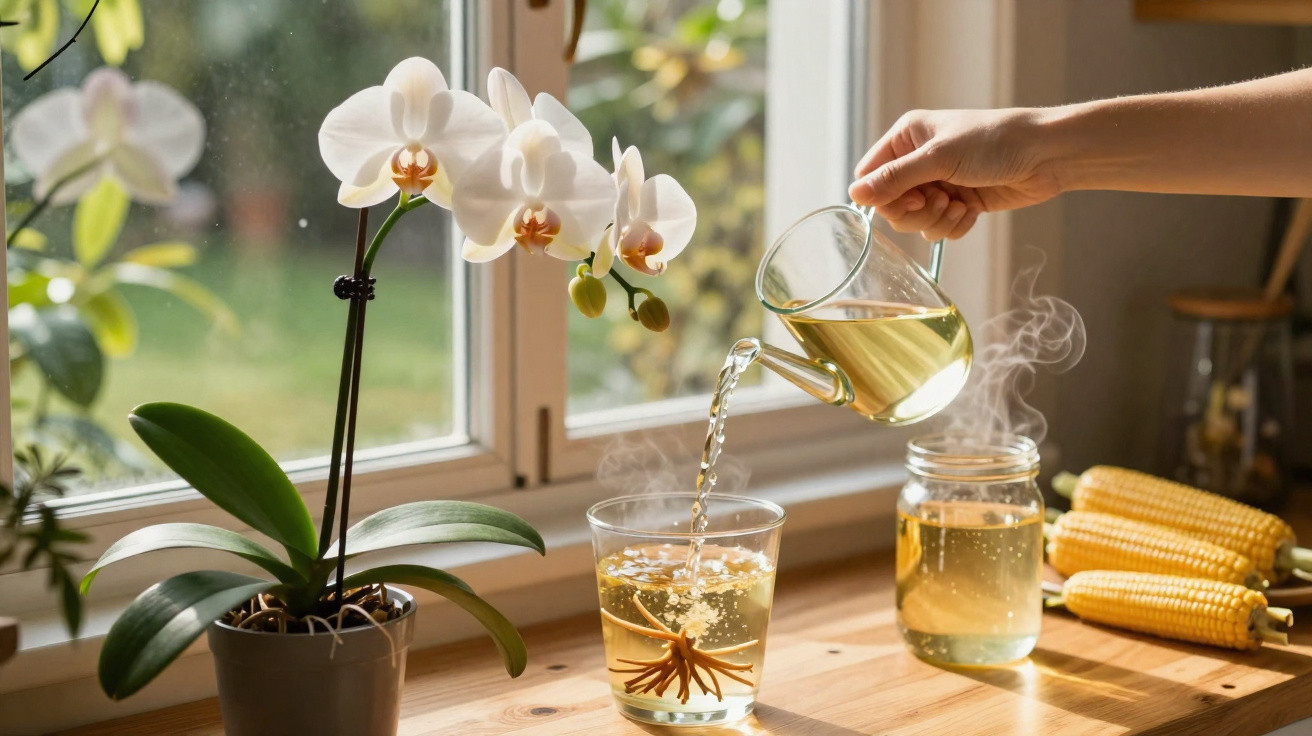
Many people throw away their Phalaenopsis orchid as soon as its last flower spike has dried out. Yet the plant often still has a surprising amount of life in it. A simple trick using cooked corn can give the roots fresh momentum – and may bring the next flowering period back far sooner than many people expect.
Has your Phalaenopsis orchid really reached the end when it has no flowers?
Before putting it in the food-waste bin, inspect the plant closely. Orchids naturally go through resting periods, and during this time the windowsill favourite can look far worse than its true condition suggests.
Signs that your Phalaenopsis still has a chance include:
- Roots are green or silvery grey and feel firm
- Leaves remain flexible, even if they look slightly limp
- There is no rotten smell coming from the pot
- The stem is neither soft nor black
The situation is different if the roots are brown, slimy and hollow, and the plant smells of rot. In that case, it needs rescuing first rather than feeding.
When should you repot instead of feeding?
If the roots are decaying, the orchid needs fresh growing medium. Using clean scissors, remove every brown and mushy section of root, then place the plant in fresh bark chips. Do not water it for several days afterwards. Only once the root system has recovered is it worth trying gentle household remedies such as the corn trick.
“Before the orchid receives fertiliser, its roots must be healthy – otherwise even the best trick will achieve nothing.”
Why cooked corn can help orchid roots
Cooked corn may initially seem like a completely unsuitable choice for plant care. In the pot, however, it can have an interesting effect.
Corn kernels contain:
- Plenty of starch (carbohydrates that “feed” microorganisms in the growing medium)
- Fibre
- Antioxidants and trace elements
This combination provides food for soil bacteria and fungal networks around the roots. These include mycorrhizal fungi, which live in symbiosis with the plant. They improve nutrient uptake and help to stabilise the root system.
“The corn does not provide fertiliser directly to the orchid; instead, it supports the ‘soil life’ that helps it absorb nutrients.”
Garden professionals are already familiar with a similar idea through the popular “rice water method”. In that case too, starch and minerals give the roots a mild organic boost. The corn trick works on the same principle, but uses an ingredient that is often left over in many kitchens anyway.
How to prepare corn fertiliser correctly
Preparation matters if this method is to work. Simply throwing a few corn kernels into the pot would be a bad idea, as they would merely go mouldy.
Step-by-step recipe for a corn root booster
- Measure the amount: Use around 100 grams of cooked, unsalted corn.
- Mix with water: Put the corn and 1 litre of lukewarm water into a blender.
- Blend until smooth: Continue blending until no visible pieces remain.
- Strain thoroughly: Pour the liquid through a very fine sieve or cloth so that no residue remains in the watering liquid.
- Chill it: Store the resulting liquid in a clean bottle in the fridge.
The mixture will keep for only 24 to a maximum of 48 hours. As soon as it smells sour or sediment develops, pour it down the sink rather than using it on the plant.
How to use corn water on a Phalaenopsis orchid
Apply it sparingly and with care:
- Moisten the growing medium slightly first; do not apply it to bone-dry bark
- Drip 1–2 teaspoons of the corn solution directly onto the root area
- Use it every 3–4 weeks during the growing period
- Do not combine it with ordinary orchid fertiliser on the same day
“Less is more here: the corn liquid is an addition, not a replacement for careful watering and feeding.”
Between applications, water the orchid as usual: give it a short soak in lukewarm water every 10 to 15 days until the growing medium is saturated, then allow it to drain well. If unsalted corn cooking water is left over, you can occasionally mix a small splash into the watering water – again, only when the growing medium is already moist.
Even the best corn trick needs the right climate
Phalaenopsis orchids originate from tropical regions. On a windowsill, their main challenges are dry air from central heating and unsuitable temperatures.
Setting humidity and temperature correctly
Garden experts recommend humidity of between 50 and 70 per cent for this species. In many living rooms, levels are considerably lower during winter. One straightforward solution is to:
- Place the pot on a tray filled with expanded clay pebbles or gravel
- Add a little water to the tray, ensuring that the base of the pot does not touch it
- Choose a bright position without direct midday sunshine
The plant also responds strongly to temperature differences. To produce new flowers, it generally needs a small “cooling stimulus”:
- Around 18–22 degrees during the day
- 4–8 degrees less at night, therefore around 12–15 degrees
Moving the orchid closer to a slightly cooler window in autumn can encourage bud formation. At the same time, the corn trick supports root growth – and together these measures can make the plant noticeably more resilient.
What the corn trick can do – and what it cannot
Many hobby gardeners hope for miracle remedies that can rescue every plant on their own. Unfortunately, nature does not work that way. This kitchen leftover can support good care, but it cannot undo care mistakes.
“Corn liquid is a bonus for orchids that are kept reasonably well – not a magic potion for completely neglected plants.”
Anyone keeping their Phalaenopsis in blazing sunlight, in wet soil rather than bark growing medium, or in a draught should not expect miracles from a few teaspoons of corn solution. In a well-managed orchid care routine, however, the trick may help make roots more active and speed up recovery after flowering.
Risks, limits and useful additions
As with every household remedy, there are potential problems. Too much organic material in the pot can attract mould and fungus gnat larvae. Therefore:
- Never add undiluted corn leftovers to the growing medium
- Always use a very small dose
- Use only a fresh solution with no odour
- Stop immediately at the first sign of mould and check the growing medium
If you are unsure, it is better to combine conventional orchid fertiliser at a very weak concentration with occasional corn water. This gives the plant both direct nutrients and active soil life.
Another factor many people underestimate is light. Phalaenopsis likes bright conditions, but not harsh direct sun. An east- or west-facing window will usually bring better results than a dark hallway or a shelf far from daylight. When the location, temperature and humidity are right, a mild aid such as the corn trick can be much more effective.
If you enjoy experimenting, test the method on one orchid and compare it with a second plant without the corn addition. This makes it fairly easy to see whether the roots grow back more strongly, new aerial roots emerge, or the plant sends up a fresh flower spike sooner. In many cases, it becomes clear that an unremarkable leftover from the cooking pot can make a surprising difference on the windowsill.



Comments
No comments yet. Be the first to comment!
Leave a Comment