
Many keen gardeners instinctively reach for chemical moss killers in spring. Yet the real issue usually lies deeper in the soil. By planning a few targeted jobs in March, you can strengthen your lawn for the long term, create denser growth and push back moss almost as a side effect – without any specialist products.
Why March reveals your lawn’s true condition
Once the snow has gone and temperatures begin to rise, your lawn gives an unforgiving picture of its actual state. Yellow patches, puddles, bare areas and dense cushions of moss are not merely cosmetic flaws; they are signs that something is wrong.
“Moss is not an enemy but a warning sign: the soil is compacted, wet and often too shady – and grass has no chance there.”
Garden professionals repeatedly point out that good lawn grass needs free-draining, loose soil. Where water regularly collects, the ground sounds as hard as concrete or shoes sink into the surface, the grass is under strain. Moss, on the other hand, thrives in these conditions.
Typical causes in spring include:
- Compacted soil caused by foot traffic, children playing or garden furniture
- Waterlogging after rain because water cannot drain away
- Permanent shade beneath trees or alongside walls and hedges
- Thin turf caused by a lack of nutrients or an incorrect mowing height
The good news is that there is no need to dig over the entire garden. Three focused measures in March are often enough to make a lawn noticeably denser and more resilient.
Step 1: Loosen and aerate the soil with a garden fork
The most important work takes place below the surface. In a domestic garden, a simple garden fork is generally all you need instead of machinery.
How to aerate a lawn by hand
Choose a dry day when the ground is not muddy. The soil should have dried out slightly while retaining some moisture, so that it does not break apart into large clumps.
- Push the garden fork vertically into the lawn to a depth of around 8–10 centimetres.
- Tip the handle slightly forwards or backwards to create fine cracks in the soil.
- Pull out the fork, move forward one step – roughly 15 centimetres – and make the next insertion.
- Work especially thoroughly in places where puddles form or where the soil sounds hard.
These many small holes and cracks act like air channels: they allow excess water to drain away, bring air to the roots and relieve compacted patches. For smaller areas, an hour’s work is enough to treat the whole lawn.
“Thoroughly loosening the soil with a fork once a year has a stronger long-term effect than any moss chemical.”
Step 2: Apply a light layer of sand and fine material
The second task follows immediately after loosening the soil: spread a thin layer of fine material to fill the holes and improve the soil structure. Gardeners call this topdressing.
The best mix for hard-wearing lawn soil
For the ideal blend, combine equal parts of:
- finely sieved topsoil
- coarse sand, such as play sand or river sand, rather than fine building sand
- mature, sieved compost or leaf mould
If one of these ingredients is unavailable, coarse sand on its own will do in an emergency. It will at least improve drainage, which is better than doing nothing.
Apply the mixture as follows:
- Scatter the material thinly over the area already loosened with the fork.
- Brush or rake it in using a sturdy yard broom or rake so that the holes are filled.
- Spread any excess evenly; the lawn must not be completely covered.
“The thin layer of sand, soil and compost does not close the air channels; it stabilises them and improves nourishment for the roots.”
This measure produces a lasting improvement in the soil structure. Water drains away more quickly, the soil remains looser, and the organic component feeds soil life. Lawn grass benefits from precisely this in the following weeks: it can grow back more densely and naturally crowd out moss.
Step 3: Rake out moss vigorously and keep the first cut high
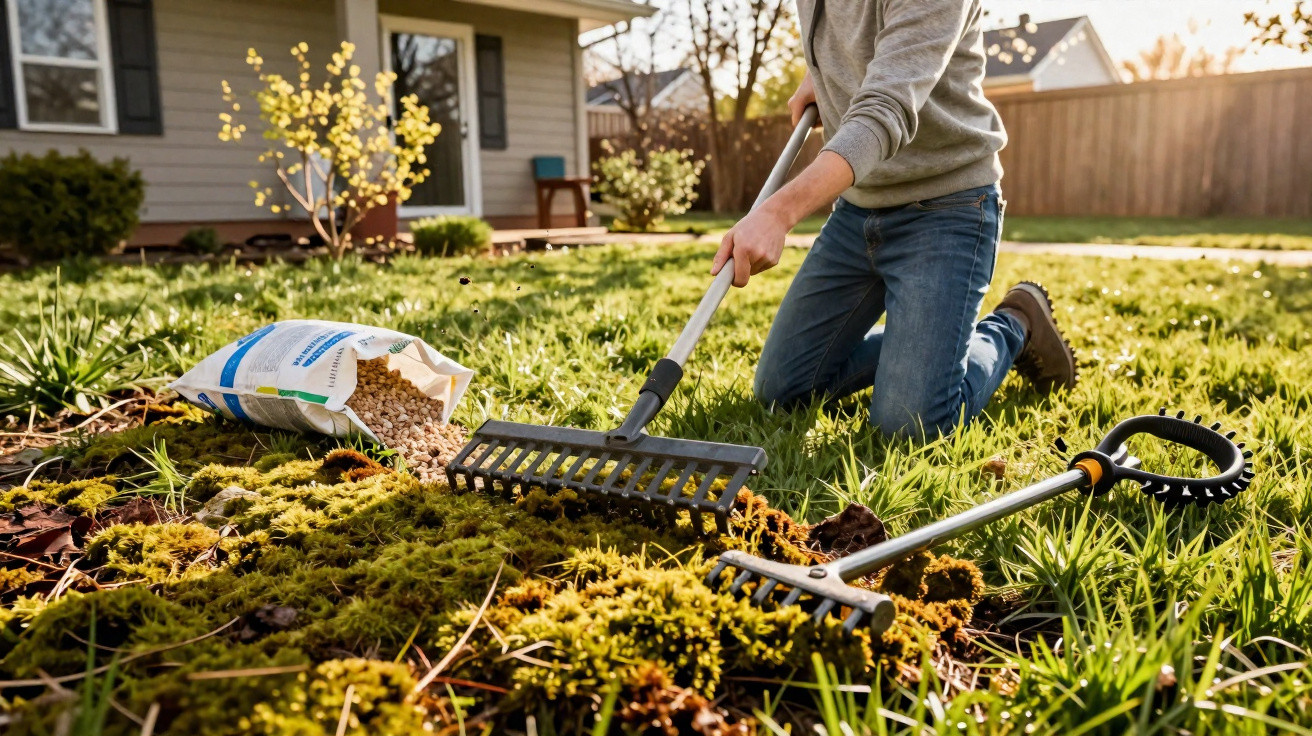
After aeration and topdressing comes the job many people would prefer to do first: removing the moss from the lawn. This is now the right moment, however, because the roots will immediately have more light, air and space afterwards.
Rake properly rather than gently brushing the surface
Use a robust scarifying rake or a metal leaf rake. Then work firmly across the area:
- Pull the rake vigorously back and forth to loosen moss thatch and dead grass.
- Go over shady areas and heavily thatched sections several times.
- Gather up the loosened thatch afterwards and remove it from the lawn.
The material pulled out can go on the compost heap or into the garden waste bin. Do not leave it on the lawn, as it will hinder grass growth again.
“After raking, the lawn often looks alarmingly bare – and that is exactly the aim. It allows light and water to reach the soil again.”
First mow: raise the blades instead of cutting low
Raking should be followed by the first cut of the year. Mowing too closely at this stage weakens the lawn all over again. Set the lawnmower substantially higher than in summer, to a cutting height of around 4–5 centimetres.
During the first few days after this treatment, the area may look rather battered. Some spots will appear patchy and others dull. Within one to two weeks, the lawn will usually begin to regrow much more strongly because its roots suddenly have better conditions: looser soil, more oxygen and less competition from moss.
When is the best time of year, and what are the limits?
The best period for this three-part treatment is the middle of March. In mild areas, experienced gardeners can start as early as late February, provided the soil is no longer frozen and has begun to warm up.
These conditions are especially suitable:
- The ground is neither frozen nor completely waterlogged.
- Daytime temperatures are clearly above zero.
- The weather is dry, at least for several hours at a time.
With heavy, wet soil, it is better to postpone the work for a few days. Pushing a fork into softened ground or raking it can compact the surface even more.
Where moss has a place and lawn grass reaches its limits
Not every area is suitable for a classic closely mown lawn appearance. In deep shade beneath dense trees, on permanently damp north-facing sides or in hollows where water constantly sits, grass will struggle to establish itself even with the best care. In such places, deliberately allowing a carpet of moss or planting shade-loving perennials can be a less stressful long-term option.
For typical home gardens with average levels of sunshine, however, this March routine usually brings noticeable improvements. Repeating it year after year gradually builds stable soil in which grass gains the upper hand.
What else you can do for a dense lawn
After the three main steps, it is worth considering two additional measures: overseeding and nutrient supply.
Where larger bare patches remain after raking, overseed straight away. Special lawn overseeding mixes germinate quickly and close gaps before moss or weeds can become established again. Lightly rake the seeds into the soil and keep them moist for several days in dry weather.
A moderate lawn feed in March or April supports the rebuilding of the turf. Mineral quick-start fertilisers act rapidly, while organic feeds provide a slower, more even boost and strengthen soil life. If compost has already been included in the topdressing mix, the lawn has received a useful initial boost.
Anyone whose lawn gets heavy use during the year – for example, as a children’s play area – benefits particularly from this March combination. The grass develops stronger roots, recovers more quickly from damage caused by foot traffic and copes better with dry spells in summer. A patchy winter lawn can therefore gradually become dense, durable green turf again, without calling for chemicals whenever moss appears.




Comments
No comments yet. Be the first to comment!
Leave a Comment