
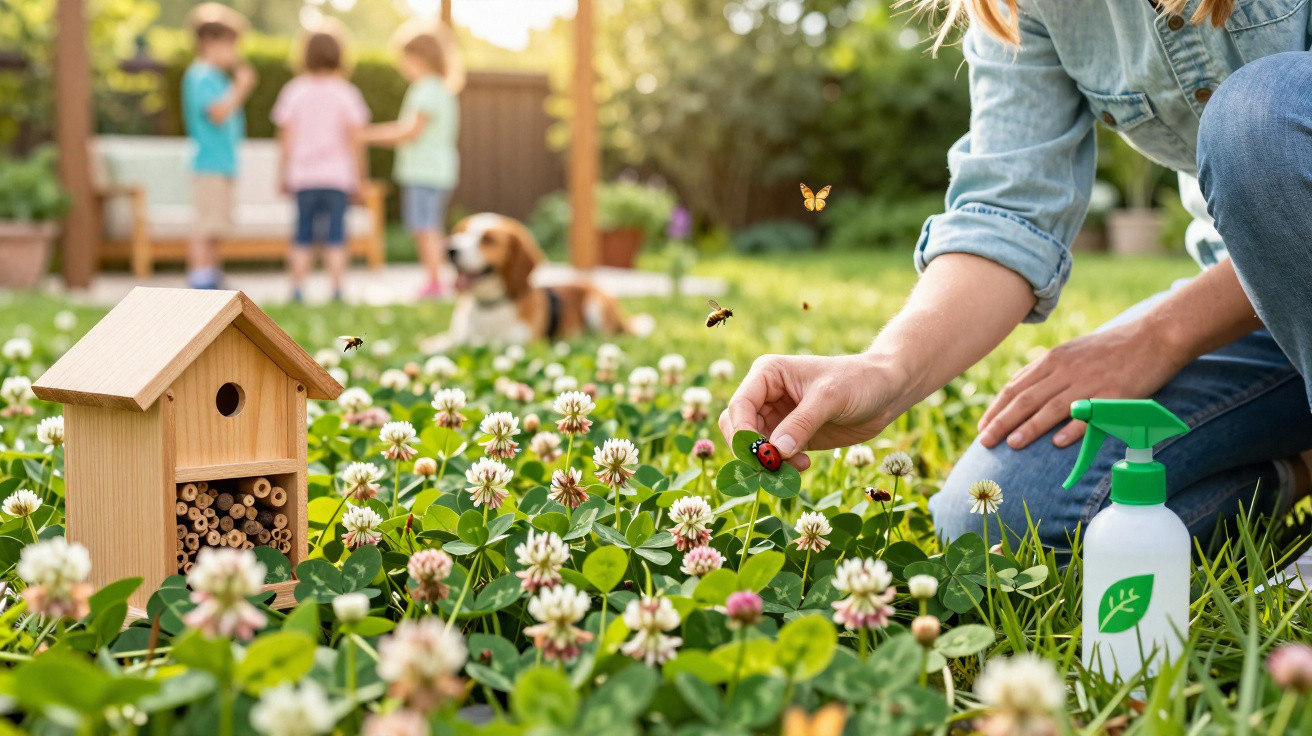
The reality is far more interesting than many people expect.
Clover in a lawn is considered easy to look after, hard-wearing and environmentally friendly. Yet the same question keeps coming up: do the white or pink flowers automatically bring more stinging or crawling creatures right up to the patio door? Anyone planning to redesign their garden should understand exactly which insects clover attracts – and whether this is a drawback or perhaps even an advantage.
Clover in the lawn: what really flies in and buzzes around
Clover flowers provide plentiful nectar and pollen. For many insects, this is like a free buffet in the middle of the garden.
Clover does attract plenty of insects, but most of them are beneficial rather than dangerous.
The most frequent visitors to a clover lawn include:
- honey bees and bumblebees
- butterflies
- various species of solitary bee
- ladybirds
- hoverflies
Every one of these species either helps pollinate plants or feeds on pests. Activity rises noticeably during clover’s flowering period, broadly from late spring into autumn. If you are relaxing on a sun lounger and wondering why the lawn has suddenly become livelier, clover is the reason.
There are also a few less welcome visitors, including:
- clover mites (tiny arachnids)
- Japanese beetles (a growing issue in some regions)
- grasshoppers and various leafhopper species
The good news is that most of these creatures cause very little damage to the clover lawn itself. In many cases, they are more noticeable by their appearance than through any real harm to plants.
Beneficial insect or pest: which role does each play in a clover lawn?
Allowing clover to remain in the lawn creates a small ecosystem in the garden. This can be highly positive, provided you understand the role played by each insect.
| Insect group | Role in the garden | Effect on a clover lawn |
|---|---|---|
| Honey bees, bumblebees, solitary bees | Pollinate many food and ornamental plants | Use the flowers without causing damage |
| Butterflies | Pollinators and an indicator of a healthy environment | No significant damage |
| Ladybirds | Eat aphids and other pests | Protect clover and nearby plants |
| Hoverflies | Larvae consume pests, while adults pollinate | Support natural pest control |
| Clover mites | Can become a nuisance inside buildings | Barely harm plants; mainly a hygiene issue indoors |
| Japanese beetles | Feed on the leaves of many plants | Chew leaves, but usually remain limited within the clover lawn |
The positive side: more pollinators, fewer chemicals
Pollinators are the clear winners in a lawn rich in clover. Bees, bumblebees and butterflies support the reproduction of fruit trees, berry bushes and vegetables. In densely built-up residential areas especially, many insects lack feeding sources. Clover fills that gap.
Predators such as ladybirds and hoverfly larvae also benefit. They eat aphids, small caterpillars and other soft-bodied pests that would otherwise feed on roses, vegetables or herbaceous perennials. Relying on these natural helpers means significantly less need for sprays.
A clover lawn works like free biological pest control – if you let it.
The downside: mites indoors, beetles on leaves
It is not entirely problem-free. Clover mites can appear in large numbers on house walls, particularly in spring and autumn, and enter buildings through the smallest cracks. They do not bite, but leave reddish marks if crushed and can feel unpleasant when present in large swarms.
Where Japanese beetles are already established, they feed on clover leaves before readily moving on to roses, fruit trees or ornamental shrubs. Adult beetles like clover, although they often prefer other plants when given a choice.
How to manage insects in a clover lawn
Anyone who wants to retain clover in the lawn without constantly worrying about stings or infestations can take several steps. The key is not to eliminate every beetle, but to maintain a balance.
Fewer bees and bumblebees around play areas
Families with young children and people with allergies often ask whether more clover automatically means more stings. In practice, bees and bumblebees are usually busy foraging and only react defensively if disturbed or if somebody treads on them barefoot.
Gardeners can greatly reduce the risk with these measures:
- Mow clover lawns in heavily used areas, such as directly in front of the patio, more often before many flowers open.
- Establish clover mainly around the edges, beneath trees or at the far end of the garden.
- Position beds of flowering perennials slightly away from seating areas, so bees can carry out most of their work there.
- Explain to children that they should not swat at or blow on bees, but walk calmly past them.
- During high summer and full flowering, avoid walking barefoot through areas that are especially rich in flowers.
Keeping clover mites and beetles under control without pesticides
A simple structural measure helps against clover mites: create a plant-free strip around 40–50 centimetres wide directly alongside the house foundations. This gravel or bare-soil “buffer” prevents the tiny creatures from travelling to the walls in large numbers.
It is important not to leave thick layers of mulch or dense ground cover in this area. Mites like to hide there, making it much easier for them to find their way indoors.
Targeted and, wherever possible, gentle measures can help with Japanese beetles on clover and other plants:
- Collect beetles from plants in the morning, when they are still sluggish.
- Use biological treatments such as certain soil bacteria that target the larvae without harming other species.
- Avoid broad-spectrum insecticides, so beneficial insects such as ladybirds and solitary bees remain in the garden.
Is clover in the lawn worthwhile despite attracting more insects?
Mixing clover into a lawn is a conscious choice for more life in the garden. In return, maintenance requirements fall: clover copes better with poor soils and dry spells, needs less fertiliser and often stays green longer than a conventional ornamental lawn.
Clover attracts more insects, but most of them make the garden more resilient, not more dangerous.
For heavily used entertaining spaces or pools next to the patio, it may make sense to keep clover mainly in border areas. The buzzing activity is less intrusive there, while the animals can still contribute to the local environment.
Anyone who values nature and climate protection, on the other hand, benefits from a lawn that is rich in clover throughout. More bees and butterflies mean better pollination across the whole neighbourhood – something that eventually becomes visible in the harvests from fruit trees and berry bushes too.
How a clover lawn affects neighbouring plants
Clover fixes nitrogen from the air and makes it available in the soil. This nutrient can then also be used by neighbouring grasses and perennials. That is why mixed lawns containing clover often look lusher even though less fertiliser is used.
These mixed lawns also support more beneficial creatures, including ground beetles that hunt slugs and caterpillars at night. So, anyone with roses, vegetable beds or perennial borders close to the lawn receives unnoticed support from the clover.
When clover is genuinely not a good idea
Clover is completely unsuitable where people with severe insect-venom allergies live and bee stings can be life-threatening. In such cases, a conventional lawn with relatively few flowers is often the safer choice close to the home, while clover-rich areas can be placed further away.
Clover can also be visually disruptive in highly formal front gardens where an entirely uniform, closely clipped green lawn with no white flowers is wanted. Anyone seeking a perfect carpet-like appearance is unlikely to be happy with the livelier look of a clover lawn.
For many other gardens, however, the answer is clear: yes, clover attracts more insects. In practice, this usually means more pollinators, more natural pest hunters and a more robust, climate-resilient surface – as long as a few straightforward rules are followed when living alongside the new residents.




Comments
No comments yet. Be the first to comment!
Leave a Comment