
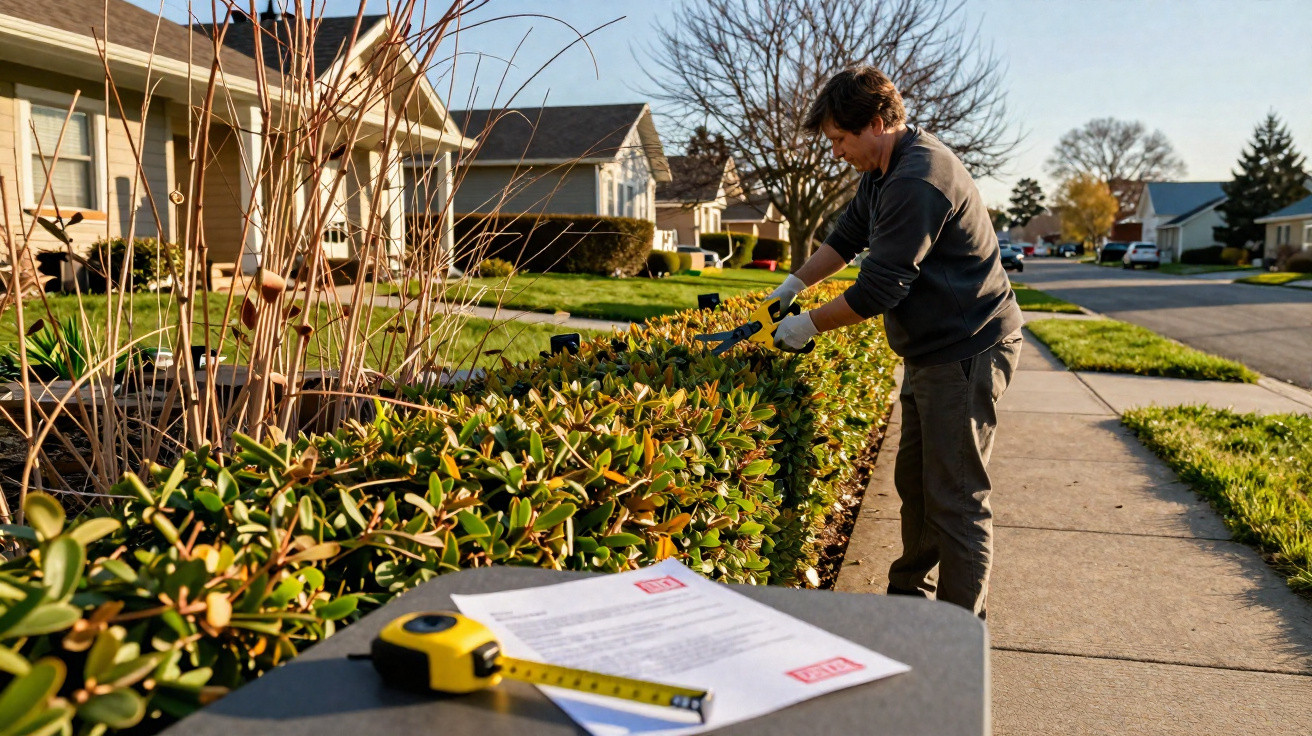
Every spring, it is the same story: nature shoots up, hedges spread unchecked and unused plots turn into miniature jungles. At the same time, complaints reach local councils and enforcement offices – and, in the worst cases, property owners receive a fixed-penalty notice. The reason is a duty that applies in many local authority areas but is surprisingly often ignored or simply unknown.
What it is really about: the duty to maintain your property and its surroundings
Many people think ‘property maintenance’ means looking after their own garden: mowing the lawn, pulling a few weeds and perhaps trimming the hedge. Legally, however, the issue often extends much further.
In numerous local authority areas, owners must maintain not only their own land but also adjoining areas, including:
- undeveloped plots or brownfield land;
- strips of land along their property;
- pavements and footpaths outside the house;
- hedges and shrubs that extend into public areas; and
- vegetation in places at increased risk of fire.
Growth accelerates particularly quickly in spring. What may seem like ‘grass that has grown a little too tall’ can soon become waist-high wild vegetation. This is exactly where many local rules intervene, aiming to reduce the associated risks.
The duty to maintain a property is not simply about keeping things tidy – it is intended to prevent fires, control vermin and avoid disputes with neighbours.
Fire risk, pests and neighbour disputes: why these rules exist
The principal reason behind many requirements is preventative fire protection. In areas with dry summers in particular, neglected land can become a genuine fire hazard. Dry grass and scrub are enough for a spark or carelessly discarded cigarette to start a blaze.
Councils also identify further concerns:
- Pest infestations: Tall grass and unused land offer ideal shelter for mice, rats and insects.
- Obstructed visibility: Overhanging branches or hedges can make junctions and driveways difficult to see clearly.
- Everyday disruption: People with allergies can suffer from heavy pollen levels, while neighbours may be troubled by areas that are growing wild.
- Risk of injury: Overgrown pavements and trip hazards caused by roots and shrubs increase the risk of accidents.
For this reason, many local authorities use bylaws and regulations that place clear responsibilities on owners. Owning a house or plot there means taking responsibility not only for the four walls, but also for safety in the surrounding area.
Local rules, substantial fines: why the penalty catches so many people out
The difficult part is that there is no single nationwide rule. Each local authority, and in some cases even individual districts, can set its own requirements. Owners are expected to know these rules, even though they are rarely made prominent when a property is bought.
In many cases, the process works as follows:
- The council adopts a local bylaw on property maintenance.
- It publishes the bylaw in its official bulletin or on its website.
- Many owners never read it – or later forget about it.
- In spring, enforcement staff carry out checks or respond to complaints.
- This is followed by a request, a deadline and, in serious cases, a fine.
The amounts can be significant. In particularly sensitive areas, such as those with an elevated wildfire risk, fines of up to €1,500 may be imposed if land is not cleared in time. Some councils will even send in specialist contractors when an owner refuses to act – and then charge the property owner for the work.
Anyone who ignores property-maintenance requirements can quickly pay twice: first the fine, then the bill for the subsequent clearance work.
Which areas are covered? Typical property-maintenance duties at a glance
Exactly what must be maintained is always set out in the relevant local bylaw or a specific regulation. However, certain requirements appear frequently.
Around the house
Minimum distances for short grass and cleared land may apply around residential buildings. In areas close to woodland or dry heathland, authorities often require a cleared strip around a building. The aim is to stop a fire from spreading unchecked right up to the house.
Pavements and roadside edges
Many owners are surprised to discover that they share responsibility for the pavement outside their property. In winter, this means clearing snow and gritting; in summer, it also means cutting back vegetation and keeping the area clear. If weeds, grass or roots spread across the path, the local enforcement office may issue a warning – followed, if matters escalate, by a formal notice.
Hedges, trees and shrubs
The main concern here is preventing anything from protruding into the highway. Hedges must not narrow cycle paths or footpaths, and branches must not hang at head height above the pavement. Traffic lights, road signs and street lamps must remain clearly visible at all times.
How property owners can avoid spring fines
Anyone wishing to play it safe should not wait for an unwelcome official envelope to arrive through the letterbox. A few straightforward steps can prevent stress and expense:
- Ask the local council: A brief call to the town hall or enforcement office is often enough to clarify the key obligations.
- Check the bylaws: Local rules are usually available online. Useful search terms include ‘street-cleaning bylaw’, ‘public-safety regulation’ and ‘tree-protection bylaw’.
- Plan early in the year: Check as early as March or April which areas need cutting back.
- Maintain regularly rather than rushing: It is better to mow and prune several times a year than to face one major clearance operation.
- Send photographs to the council if unsure: Sometimes a short email with pictures is enough to obtain a clear answer.
Those without the time or equipment can hire gardening and landscaping contractors. That does cost money, but it may still be considerably cheaper than substantial fines and compulsory enforcement measures.
What owners in high-risk areas should consider
Particularly strict requirements often apply in regions with a high wildfire risk. For example, owners may be required to reduce all combustible material within a specified radius of the house, including dry leaves, dead branches and tall grass. The authority then determines how wide this protective strip must be.
Anyone moving to such an area should contact the local council or fire service as early as possible. Those responsible will understand the local risk situation and can usually explain clearly how the land around the house should be arranged so that a fire can be tackled quickly in an emergency.
Legal terms explained briefly: bylaw, notice and fine
Many owners find the legal position overwhelming. Three terms occur repeatedly:
- Bylaw: A rule adopted by the local council that applies throughout its area.
- Notice or order: A letter from the authority addressed to a particular person, for example: “You must clear your property by date X.”
- Fixed-penalty notice: The official imposition of a financial penalty when rules have not been followed.
Anyone who receives a notice can generally challenge it within a set time limit. This may be worthwhile if it is unclear whether the authority acted correctly or whether the recipient is actually the responsible owner. Solicitors specialising in administrative law are familiar with such cases.
Practical examples: when it becomes a problem – and when it does not
Not every untidy corner of a garden immediately causes trouble. A few typical scenarios show where the boundary lies:
| Scenario | Typical legal assessment |
|---|---|
| Naturally planted wildflower meadow at the rear of the garden | Often unproblematic, provided there is no fire risk and pests do not become excessive. |
| Pavement outside the house completely overgrown | Usually a clear breach of the duty, as pedestrians are obstructed or put at risk. |
| Hedge extending a long way into the road | It will generally have to be cut back, not least for road-safety reasons. |
| Neglected brownfield plot near woodland in high summer | High likelihood of requirements or a fine because of the fire risk. |
Anyone who deliberately wants to manage their land in a wildlife-friendly way should ideally agree this with the local council. Some towns now even support insect-friendly gardens – as long as they are clearly maintained and do not create a hazard.
The basic principle is straightforward: anything that could endanger others, obstruct public space or significantly increase the fire risk should be checked especially carefully in spring – before the postman arrives with an unpleasant envelope.






Comments
No comments yet. Be the first to comment!
Leave a Comment