
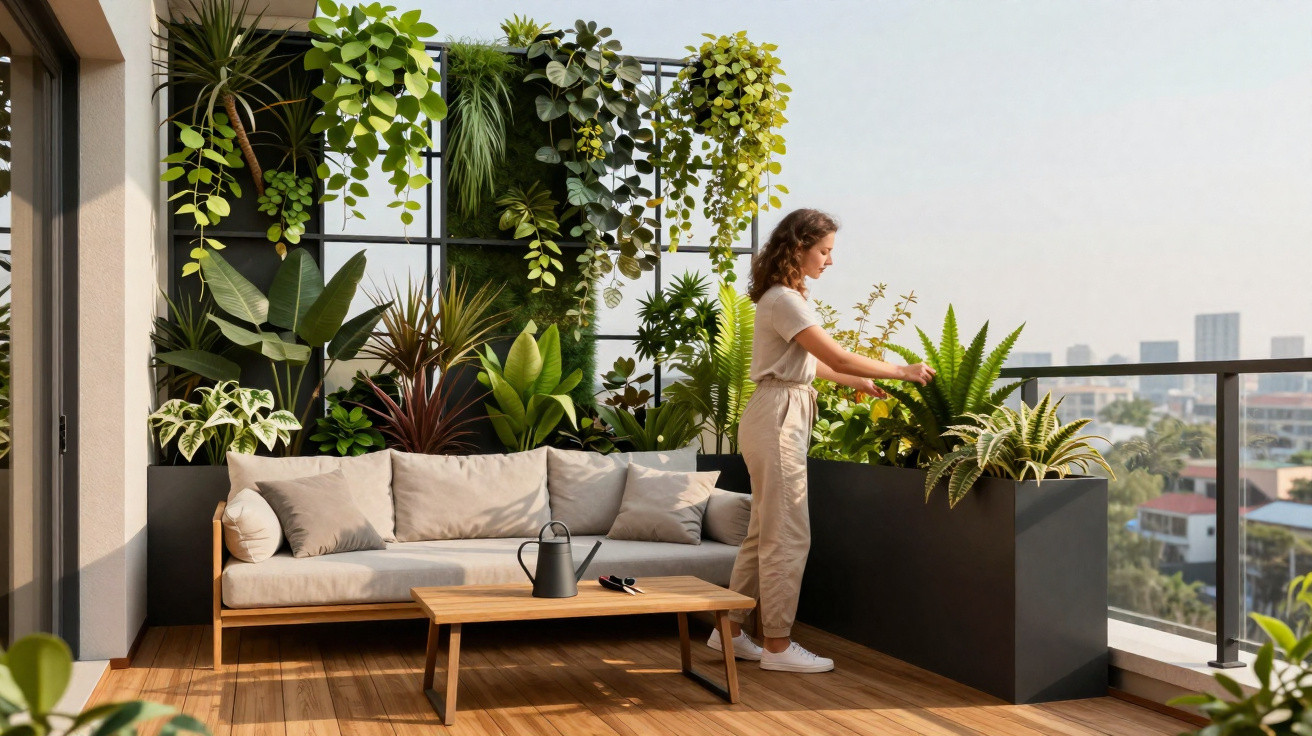
The new decorating wave for 2026 is clearing away the clutter – and presenting plants in a completely different way.
For years, many city dwellers treated their balcony as a leftover space: a few pots, a chair, and that was it. Now attitudes are shifting. Outdoor space is taking centre stage and being planned like an extra room – with a clear layout, considered design and an unexpected leading role: deliberately arranged planting.
From pot clutter to a designed outdoor space
Individual flowerpots placed on the floor were long considered the standard solution. They were practical and quick to put out, but rarely formed a truly coherent look. In 2026, a different approach is coming to the fore: structured, carefully planned greenery that visually organises the balcony while creating more usable space.
Plants are moving upwards – off the floor and into considered systems that free up space and make the balcony feel like a designed room.
Raised planters and window boxes instead of floor pots
A key feature of this development is the raised planter. Rectangular containers sit on metal or wooden frames, run alongside the railing or create a green line along the wall in the manner of sideboards. As a result, most of the floor remains clear.
- More room to move: chairs, a small table and lounge chairs no longer have to compete with a mass of pots.
- Visual calm: rather than numerous separate containers, the plants form one continuous band.
- Easier care: plants are at a comfortable working height, making watering and pruning simpler.
- A cleaner floor: there are fewer water marks and less compost spread around the balcony.
Anyone without room for large planters can opt for slim versions with delicate frames. Even narrow balconies then appear less crammed with furniture and instead feel tidier and more airy.
Minimalist looks with bold contrasts
Simple shapes, crisp lines and restrained colours dominate the design. Matt black metal frames combined with pale wood surfaces and rich green foliage are particularly sought after. This contrast recalls Scandinavian interiors and works especially well in contemporary flats.
White or sand-coloured containers create a Mediterranean feel, whereas grey aluminium gives a more urban impression. What matters is that the planters, furniture and textiles work together. The balcony should feel like one cohesively designed space, rather than a random collection of finds.
A unifying theme instead of a plant collection
The new balcony aesthetic is defined by structure. Plants are no longer placed alongside one another at random; they are consciously grouped and arranged. The eye follows lines and varying heights instead of jumping between individual pots.
Clear zoning is typical of 2026: a continuous planting line around the edge, an open area for furniture and perhaps a second, higher level against the wall. This allows even a small balcony to resemble a carefully planned layout rather than a storage area with some greenery.
Playing with height: plants become spatial architecture
Instead of positioning every plant at the same level, designers and amateur gardeners are increasingly using tiers, shelving and hanging features. The result is a layered outdoor setting that seems bigger than it actually is.
Vertical arrangements add depth in just a few square metres
Several levels can transform the sense of space. Tall grasses at the back, mid-height planters on frames and low greenery at the front: this straightforward three-part arrangement alone makes a balcony feel more vibrant. Wall trellises, climbing supports and shelves can be added as well.
| Level | Suitable plants | Effect |
|---|---|---|
| Upper / wall | Climbing plants, trailing plants | Frames the space and makes it feel more sheltered |
| Middle | Shrubs in containers, grasses, herbs in planters | Creates the green “main focal point” |
| Lower | Ground-cover plants, small pots, decorative elements | Adds detail without filling the space |
Compact balconies in particular benefit greatly from this approach. By playing with heights, the gaze naturally moves upwards and perceives more “space”, even though the floor area remains unchanged.
Plants as natural room dividers
Planting also has a new role in dividing up the space. Rather than solid partitions, planters can define zones without blocking the balcony off. For example, a tall, long planter positioned between a table and a sun lounger can visually separate the dining area from the relaxation zone.
Popular combinations include:
- A tall planter that screens the balcony from the street, with a lower herb planter in front of it.
- A narrow plant shelf serving as a side “boundary” next to the neighbouring balcony.
- Trellis panels with climbing plants forming a green wall behind a bench.
This makes it possible to create several small areas even when the balcony measures only a few square metres. The preferred spot can change with the time of day: breakfast at the table, then an evening spent with a book in the corner behind the grasses.
The balcony becomes a fully fledged living zone
Alongside the new approach to greenery, people’s understanding of outdoor space has also changed. Many now design their balcony like an additional room, with atmosphere, function and a clear concept. Cushions, outdoor rugs, fairy lights and lanterns set the mood. Plants are no longer an accessory but part of the overall spatial composition.
In 2026, the balcony no longer stands for a few containers at the edge, but for a consciously designed little retreat – and plants provide its framework.
When sitting on the sofa in the evening, the view is no longer of a grey exterior space but of a green stage that visually extends the interior. This seamless transition makes small flats feel noticeably larger.
Practical tips for the new balcony look
A plan rather than impulse buying
The change starts not at the garden centre but on a sheet of paper. First, consider the available floor area, the aspect and how the balcony will genuinely be used: is it mainly for eating, working or relaxing? Then decide where seating should go and where plants can be positioned effectively.
Useful questions to ask include:
- Which areas do I really want to use – for eating, reading, working or sunbathing?
- Where do I need clear floor space, and where would a narrow planting line be enough?
- Which corners suit taller features without blocking light?
Only then should plant varieties be considered. Mediterranean herbs, lavender and slim olive trees in planters are suitable for sunny positions. Shady balconies benefit from ferns, hostas and grass-like plants that cope well with less light.
A considered mix of materials
Many manufacturers offer modular systems that can be expanded: frames designed to hold different planters, connecting systems for wall trellises and shelves with integrated planting boxes. It makes sense to stick to one or two material directions, for example:
- Black metal + pale wood
- White metal + terracotta tones
- Grey aluminium + a concrete-look finish
Too many different materials can quickly make a small space feel unsettled. A better option is to choose a few repeating elements that run through the balcony like a common theme.
What the trend means for care, climate and wellbeing
This new planting approach also has practical consequences. Raised planters are easier to water and can often accommodate irrigation systems or water reservoirs. Choosing perennial plants and hardy varieties reduces both annual replacement purchases and maintenance work.
At the same time, more densely planted areas act like a small air-conditioning system. Plants provide shade, release water through evaporation and therefore cool the surrounding air slightly. On south-facing balconies that become intensely hot, this can determine whether it is still comfortable to sit outside in high summer.
The green structures also matter psychologically because they create order. Instead of encountering an arbitrary jumble, the eye sees deliberately designed lines and surfaces. This has a calming effect, particularly in densely built-up urban neighbourhoods where access to open nature is limited.
Anyone wishing to try the trend does not need to throw away every pot immediately. A good starting point is one long planter on a frame along the railing, a simple wall trellis with two or three plant pockets, and a clearly defined seating area. These three steps alone are often enough to turn a storage-style balcony into a small green urban loggia – ready for the look of 2026.



Comments
No comments yet. Be the first to comment!
Leave a Comment