
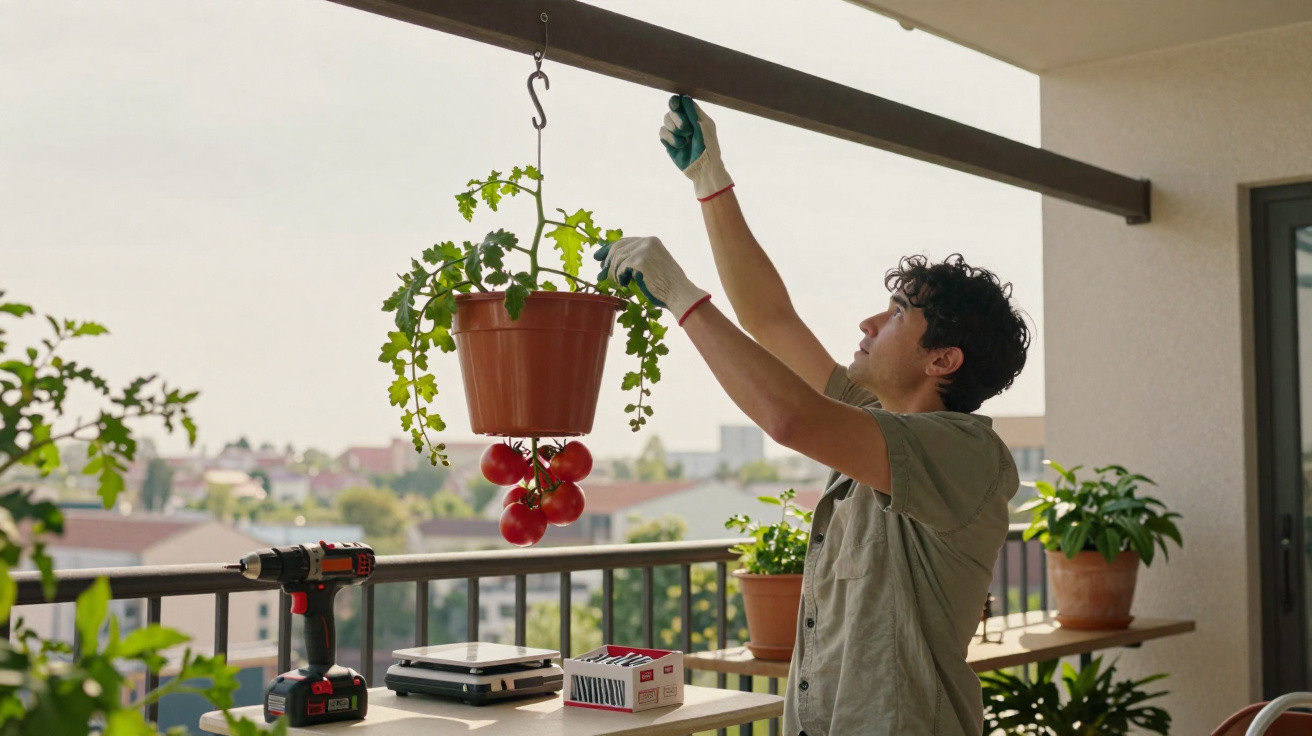
Growing tomatoes upside down in a bucket for the first time, most people focus on the variety, compost and feeding. Yet the crucial issue is often elsewhere: the load and a secure fixing. A bucket full to the brim can weigh more than a packed suitcase – and if it falls, the consequences can be dangerous, not just for the plants.
Why growing tomatoes upside down in a bucket makes sense
Growing tomatoes upside down may initially seem like a gardening gimmick. There is, however, a smart principle behind it. The plants emerge downwards from a bucket filled with compost, while watering is done from the top. Their fruit hangs freely, so they require very little support.
- Well suited to small balconies and patios
- Very little contact with the ground, meaning fewer slugs
- Tomatoes hang in open air, which may reduce fungal diseases
- An eye-catching feature that draws immediate attention
Plastic buckets holding 18 or 20 litres are often used, such as thoroughly cleaned old paint tubs, mortar buckets or sturdy builders’ buckets. It all sounds fairly harmless, but the difficulty begins once compost and water are added.
The overlooked risk: how heavy a tomato bucket really becomes
An empty plastic bucket feels light. Once it contains growing medium, water and a vigorous tomato plant, it becomes a small workout in its own right.
“A typical tomato bucket can easily weigh 15 to 25 kilograms during the season – and often even more after watering.”
The calculation behind this initially appears straightforward:
- Compost or growing medium for 18–20 litres: approximately 6–10 kg, depending on the mix
- Water after a thorough watering: another 6–10 kg
- Plant including stem, foliage and fruit: 1–3 kg, or more when carrying a heavy crop
This means the equivalent weight of a large crate of drinks may suddenly be hanging from a hook, gutter or balcony railing. At the beginning, when the plant is still small, the arrangement seems harmless and lightweight. A few weeks later, the reality becomes clear: this system needs planning rather than improvisation.
Where to hang tomato buckets safely
Before filling the first bucket with compost, one question must be answered clearly: where will the structure safely support this weight over time?
Strong fixing points around the home
- Substantial steel or concrete balcony railings – provided they are securely anchored into the building structure
- Ceiling joists, steel beams or robust timber beams – for example beneath a canopy
- Solid wall hooks with heavy-duty fixings in brickwork or concrete
- Purpose-built climbing or hanging frames made from wood or metal, standing on the ground and transferring the load downwards
Many home gardeners try spontaneous solutions, such as suspending buckets from a gutter. A practical example illustrates the appeal: tomato buckets shaded beneath the roof edge and conveniently positioned at hand height. It sounds useful – but the real issue is whether the gutter can actually cope with the load.
“Gutters are designed for rainwater, not as heavy-duty supports. Several tomato buckets can overload their brackets.”
Anyone who does not know the structural capacity precisely, or cannot ask a professional, should avoid such experiments. A falling bucket can endanger people, pets and windows, while also destroying the carefully raised tomato plant.
How to plan the suspension correctly
A safe setup does not happen by accident. A few basic rules can significantly reduce the risk.
1. Assess the weight realistically
Allow for at least 20 kilograms per bucket. If several buckets are hung from the same bar or structure, the load quickly adds up.
- 2 buckets: around 40 kg
- 3 buckets: around 60 kg
- 4 buckets: up to 80 kg and more
Wind loads must also be considered: strong gusts create additional temporary forces on hooks, screws and beams.
2. Use only robust fixing materials
Makeshift arrangements using thin wire, old string or basic plastic hooks rarely last a full season. More suitable options include:
- Heavy-duty metal carabiners
- Galvanised chains with sufficient load capacity
- Wide ratchet straps instead of narrow cords
- Threaded hooks seated deeply in a beam or wall plug
“For maximum peace of mind, choose fixings from the ‘heavy-duty’ range – like those used for shelving or punch bags.”
3. Avoid concentrated loads
When several buckets are suspended from one bar, the load is distributed more effectively. It becomes critical when everything hangs from a single point, such as a poorly anchored hook in crumbling render. In this situation, reinforcement with longer screws and high-quality wall plugs fixed into load-bearing masonry is worthwhile.
Practical tips for everyday care of hanging tomatoes
Once the structure is secure, everyday matters raise new questions: how should the plants be watered, checked and protected from wind damage?
Watering without flooding
Upside-down tomatoes in a bucket need regular watering because some of the water quickly drains out through the hole around the plant. One simple approach is to shape a shallow hollow in the compost at the top and cover it with a thin layer of mulch. This helps water spread more slowly and soak in more effectively.
Those who wish can fit a simple watering collar at the top, such as the cut-off neck of a bottle pressed lightly into the compost. This directs the water more directly towards the roots.
Limiting wind and movement
Hanging buckets can easily start swinging in a storm. The longer the chain or rope, the greater the movement. Two steps can help:
- Use a shorter suspension so that the bucket hangs as close as possible to its fixing point
- Add a second restraint, such as a line tensioned sideways to the railing
This reduces the amount the bucket swings out and places considerably less strain on the hooks.
Which tomato varieties are suitable for a bucket
Not every tomato is comfortable growing upside down. Large beefsteak tomatoes with very heavy fruit can pull strongly downwards on the stems. Better choices include:
- Cherry tomatoes
- Roma tomatoes with medium-sized fruit
- Compact balcony varieties with limited height growth
Even with hanging tomatoes, regular removal of side shoots is worthwhile so that the plant does not become too heavy or difficult to manage. Fewer side shoots mean less weight concentrated in one area and usually more flavoursome fruit as well.
How to spot typical damage early
Anyone who inspects a hanging arrangement only when planting, then forgets about it, will often notice cracks or bent hooks too late. A quick weekly check is enough.
- Replace rusty or bent hooks
- Swap frayed ropes for chains or straps
- Tighten loose screws in masonry and address cracks in timber beams
“As soon as a hook is visibly bending, it needs replacing – not after a loud bang.”
Useful information for anyone wanting to take it further
Those who enjoy this method can apply the same principle to other crops. Hanging peppers, chillies or strawberries in buckets follow the same basic arrangement. The safety considerations remain identical: check the load capacity, account for the weight and choose a solid suspension.
The choice of growing medium is another important consideration. Lightweight, airy mixes based on coconut fibre, or potting compost with perlite, weigh less than heavy garden soil and therefore place less stress on the structure. With several buckets, this can make a difference of a few kilograms – enough to determine whether the setup remains stable or becomes overloaded.
For a long-term arrangement, it is possible to build a separate timber or metal hanging structure that stands directly on the ground rather than being attached to the house. The posts and crossbeams then carry the weight, leaving the façade unstressed. For tenants subject to strict building rules, this is often the less stressful option – the tomatoes still hang spectacularly, and the landlord remains relaxed.



Comments
No comments yet. Be the first to comment!
Leave a Comment