
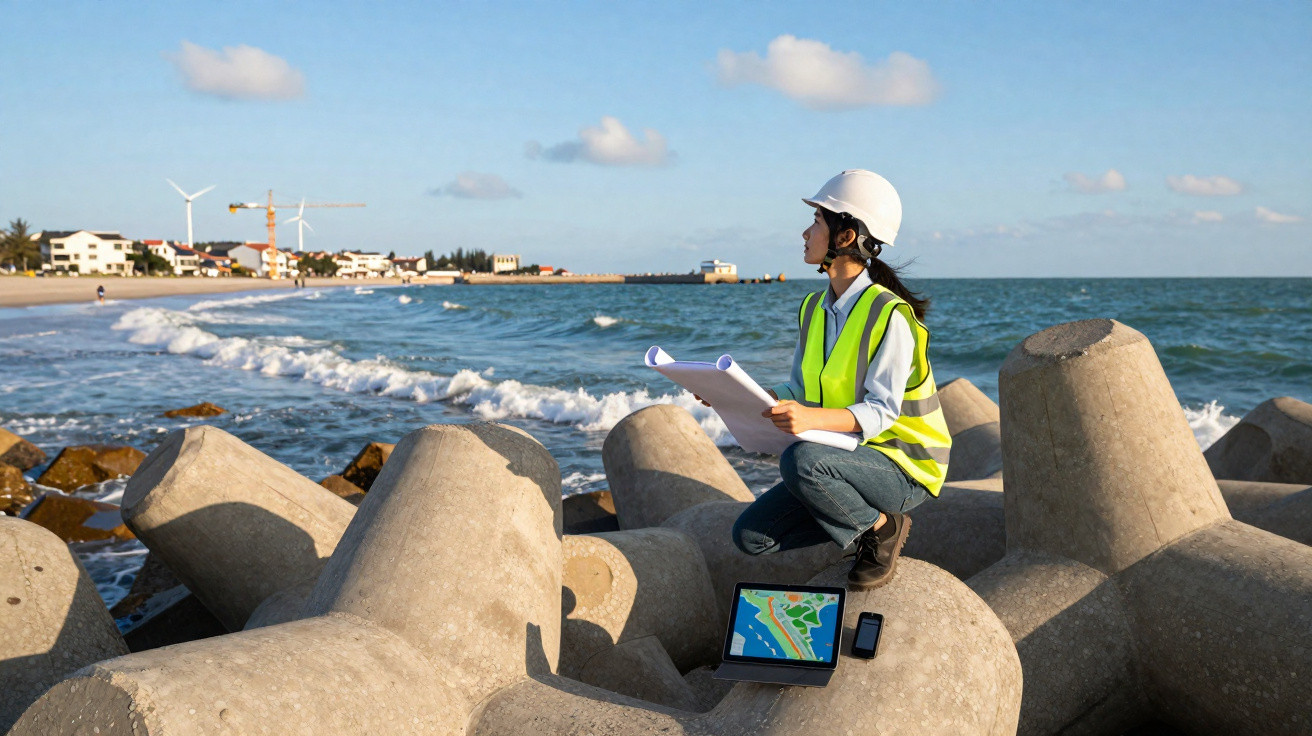
Coastal structures face enormous challenges as violent tides advance along urban beaches. To limit the destructive impact of storms, civil engineering has developed innovative geometric blocks that drastically reduce the force of the water and prevent accelerated erosion.
How do coastal protection structures work?
Traditional breakwaters would sustain severe damage under the continual impact of powerful sea currents. For this reason, the use of heavy four-legged blocks has become an essential alternative for ensuring the stability of defences against giant waves.
Their distinctive design allows the concrete elements to interlock perfectly when stacked along the seafront. This intelligent arrangement dissipates hydraulic energy and prevents the units from shifting, shielding nearby towns from the destruction caused by rough seas.
Several features make these elements vital for coastal protection:
- Three-dimensional shape: The four legs disperse the water’s force efficiently.
- High stability: Their weight and shape ensure they remain secure even under intense pressure.
- Durable concrete: They are manufactured with materials that resist corrosion caused by salt.
- Interlocking system: The units connect together, preventing waves from washing them away.
- Urban protection: They safeguard ports and coastal roads from the effects of erosion.
Why is the shape of tetrapods so effective?
Unlike flat retaining walls, which receive the direct impact of the water, these geometric structures split the water flow into multiple paths. This dispersion lowers pressure on the artificial barrier and provides far greater durability for coastal infrastructure projects.
As water moves around the four concrete axes, the resulting friction absorbs the force of its natural movement. Consequently, the returning tide loses its ability to carry away seabed sediment, reducing the continual degradation of the sandy ground.
What is Fudo Tetra Corporation’s importance in this market?
The Japanese corporation has become a global benchmark in developing civil-engineering technologies for containing marine flooding. Its projects meet stringent safety criteria and are used in vulnerable locations to ensure the preservation of communities against disasters linked to the current climate.
Cutting-edge technology
Advanced coastal engineering
Developing these solutions requires complex hydraulic simulations to ensure the blocks perform as intended in extreme conditions.
In practical use, they reduce long-term maintenance costs and efficiently protect public assets in coastal towns.
Through ongoing research, the company improves the shape of the metal moulds used to manufacture the concrete units. This technical attention ensures that every unit produced can withstand the severity of storms and the wear caused by contact with ocean salinity.
The main benefits of this engineering include the following:
- Optimisation of water flow in port areas.
- Significant reductions in expenditure on seafront repairs.
- Greater safety for residents of coastal regions.
What are the environmental effects of these artificial barriers?
Although installation changes the visual appearance of beaches, these concrete structures create new habitats for a range of hardy marine species. Small fish and algae find shelter in the gaps between the interlocking blocks, creating a small local biodiversity in areas with strong coastal currents.
Over time, tetrapod breakwaters act as artificial reefs that help support the ecological balance of coastlines degraded by urban development. This coexistence of heavy engineering and nature demonstrates that effective solutions can be implemented for the sustainability of our inhabited regions.
Several ecological aspects can be observed in these structures:
- Establishment of benthic ecosystems on submerged surfaces.
- Protection for species against predators from deeper waters.
- Stabilisation of fine sediment around the barrier.
How are cities planning the future of coastal protection?
Modern urban planning requires continued investment to contain the severe effects of rising ocean levels worldwide. Many nations are carrying out complex large-scale structural operations on beaches, combining engineering and natural preservation in the defence of inhabited shorelines.
Combining concrete barriers with artificial beach nourishment represents the forefront of global coastal management. In this way, municipalities protect property and keep tourism potential active, winning the daily battle against the fury of the tides.
Official source: Information obtained directly from Fudo Tetra Corporation.





Comments
No comments yet. Be the first to comment!
Leave a Comment