
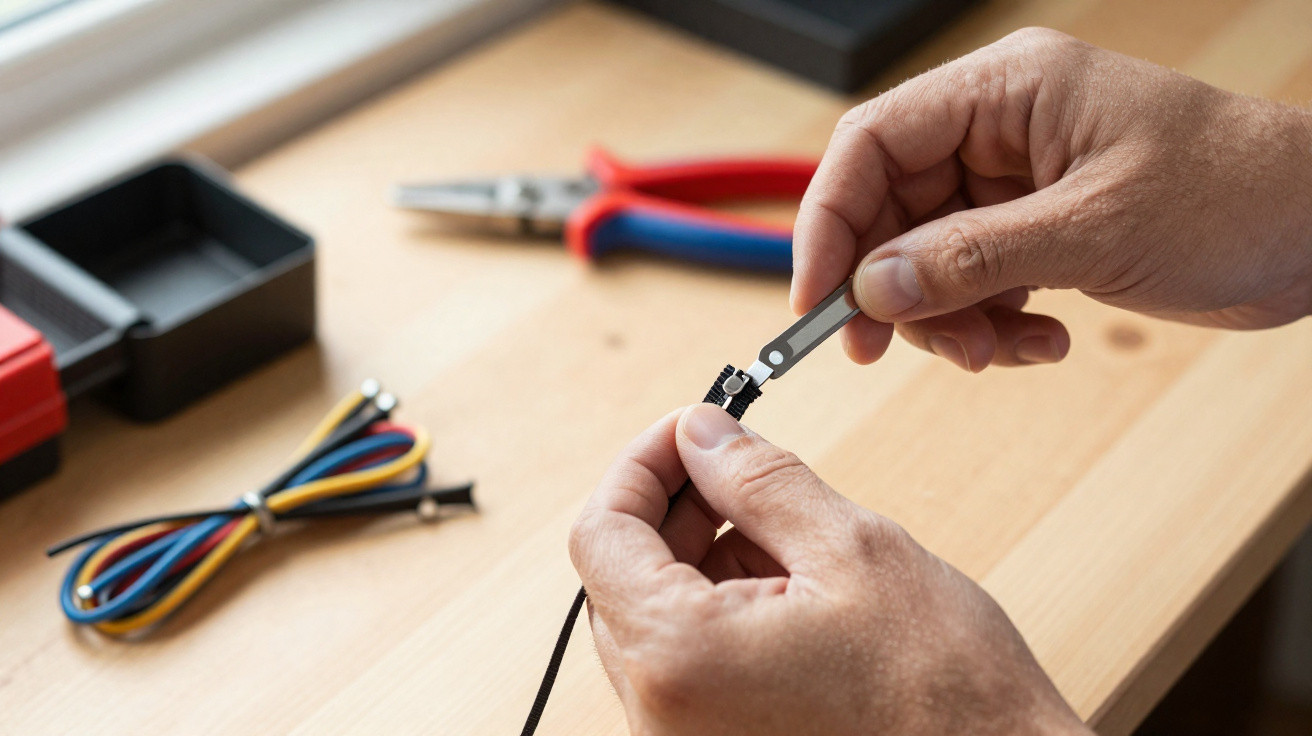
A nylon cable tie is often treated as a disposable item because, once tightened, it locks onto a small internal tab. However, using a fine tool such as a pin, a large needle or a small screwdriver, you can carefully lift this catch, release the toothed strap and use the tie again for wires, cables and minor household repairs.
How does a nylon cable tie lock?
A nylon cable tie has a head containing an internal tab that engages with the teeth along the strap. As the pointed end passes through the head, the teeth move in one direction, but catch if anyone tries to pull the strap back out.
This ratchet mechanism is what keeps the fastening secure. Therefore, to remove it without cutting it, the key is not to pull hard but to release the tab holding the teeth in place.
What is the trick for removing it without cutting?
The method involves placing a fine point between the internal tab and the toothed strap of the nylon cable tie. Once this catch is lifted slightly, the strap is no longer held in place and can be pulled backwards to open it.
- Locate the cable tie head, where the strap end passes through and becomes locked.
- Use a pin, a large needle, an unfolded paperclip or a very fine screwdriver.
- Slide the tip of the tool beneath the internal tab.
- Carefully raise the catch without breaking the plastic.
- Slowly pull the strap back until the cable tie opens.
When can a nylon cable tie be reused?
A cable tie can be used again if its teeth remain intact and the internal tab has not broken while it was opened. If the plastic has turned white, cracked or become heavily misshapen, the item has lost strength and should not be used to hold weight, pressure or important cables.
Reusing it is most suitable for light tasks, including organising wires, securing small objects, tidying extension leads, storing tools and temporarily grouping cables. For electrical installations, outdoor locations or fixings that require safety, a new cable tie is more reliable.
What precautions prevent damage to the cable tie?
Rushing is the main mistake. If the strap is forced without releasing the tab, its teeth may become worn, the head may open too far and the cable tie may no longer lock properly the next time it is used.
- Do not use a knife or an object that is too wide to lift the catch.
- Avoid twisting the cable tie head from side to side.
- Reduce the tension by pushing the strap slightly further in before pulling it out.
- Wear gloves if the cable tie is very tight or located in an awkward place.
- Dispose of it if there is any cracking, cutting or loss of locking ability.
Is this method worthwhile at home?
This trick is helpful when a nylon cable tie has only been used to organise cables or secure something temporarily. Rather than cutting it and throwing it away, it can be opened within seconds and kept for another light-duty use.
Even so, reuse has its limits. The cable tie was designed to lock firmly, and each opening may wear down the internal tab; for that reason, the method is practical for saving money and organising items, but it should not replace a new tie for fixings that demand strength and safety.





Comments
No comments yet. Be the first to comment!
Leave a Comment