
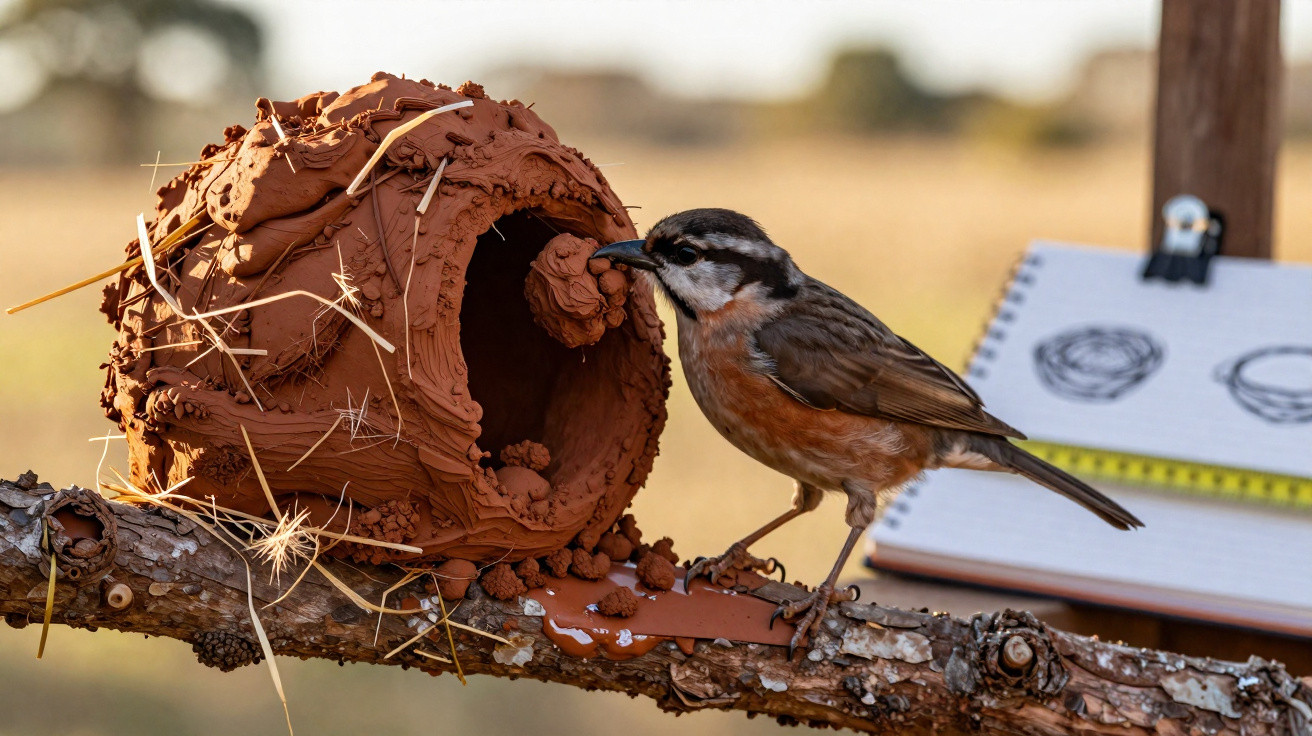
The rufous hornero turns damp mud, plant fibres and small amounts of organic material into a solid, ventilated and long-lasting structure. Its oven-shaped nest ranks among the most sophisticated constructions made by Brazil’s birdlife: it shelters eggs and chicks, withstands rain and may also be used by other species once it has been abandoned.
Why is the rufous hornero’s nest so durable?
Although mud is the nest’s principal material, it is far more than a simple clump of earth. The bird mixes moist clay with fibres, straw, fine roots and other fragments, producing a compound that dries gradually and becomes hard in the sun.
Its rounded shape spreads weight and impacts more evenly, while the thick walls limit direct water ingress. The side opening provides access inside without immediately exposing the egg chamber, offering greater protection from wind and predators.
How does the bird select clay, fibres and moisture?
The pair gathers mud from wet spots, particularly after rainfall or close to waterlogged ground. Moisture is crucial because it makes the clay workable: dry mud does not bind properly, whereas excessively liquid mud loses its shape before it can set.
- Moist clay: binds the mixture together and forms the nest’s main wall.
- Plant fibres: reinforce the material and limit cracking as it dries.
- Small organic fragments: improve the mixture’s cohesion and texture.
- Sunlight and ventilation: dry the structure from the outside in, gradually creating rigidity.
What happens while the nest is being built?
Construction takes place in stages. The rufous hornero carries small amounts of material in its beak, places them at the selected site and shapes the mixture through repeated movements. The work can require many trips, as each layer must build up without collapsing.
Both members of the pair contribute to the work, first raising the base, then the walls and dome. Finally, they create the entrance and an internal partition, forming a kind of passage before the incubation chamber. This division reduces direct exposure to the outside and improves nest security.
How does the rufous hornero nest withstand rain, heat and predators?
Its effectiveness comes from the combination of materials and design. Hardened clay acts as a protective shell, while the fibres help to prevent cracks. The internal chamber provides thermal shelter, and the side access makes it harder for water and larger animals to enter directly.
- Rain: dry mud walls offer better resistance when built in compact layers.
- Heat: the clay mass helps to reduce sudden temperature fluctuations within the chamber.
- Predators: the narrow entrance restricts access to the interior.
- Reuse: abandoned nests may provide a cavity for other birds and small animals.
What this natural architecture teaches engineering
Researchers view the rufous hornero’s nest as an example of building with local materials, low energy use and performance adapted to the climate. Studies of Furnarius rufus emphasise the importance of its form, the orientation of the entrance and the nest’s role as an incubation chamber rather than merely a shelter.
Its value as an inspiration for engineering and materials lies precisely in this approach: using earth, fibres and moisture in the right proportions, shaping the structure in layers and allowing drying to consolidate it. The rufous hornero does not build through force; it builds through sequence, careful material selection and command of the mud’s curing time.






Comments
No comments yet. Be the first to comment!
Leave a Comment