
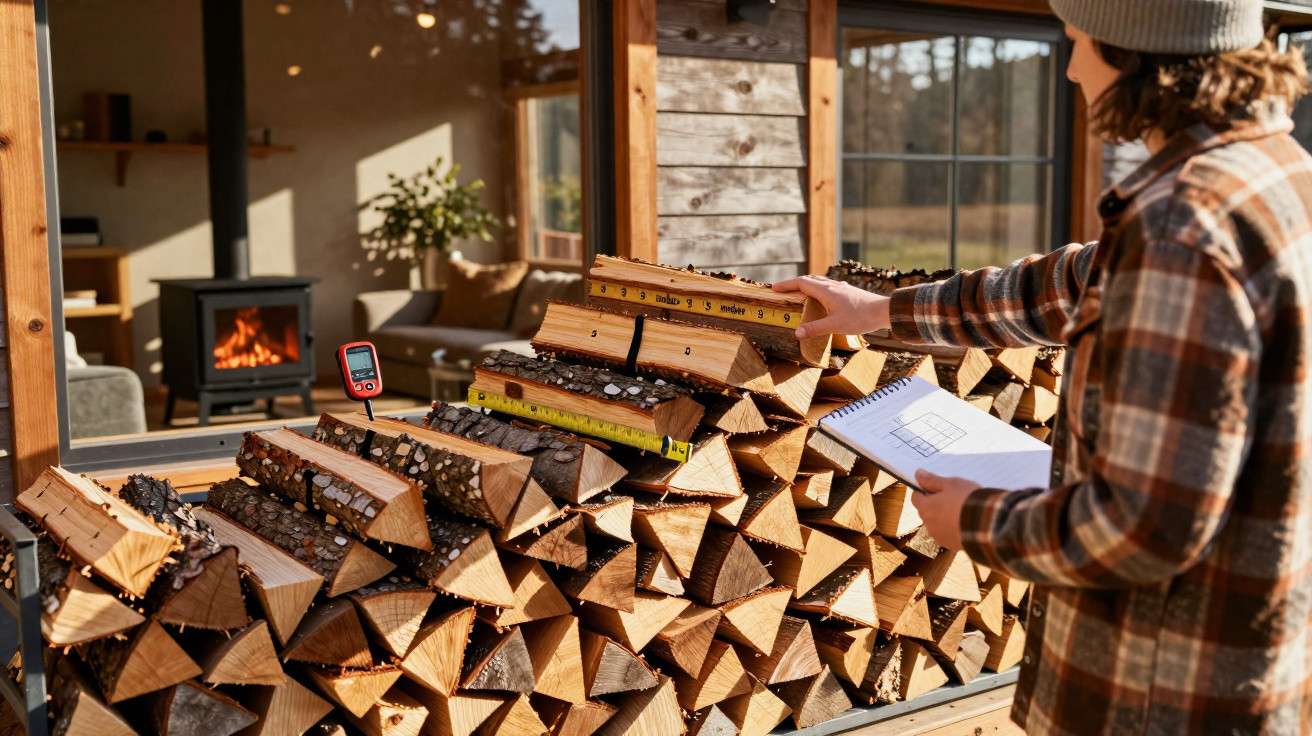
If you rely on a wood-burning stove or fireplace insert through the colder months, the same question comes up every year: will the quantity of wood you have ordered actually last, or will your log store be empty by the middle of February? The answer depends on far more than your home's floor area. A number of commonly overlooked factors also play a part.
What a stacked cubic metre of firewood really means
Before looking at quantities, it is worth clarifying the term. The timber trade often uses a stacked cubic metre (sometimes called a stere). This means one cubic metre of logs stacked over an area of one square metre to a height of one metre.
There is an important practical detail, however: a stacked cubic metre is based on logs measuring one metre in length. Once logs are cut to 50, 33 or 25 centimetres, they can be stacked more closely together. The pile takes up less visible space, even though the amount of wood remains unchanged.
“If you order firewood in shorter lengths, the same stacked-cubic-metre price gives you less ‘air’ and more actual wood in storage.”
When comparing suppliers, always check the log length and ask whether the merchant charges by stacked cubic metres or loose cubic metres. Loose cubic metres refer to tipped, unstacked logs, with substantially more air between them.
The main factors that determine firewood demand
The amount of wood a household burns during a heating season varies considerably. The following factors have the greatest influence on consumption.
Floor area and room volume
A compact terraced house with 90 square metres of floor space and standard-height ceilings will use much less firewood than a detached period property with 160 square metres and open galleries. It is not floor area alone that matters, but the full volume of air that needs heating.
Insulation quality
A well-insulated new-build home with triple glazing requires considerably less energy to achieve the same comfortable temperature than a house with old, draughty windows. Modern efficiency standards can reduce firewood requirements by 30 to 50 per cent compared with an unrefurbished building.
Type and efficiency of the heating appliance
A modern wood-burning stove with clean combustion and secondary air makes much better use of its fuel than an open fire. While current appliances can achieve efficiencies of more than 80 per cent, an open fireplace loses most of its heat up the chimney.
Timber type and quality
Hardwoods such as beech, oak and ash are dense and provide a great deal of energy from each log. They burn slowly and evenly. Softwoods including spruce and pine light more readily and produce plenty of heat quickly, but they also burn away faster.
“For heating with wood over the long term, properly dried hardwood is usually better value, even when the purchase price per stacked cubic metre is higher.”
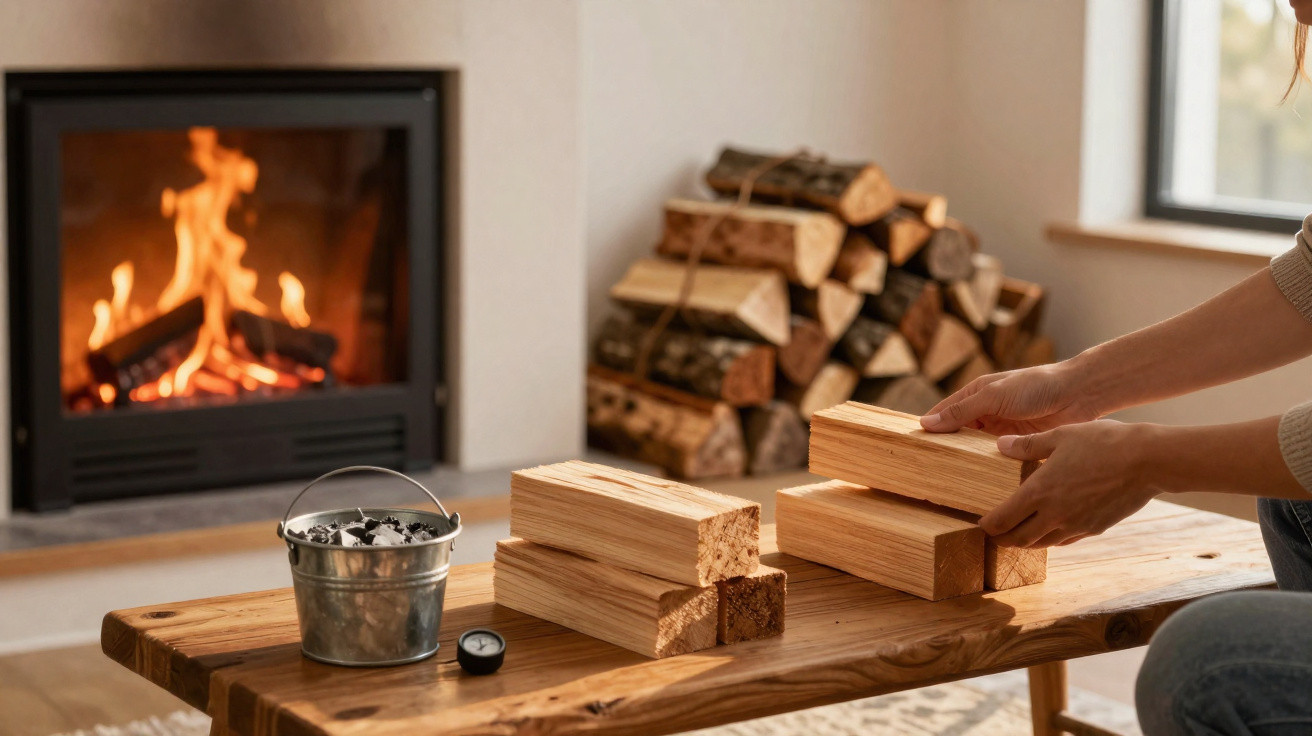
Moisture content is just as important as the species of wood. Only seasoned timber with a residual moisture level below 20 per cent burns cleanly and efficiently.
Climate and personal preferences
Consumption will naturally be higher in snowy areas with long, cold winters than in milder regions. Personal comfort expectations also matter: some people are content at 19 degrees, while others only turn the stove down at 23 degrees.
How many stacked cubic metres does a household need each winter?
Broad guide figures can be drawn from the experience of energy advisers and stove installers. They are not a replacement for an individual calculation, but they offer a sound starting point.
Occasional use for a cosy atmosphere
Those who light their wood-burning stove mainly at weekends or on particularly unpleasant evenings usually remain within a very modest range.
- Occasional use: around 1 to 3 stacked cubic metres per heating season
This is enough for plenty of comfortable evenings by the fire without placing too much pressure on the budget.
Regular use as supplementary heating
Many households use a wood-burning stove to reduce demand on gas or electric heating. The stove then does much of the work in the living area, while the remaining rooms continue to be heated conventionally.
- Everyday supplementary heating: around 3 to 6 stacked cubic metres per winter
The precise requirement depends heavily on the insulation level and on how far the rest of the heating system is turned down.
Wood as the main heating source
If the stove or fireplace insert supplies all, or nearly all, of the home's living space, the quantities rise noticeably.
- Wood as the primary heat source: roughly 5 to 12 stacked cubic metres per season
A modern, well-insulated detached house will often manage with 5 to 7 stacked cubic metres. Older properties with poor refurbishment standards can quickly require 10 or more.
Practical ways to reduce firewood consumption
Following a few basic principles means using less fuel, doing less work and putting less strain on the appliance.
- Use dry logs: Only timber with low residual moisture burns cleanly. Depending on the species, freshly felled wood should be stored for at least two summers.
- Service the stove regularly: Remove ash, inspect seals and clean the glass – a well-maintained stove operates more efficiently.
- Have the chimney swept regularly: The required chimney-sweeping visit is not merely an obligation; it also improves draught and therefore combustion.
- Light the fire correctly: Lighting from the top with dry kindling reduces smoke and makes better use of the wood.
- Improve insulation: The top-floor ceiling or loft in particular often offers considerable potential for savings.
“Every additional centimetre of insulation saves firewood over the years – often more than many homeowners expect.”
Store firewood properly so it provides real heat
The way timber is stored affects its calorific value almost as much as the type of wood itself. Anyone who piles logs directly on damp ground and seals them tightly under plastic sheeting may face an unpleasant surprise when trying to light them.
The ideal storage location
- well ventilated, with good airflow
- protected from direct rain and snow
- slightly raised, for example on pallets, bricks or a slatted base
- open at the front or sides to allow air to circulate
A roof or cover is useful, whereas impermeable tarpaulins over the entire stack cause problems: they trap moisture and slow down drying.
Firewood demand: practical examples
Typical scenarios help put the likely quantities into perspective:
| House type | Stove use | Estimated requirement |
|---|---|---|
| Terraced house, 100 m², well insulated | Supplementary heating in the living area | approx. 3–4 stacked cubic metres |
| Detached house, 140 m², average insulation | Main heating with a central wood-burning stove | approx. 6–8 stacked cubic metres |
| Period property, 160 m², hardly refurbished | Wood as the main heat source | approx. 9–12 stacked cubic metres |
These figures will naturally vary. Anyone who ventilates frequently and for long periods, or constantly leaves windows on the latch, will burn significantly more wood.
What many people overlook when buying firewood
Ordering early will usually save both money and hassle. Prices rise sharply in autumn, and delivery times become longer as well. Buying in spring or summer often brings better terms and leaves enough time for further drying.
Keeping a small reserve is also sensible. Those who calculate their needs too tightly each year can find their store empty by the third cold spell. An extra half to one stacked cubic metre makes planning much less stressful.
It is also worth considering the combination of a modern heating system and a wood-burning stove. Many people deliberately use their stove during periods of high energy prices to ease demand on their central heating. Managed correctly, this can reduce costs without sacrificing comfort – by heating the living area with wood, for example, while keeping bedrooms at a moderate temperature through the central heating system.
For anyone new to the subject, a straightforward approach can help: allow for one to two stacked cubic metres more in the first season, record actual use and fine-tune the amount the following year. This gradually builds an accurate picture of your own firewood demand, keeping winter warm without panic orders during frost and snowstorms.




Comments
No comments yet. Be the first to comment!
Leave a Comment