
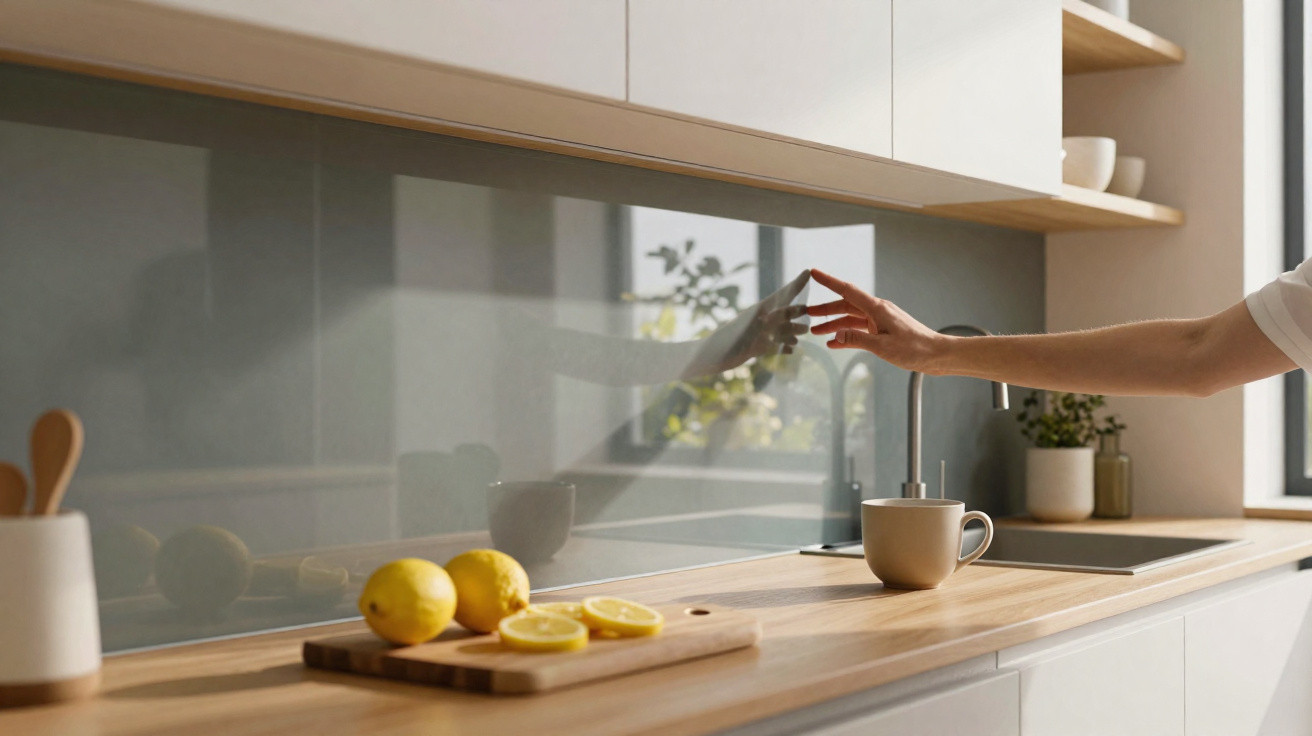
Anyone who thinks of dark, tinted glass in the kitchen may immediately picture the orange-brown fitted kitchens of the 1970s. Yet this material is now making an unexpected return: as an elegant, subtly reflective splashback behind the hob and worktop. Interior designers are embracing its revival, while traditionalists are shaking their heads. What makes the smoky glass kitchen splashback so desirable – and why does it provoke such strong reactions?
Why an old kitchen idea is returning now
As winter draws to a close, the days become longer, yet people are still spending plenty of time indoors, attention turns to the kitchen. White metro tiles can suddenly feel dull, while stainless steel may seem flat and cold. Many people want a change without replacing the entire kitchen. That is exactly where a tinted glass splashback comes in.
Only a few years ago, hardly anyone would have chosen this material willingly. It was considered dark, dated and awkwardly retro. The perception has shifted considerably since then. Glass manufacturers and kitchen studios now work with more refined tints, cleaner lines and higher-quality finishes. What was once seen as a “kitschy” relic has become a statement of intentional, long-lasting design.
“Smoky glass acts like a subtle filter: it has a touch of nostalgia, yet a distinctly modern attitude.”
The trend suits a time when many consumers no longer want to refit their homes completely every few years. Favourite pieces should last longer, and a kitchen should still look current after years of use. A new tinted glass splashback can transform an existing kitchen dramatically, without requiring new cabinets, worktops or appliances.
How the modern glass splashback differs from its 1970s predecessor
The changing trend becomes clear when looking at the new colour palette. Heavy brown has given way to sophisticated, softened shades:
- soft anthracite with a slight mirror effect
- warm bronze with a restrained golden shimmer
- deep black with transparency that still lets light through
These tones are easier to combine with other finishes and feel less overpowering. They can instantly update a rustic wooden kitchen or make an extremely minimalist white run of units feel softer and more inviting.
Price is another factor. Natural stone, intricately laid tiles and handmade ceramics can quickly push up the budget. A high-quality glass splashback, cut precisely to size, is considerably more affordable in many projects while still looking very premium.
How smoky glass uses light to make small kitchens feel larger
The key quality of tinted glass is not its colour but the way it handles light. Matt tiles tend to absorb illumination, while an ordinary mirror can feel too harsh and demand frequent cleaning; a lightly tinted glass splashback sits neatly between the two.
It bounces light around the room without creating glare. Daylight becomes gentler, and artificial lighting appears less stark. This is especially beneficial in compact kitchens, period properties or narrow galley kitchens: the surface behind the worktop seems deeper, almost like an additional space.
“Its semi-transparency creates the sense that the wall is receding slightly, which noticeably relieves cramped layouts.”
The material is also pleasingly practical in daily use. Water marks, grease splashes and fingerprints are far less visible on tinted glass than on clear glass or polished stainless steel. A wipe with glass cleaner is normally enough; for heavier dirt, a soft sponge with a little mild washing-up liquid will help.
Which materials work best with smoky glass
One reason for the success of new glass splashbacks is that they pair perfectly with the kitchen materials currently in demand. Rather than entirely smooth, high-gloss cabinet fronts, many manufacturers and customers are once again choosing natural finishes, visible grain and texture.
A strong pairing: glass and wood
Smoky glass is particularly popular alongside wood tones:
- lightly grey-tinted glass with light oak
- bronze-coloured glass with walnut or smoked oak
- almost-black smoky glass with black-stained wood
Wood adds warmth, whereas glass brings clarity and a hint of elegance. Particularly with handleless kitchen fronts, this combination looks understated but noticeably more upscale than a plain white tile.
Contrast with concrete, stone and ceramic
Those using concrete-effect finishes, plastered walls or natural stone often opt for highly matt, almost powdery surfaces. Glass introduces a point of shine without tipping the room towards a high-gloss kitchen look. The tint softens the glass, creating less of a mirror surface and more the impression of deep, gently reflective water.
Designers often advise keeping the rest of the kitchen relatively calm when fitting a dark glass splashback. Too many eye-catching accessories, shelves and decorative objects can diminish the surface’s impact. Two or three distinctive ceramic vases, or an attractive collection of wooden chopping boards, are usually enough to complete the look.
Why the trend divides opinion – and who it suits
Despite its advantages, this is a divisive design choice. Some people still find dark glass “retro”, while others dislike being able to faintly make out the wall behind it, depending on the tint. The association with bars, hotels or office kitchens is not positive for everyone either.
The splashback is particularly suited to people who:
- want to improve an existing kitchen without buying everything again
- enjoy cooking but do not want constant cleaning
- like clean lines and calm colour palettes
- nevertheless appreciate a certain lounge or bar-like character
By contrast, anyone who loves a highly decorative country-kitchen style with patterned wallpaper and open shelving is unlikely to be as happy with smoky glass. In that setting, textured tiles or ceramic wall tiles often feel more harmonious.
Practical considerations: safety, fitting and care
Technically, toughened safety glass or laminated safety glass is almost always used. The material withstands heat near the hob and, in the event of breakage, shatters into small, blunt pieces. Once measurements have been taken in the kitchen, the glass is generally cut at the factory, with edges polished and cut-outs for sockets prepared in advance.
Installation is usually carried out by fixing the glass directly to the surface with specialist adhesive, or by using rails. If you do not want to remove an existing tiled splashback, it is often possible to fit the glass straight in front of it. Tenants should ask their landlord whether this type of alteration is permitted. Some systems can even be removed later without leaving residue.
For everyday care, glass cleaner and a microfibre cloth are sufficient. Cream cleaners and abrasive sponges should be avoided, as they can scratch the surface over time. Harsh cleaners with a high alcohol content may damage the tint or any applied coatings.
What to consider carefully when choosing a colour
Brochure photographs often show perfectly lit display kitchens. Real homes look different. Before placing an order, it is worth requesting several sample panels and holding them against your own wall at different times of day. The most relevant questions are:
- How does the shade appear in daylight from north- or south-facing windows?
- How does the impression change under warm or cool LED lighting?
- How strongly does the surface reflect if windows or lights are opposite it?
Many people are surprised by how much lighter an initially “very dark” shade looks once it stretches across an entire wall and reflects light. Conversely, a bronze tone that is too pale can quickly appear busy if lots of wall units, handles or appliances are reflected in it.
Anyone unsure should choose a mid-grey shade. It works with white, black and wood-coloured kitchens without pushing itself visually into the foreground.
More than a passing craze: what the trend reveals about our kitchens
The return of smoky glass reveals how views of the kitchen are evolving. The kitchen has long ceased to be merely a workspace; it is part of the living room, the backdrop for video calls and the setting for everyday life. Materials once more commonly found in hotels or bars are now moving naturally into private homes.
Anyone planning a new kitchen today, or looking to improve an existing one, can create a striking effect with relatively little effort by using this type of glass splashback. Yes, the trend is polarising. But that is exactly what makes it interesting: it requires a clear design decision rather than simply choosing the nearest standard tile.






Comments
No comments yet. Be the first to comment!
Leave a Comment