
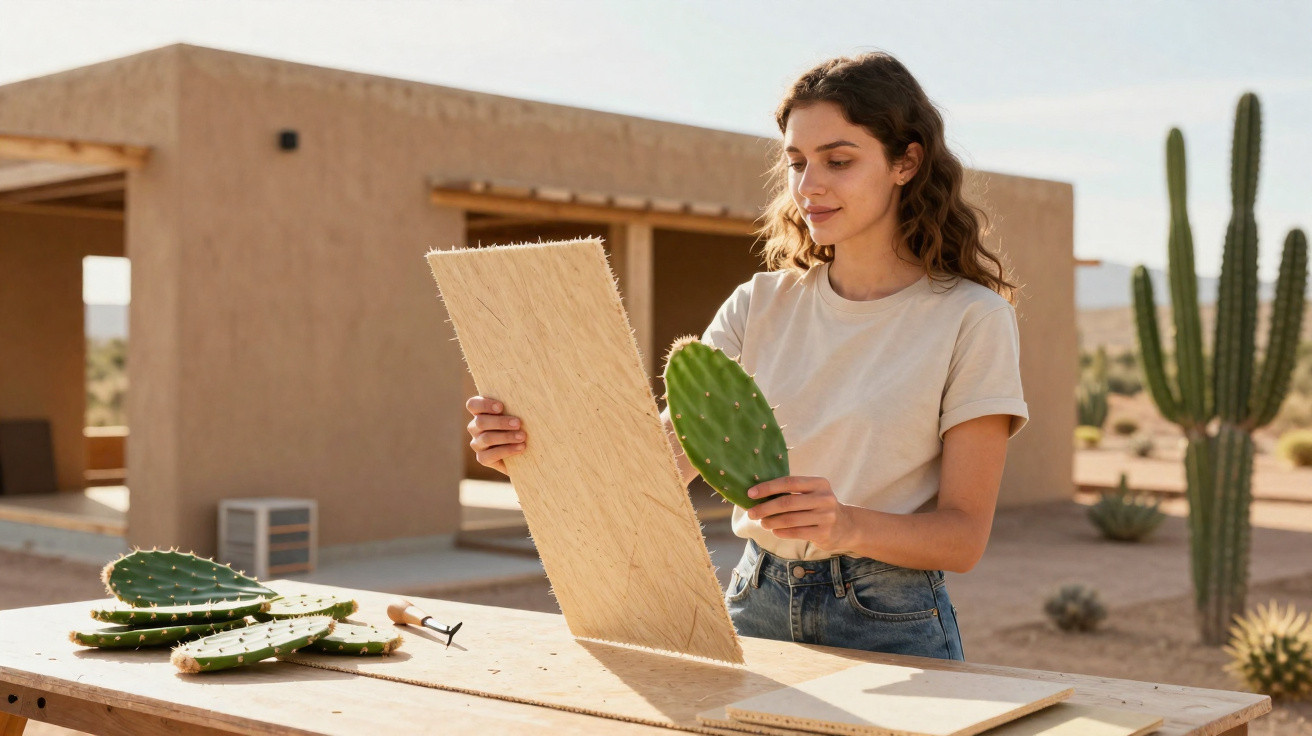
Construction sites are not places most people would associate with cactus plants. Yet engineers believe waste left over from prickly pear cactus cultivation may provide a cleaner, more affordable route to producing building materials.
The concept might initially seem unexpected, but it addresses a genuine challenge for the construction sector.
A great many modern building materials are both light and hard-wearing, qualities that have made them extremely common.
Their manufacture, however, consumes substantial energy, while recycling them once they reach the end of their useful life is frequently challenging. Much of this waste can also remain in the environment for decades.
Turning cactus waste into construction material
Scientists are investigating plant-based materials that could fulfil similar roles with less pollution. Their most recent area of interest is agricultural waste produced by prickly pear cactus plants.
Within the cactus pads is an interconnected network of natural fibres that already serves a vital purpose in the wild. These fibres help the plant remain upright and withstand powerful winds in arid environments.
The researchers think these same structures may be able to strengthen construction products in the future.
The study's lead author, Matt Hutchins, is an expert in the Department of Mechanical Engineering at the University of Bath.
“Inside the flat cactus pads is a naturally occurring fiber network. These fibers form a honeycomb-like structure that helps the plant support its own weight and resists bending in strong winds,” said Hutchins.
“We’re exploring how to extract these structures and keep them intact, borrowing their natural properties to reinforce bio-based composites.”
Why cactus waste matters
Natural fibres have long been explored in engineering. Researchers have already tested flax, hemp and other plants as substitutes for synthetic materials.
However, cultivating these crops still needs agricultural land, water, pesticides and fertilisers. Making use of discarded cactus material offers a different proposition.
Prickly pear cactus, scientifically called Opuntia ficus-indica, grows quickly and flourishes in hot, dry areas where numerous other crops find it difficult to survive.
During food production, or when preventing the plants from spreading too widely, farmers commonly prune or remove considerable quantities of cactus material. This waste generally has little worth.
Sustainable cactus materials for construction
As conditions in many areas of the world grow hotter and drier, prickly pear cactus is also likely to extend into additional regions.
This could result in an even greater quantity of unused plant waste.
“Although the benefits of sustainable, bio-based materials are well-known, their use in construction is still limited,” said Dr. Fulvio Pinto, who leads the international collaboration behind the project.
“We hope that by incorporating regionally sourced or culturally significant plants, we can not only reduce embodied carbon in building materials but also increase the adoption of natural materials in civil applications.”
Extracting strong fibres from cactus
Converting cactus waste into a useful product involves more than cutting open a cactus pad and blending it with plastic.
First, the team needed to establish how the fibres could be removed without damaging the honeycomb structure that gives them their strength.
They evaluated two extraction techniques. The first was water retting, a method that people have used with flax for centuries.
The plant matter is left in water for several weeks, allowing the softer tissue to gradually break down and leave the fibres behind.
Optimising the extraction process
The alternative technique used varying water pressure to remove the softer material far more rapidly. It reduced processing time by about 90 percent, although speed was not the only consideration.
The slower water-retting method created cleaner, stronger fibres, with fewer residual materials that might reduce the finished product's strength.
The researchers also discovered that older cactus pads were more suitable than younger pads, as their fibres were stronger and simpler to separate.
This is important because the final composite's strength relies heavily on the fibres staying intact throughout processing.
Potential everyday applications
The findings surprised the researchers when they combined cactus fibres with plastics. The resulting material was stiffer and stronger than either component on its own, particularly when bent or subjected to light impacts.
These composites still cannot rival carbon fibre in high-stress applications. They are not intended for aircraft components or heavy structural supports.
Nevertheless, they could be well suited to numerous everyday applications in which affordability and low environmental impact are more important than exceptional strength.
Potential uses include lightweight wall panels, cladding, vehicle interior components and sports equipment, including surfboard cores.
A material with visual appeal
The material also has aesthetic value, according to the researchers, because the cactus's natural honeycomb pattern remains apparent after processing.
“Beyond the mechanical stiffness, these composites are quite aesthetically pleasing, with the natural honeycomb structure of the cactus still visible in the final product,” said Omar Elhawary, who is studying the material’s tensile and flexural performance.
“The visual appeal of the research has already captured public attention; an image of the cactus-reinforced composite was showcased outside Bath Spa train station last November as part of the University’s ‘Images of Research’ competition, highlighting the intersection of engineering and sustainable art.”
The move towards greener construction
Construction accounts for a significant proportion of worldwide carbon emissions. A large share results not only from running buildings, but from manufacturing the materials used to construct them. Engineers refer to this as embodied carbon.
This has led scientists around the world to seek alternatives produced from renewable resources or waste materials.
Among the options being investigated are mushroom-based insulation, bamboo structures, recycled plastics and plant fibres.
Cactus composites form part of this broader shift.
Future research directions
The team intends to continue evaluating how effectively cactus fibres bond with construction polymers, as well as how the materials behave when stretched or bent under pressure.
They are also examining manufacturing approaches that may ultimately be viable at industrial scale.
Should the technology prove successful, future buildings could discreetly incorporate components made from a plant that many people link more readily with deserts than engineering laboratories.
The project forms part of a wider research programme associated with the Centre for Regenerative Design & Engineering for a Net Positive World and the University of Catania in Sicily.
The complete study appeared in the Journal of Natural Fibers.




Comments
No comments yet. Be the first to comment!
Leave a Comment