
When a favourite orchid drops every flower, many frustrated owners reach for the bin.
Yet an unassuming yellow kitchen leftover could offer a way to rescue it.
A bare stem on the windowsill, wrinkled leaves and tired-looking growing medium: this is how many Phalaenopsis orchids meet their end in German homes. Before discarding the plant, amateur gardeners swear by a surprising method: cooked maize used as a gentle fertiliser intended to revive the roots. Although it may sound like an internet myth, it has reportedly worked surprisingly often in practice.
Before using maize: is the orchid really beyond saving?
The first step before attempting any rescue is to assess the plant honestly. Many orchids appear dead when they are simply resting.
A transparent pot makes this much easier. Roots should be green or silvery grey, firm and free from odour. They may look dry, but they must not feel mushy. A dry brown flower spike is not automatically a bad sign; the plant itself may still be healthy.
Green or silvery-grey, firm roots mean: the orchid is alive. Brown, soft, foul-smelling roots indicate genuine rot.
If the root system looks brown, translucent and spongy, or gives off a rotten smell, a kitchen remedy will no longer be enough. The orchid then needs a more radical fresh start:
- remove old, rotten roots with clean scissors
- use fresh, coarse orchid growing medium, such as bark with a little sphagnum moss, rather than an ordinary compost mix
- choose a pot with effective drainage and never leave water standing in the decorative outer pot
- place it somewhere bright but away from direct midday sun, such as an east- or west-facing window
A gentle day-to-night temperature difference of around 4 to 6 degrees can also help. This mimics tropical conditions and encourages many Phalaenopsis varieties to produce new flowers.
What cooked maize actually does in an orchid pot
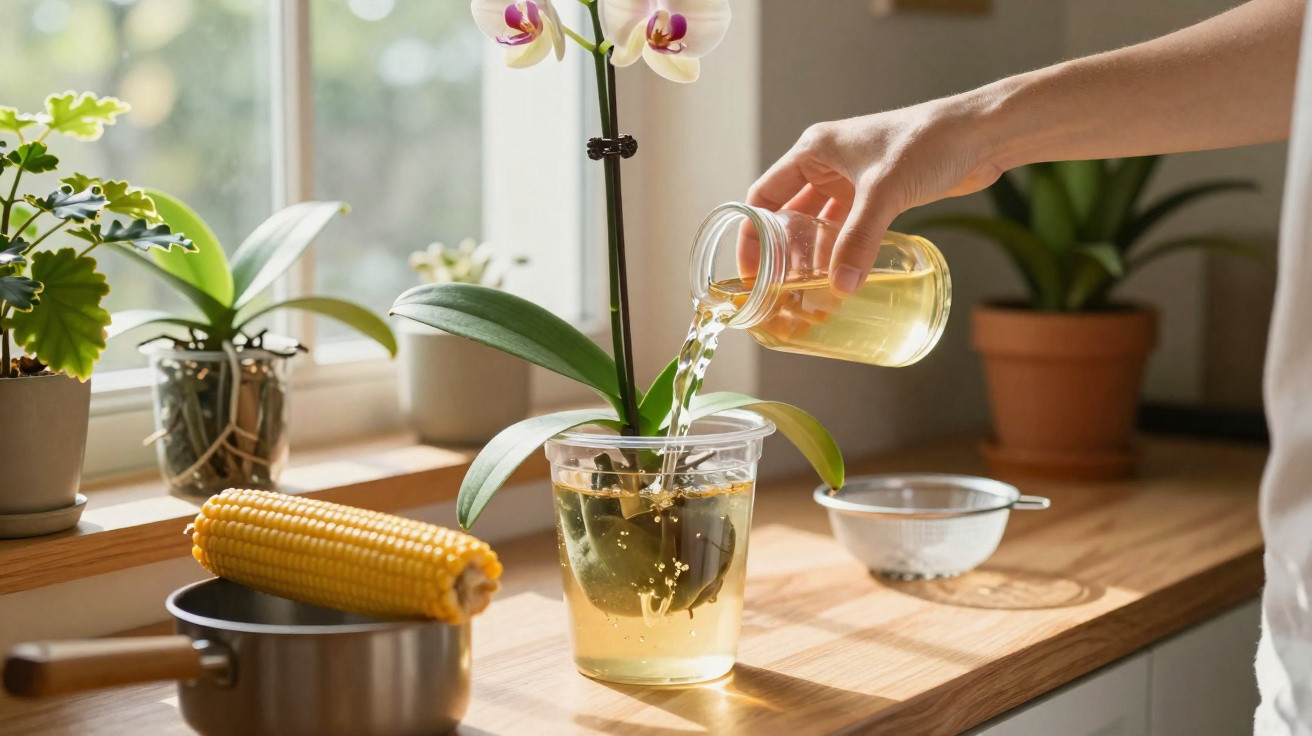
The maize method has been appearing repeatedly in amateur gardening forums and on social media for some time. The principle is that cooked maize becomes a mild liquid fertiliser which feeds not so much the orchid itself as the microorganisms in its growing medium.
As maize breaks down, its starch and sugars provide food for bacteria and fungi already living in the pot. This microfauna loosens the growing medium, processes nutrients already present and may stimulate root growth. Many gardeners report stronger roots and firmer leaves after several weeks.
Laboratory studies are lacking, but numerous personal reports suggest that the maize brew is not a miracle cure, but a gentle booster for weakened orchids.
Importantly, this method is not a replacement for proper cultivation. Anyone who overwaters, keeps the plant in dim conditions or grows it in dense compost is unlikely to achieve much even with maize. The yellow brew works only as a small extra when the light, temperature and growing medium are right.
Turning maize into a gentle liquid fertiliser
No complicated ingredients are needed for the preparation. Many people simply use leftover unsalted maize from the kitchen.
Basic recipe for maize brew
- Allow around 100 grams of cooked maize, without salt or seasoning, to cool.
- Blend it thoroughly with 1 litre of water.
- Filter the liquid extremely well through a fine sieve or coffee filter.
- Let it cool completely.
The more thoroughly it is filtered, the lower the risk of residues clogging the pot or beginning to go mouldy. If you want no solid particles in the brew at all, pour it through a second filter.
Alternatively, use the unsalted cooking water from corn on the cob. Let this cool as well, then pass it through a very fine sieve or filter. The brew keeps for no more than 24 to 48 hours in the fridge. Once it smells sour, pour it down the drain.
The best time: make a small batch of brew immediately after cooking maize and use it within a day.
Using maize brew safely: how often, how much and when to stop
As with many home remedies, the dosage determines whether this technique helps or harms. Maize brew is a micro-dose treatment, not a substitute for watering with a watering can.
Recommended application steps
- Moisten the orchid's growing medium as usual, for example with low-limescale water.
- Add 1 to 2 teaspoons of maize brew directly to the already damp growing medium.
- Allow the pot to drain briefly, ensuring that no water remains in the outer pot.
- Repeat the treatment every 3 to 4 weeks - no more often.
Applying it this way prevents the growing medium from becoming clogged or excessively wet. Anyone who mistakes the liquid for their usual watering amount risks achieving exactly the opposite of what they intended: rotting roots.
| Application | What is sensible | What causes problems |
|---|---|---|
| Amount | 1–2 teaspoons on damp growing medium | pouring an entire cup into the pot |
| Frequency | every 3–4 weeks | every week or with every watering |
| Water | no salt, no seasoning | salty water or heavily seasoned cooking liquid |
| Combination | do not mix with other home remedies | using it alongside rice water, coffee grounds or banana skins |
Stop immediately if the growing medium feels sticky or smells slightly sour. In that case, flush the pot thoroughly with water to rinse away excess residues. If the unpleasant smell persists, repotting is the only solution.
When to expect early results from cooked maize - and what to watch for
Patience remains the most important “fertiliser” for orchids. After two to three weeks, amateur gardeners report the first encouraging signs: root tips turn fresh green, finer new roots emerge around the edge of the pot and soft leaves become slightly firmer.
The hoped-for flower spike takes longer to appear. Depending on the plant's starting condition and the season, it may take several weeks or even a few months before a new flowering stem becomes visible. Anyone who keeps the plant permanently too dark is unlikely to see buds despite using maize.
Maize brew can only strengthen what the plant is already capable of doing. Light, air and an airy growing medium are the real keys to abundant flowers.
Once the orchid is growing steadily again, it is worth returning to straightforward care: moderate watering, orchid-suitable growing medium and, where necessary, a mild commercial liquid fertiliser for flowering plants at a heavily diluted strength. The maize method is better regarded as a temporary recovery treatment than a permanent solution.
Common orchid care mistakes that the maize method cannot fix
Many issues begin long before fertiliser or home remedies become a consideration. Three recurring mistakes appear in almost every household:
- Constantly wet roots: an outer pot full of water, no drainage and watering far too frequently. The result is rot, regardless of any rescue attempt.
- A location that is too dark: a shelf deep inside the room or a north-facing window behind curtains. The plant survives but produces few, if any, flowers.
- The wrong growing medium: ordinary compost with no air spaces. The roots effectively suffocate.
Cooked maize cannot compensate for these mistakes. Anyone hoping to keep an orchid healthy in the long term should correct these points first. Only then does experimenting with the yellow brew make sense.
When an orchid rescue attempt is worthwhile - and when it is not
Once every root is mushy, the stem has become soft and the leaves turn black or translucent, the plant usually has no reserves left. In such cases, cutting everything back to the last firm sections is often futile. Unfortunately, no kitchen idea can help then either.
The situation is different if a few firm, pale roots remain or the centre of the plant is still hard and green. In that case, a combination of repotting, a better position and a sparing maize treatment can be worthwhile. Many readers report unexpected recoveries in precisely these circumstances, sometimes with several strong flower spikes the following year.
Why home remedies for houseplants are popular - and where their limits lie
Whether it is rice water, coffee grounds or now cooked maize, people enjoy trying items that would otherwise be left over in the household. It saves money, reduces waste and appeals to the urge to experiment. With orchids, which many people treasure, the desire to help them with simple measures is especially understandable.
Even so, such methods should never replace sound basic care. Orchids react sensitively to waterlogging, salt and heavy fertiliser applications. Home remedies are difficult to measure precisely and can easily be overused. It is far safer to view maize brew as a mild addition rather than a miracle weapon.
A practical approach is to check the growing conditions first, then experiment carefully and observe every change in the plant closely. Keeping a record of the quantities and intervals used helps you understand how your orchid responds and assess the little yellow helper more realistically.


Comments
No comments yet. Be the first to comment!
Leave a Comment