
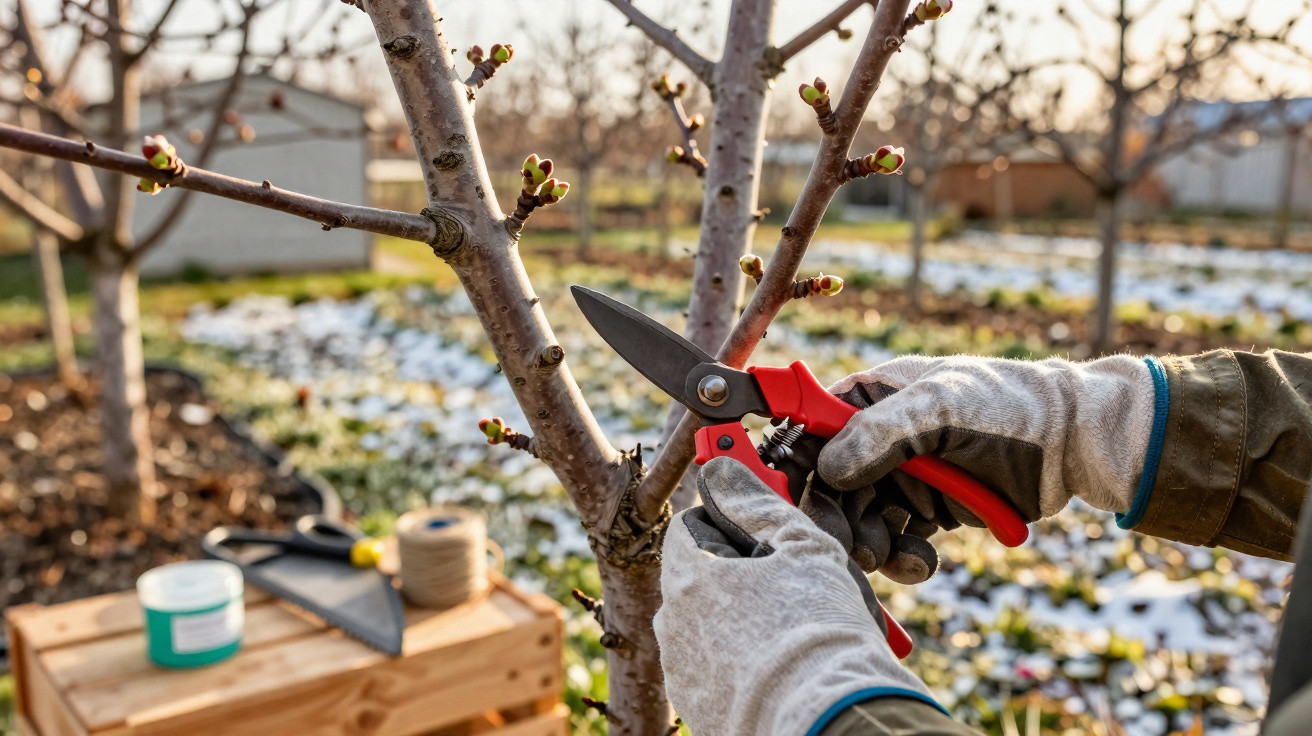
Many amateur gardeners sit back in late winter, convinced that there is nothing to do in the orchard in February. That assumption can seriously limit the harvest. Anyone hoping for crisp eating apples, fragrant apple cake or a store of home-made apple purée in the months ahead should act before spring begins – with one particular type of apple tree pruning.
Why February determines your apple harvest
In February, apple trees can look almost lifeless: there are no leaves or blossoms, only bare wood. Yet an important process is taking place inside them. The trees are dormant, with sap largely drawn back into the roots. This is precisely when they cope well with pruning, and when it can be used to improve the crop.
It is the ideal time for the so-called fruit-pruning cutback. Its purpose is straightforward: reduce unnecessary wood and encourage more flower buds. Those who wait until March or April, when sap has already started rising, place considerably more stress on the tree and may lose some of the blossom.
“Pruning apple trees deliberately in February directs the tree’s energy away from producing wood and straight into flowers and fruit.”
When carried out correctly, winter pruning allows the tree to enter spring with a balanced branch framework and plenty of productive buds. The results become visible months later: more apples, larger fruit and fewer diseased areas.
Tools and careful assessment: preparation is essential for a good cut
Preparation comes before any branch is removed. Blunt or dirty tools cause needless damage to the tree and give fungi and bacteria an easy way in.
Essential equipment for pruning an apple tree
- Bypass secateurs for thinner shoots and accurate cuts.
- Loppers for thicker branches that require more force.
- A pruning saw for old, substantial branches that secateurs cannot handle.
- Alcohol or disinfectant to clean the blades between different trees.
Clean blades reduce the risk of carrying fungal spores or bacteria from one tree to another. A quick wipe with alcohol before moving on is enough.
Reading the tree: inspect first, prune afterwards
It is worth walking around the tree once before starting. Standing back makes its overall shape far easier to judge. The aim is an open, light-filled canopy that lets sunlight reach the centre in summer.
Pay particular attention to the following:
- Branches that cross over and rub against one another.
- Shoots growing sharply upwards, known as watershoots or “gourmets”.
- Branches growing inwards and crowding the middle of the canopy.
- Bent, dead or visibly diseased sections.
Anything that creates rubbing, shade or pockets of damp weakens the tree and encourages disease. These branches should be at the top of the pruning list.
The key apple tree pruning technique: directing energy towards fruit
Fruit pruning is not about thinning the tree as heavily as possible; it is about making informed selections. The tree should retain a strong structure while putting less energy into unproductive extension growth.
The three-bud rule, step by step
Even beginners can work methodically with this simple approach:
- Find a side shoot growing out from a stronger branch.
- Starting at the base of that shoot, count three buds, known technically as “eyes”.
- Position the secateurs just above the third bud.
- Make sure the third bud points outwards, away from the centre of the canopy.
This leaves three well-supplied buds that can develop into productive short shoots. Keeping the final bud facing outwards also helps the canopy become broader and more open rather than overly dense.
“Fewer buds in the right positions are more valuable for the harvest than numerous weak shoots growing in shade.”
How much can be removed – and when should you stop?
Excessive caution is a common mistake: if you cut very little out of fear, the result may be a bushy tree with only a small number of undersized apples. The opposite extreme is equally problematic. Cutting everything back severely causes the tree to produce masses of watershoots, invest in wood again rather than fruit, and yield very little.
As a rough guide, it is acceptable to remove a good third of the shoots from a neglected tree at first, but this should be spread over several years. Each winter, it is better to build the structure up gradually than to strip the tree bare in one operation.
Correct cutting technique: small details, major results
Whether a cut heals cleanly or becomes a site of disease depends greatly on how it is made.
- Always cut at an angle: The cut should slope gently away from the bud that remains.
- Do not leave a stub: Cut immediately above the bud, without leaving several millimetres of wood above it.
- Avoid crushing: If the secateurs crush the wood, they are too blunt or the branch is too thick.
An angled cut lets rainwater run off rather than collect on the bud. Damp directly around a bud provides an ideal breeding ground for fungal infection.
Wound sealing, hygiene and patience after pruning
Once the pruning itself is complete, attention turns to protection and care. Larger cut surfaces from around two to three centimetres in diameter can allow rot-causing organisms to enter. In these cases, a wound sealant, such as one based on tree resin or clay, can help.
Apply the wound sealant sparingly over the fresh cut surface. This slows excessive drying, reduces cracking in the wood and makes it harder for fungal spores to establish themselves.
Then comes a final task that is often overlooked: clearing away the prunings. Diseased material should not be left near the tree but disposed of separately. Healthy branches can be shredded and either composted or used as mulch.
“Clearing up after pruning prevents old sources of disease surviving in the soil and infecting the tree again the following year.”
How to recognise an apple tree ready to flower
After one or two weeks, the tree will still appear bare, but the groundwork has been laid. Over the course of spring, clearly visible flower buds will form on the remaining shoots. They are generally thicker and rounder than the narrow leaf buds.
A properly pruned tree has:
- a clear basic framework with a small number of strong main branches;
- plenty of short side shoots carrying thick buds;
- an open canopy through which light and air can pass.
With older trees, two or three years of regular winter pruning may be needed before the full effect becomes apparent. Those who keep at it will notice a clear difference: the trees crop more evenly and are less likely to fall into typical “alternate-bearing years” with sharply fluctuating yields.
Tips for different garden situations
Small garden, large tree: keeping it under control
In many home gardens, an apple tree quickly becomes too tall. Reaching both the fruit and the branches then becomes difficult. Over several years, the highest shoots can be brought down gradually. Rather than brutally topping a thick upper stem, redirect a few of the top branches each year onto lower-growing side shoots.
This keeps the tree vigorous while giving it a more compact shape that is easier to harvest and maintain.
Giving young trees the right start
For newly planted young apple trees, pruning serves a different purpose: it establishes the future basic framework. Usually, three or four well-spaced main branches are retained, arranged around the trunk. Shorten all other shoots substantially or remove them completely.
A structured approach during the first few years avoids many later corrections to a poorly formed tree.
Risks, mistakes and how to avoid them
The greatest risk is being overly determined. Removing almost every major branch from an ageing tree in one winter triggers a kind of emergency response: during summer, the tree produces an extreme number of upright watershoots but very few flowers. It is better to rejuvenate the tree in stages, replacing only some of the old branches each year.
Another difficulty is uncertainty when identifying buds. Fruit buds look thicker and more rounded, while leaf buds are pointed and flat. Comparing them directly on the tree is enormously helpful. Once you know the difference, you can encourage the shoots that will genuinely bear apples.
As a rule of thumb, carefully planned and targeted cuts in February are preferable to rushed work just before flowering. The tree responds more calmly, pruning wounds heal better and the autumn basket is fuller.
Comments
No comments yet. Be the first to comment!
Leave a Comment