
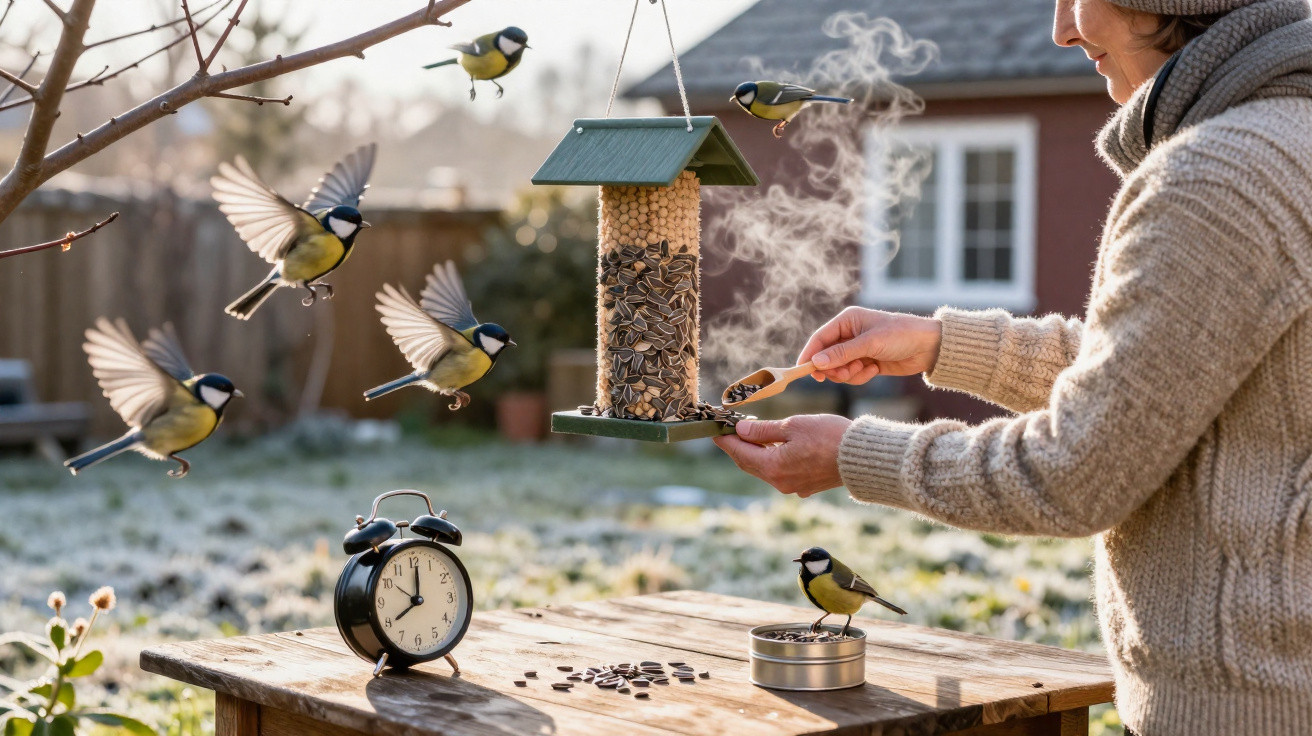
When you look out of the window in winter, there may seem to be nothing but bare branches and a grey sky. Then, as though responding to an unseen cue, tiny colourful birds suddenly appear, dart to the feeding station, vanish again – and return at precisely the same time the following day.
Why your garden suddenly comes alive in winter
Great tits, blue tits and coal tits bring colour to dull January days. Their blue-and-yellow plumage, rapid flight and crisp, brief calls are immediately noticeable when they arrive in the garden. Many people wonder why they see no tits at all on certain days, while on others a small flock seems to fill the shrubs.
Although this may look random, it follows a clear pattern. Tits are not impulsive creatures: they organise their day with surprising precision. Understanding this sense of timing can help you encourage their visits without taming them or making them dependent.
Tits do not arrive in the garden “at some point” in winter; they usually come at a highly consistent time of day that they have learned.
Neither in the middle of the night nor late in the morning
Many people put out food whenever it occurs to them – perhaps at lunchtime one day, in the afternoon the next, and not at all on another. This random approach is of little use to tits. Cold, long nights mean they must account carefully for every calorie. A dependable feeding time saves valuable energy.
In winter, the most favourable period is shortly before sunrise or right at sunrise. It should not be during the deepest pre-dawn darkness, but neither should it be as late as ten or eleven o'clock, when much of the day has already passed.
The ideal “pass-through time” in the garden during winter is shortly before or exactly at sunrise – very early, then, but not in the middle of the night or late in the morning.
How tits remember your feeding time
Putting food out at the same time each morning triggers something interesting in a tit's mind. It links the light levels, temperature and sounds in the surroundings – as well as your appearance at the feeding spot – into a kind of internal clock.
- At first, they may happen to visit for several days.
- They recognise that food is reliably available at this particular time.
- They then plan their route so that they fly to your garden at exactly that point.
- Their visiting time often settles to within a few minutes.
If the pattern remains unchanged for weeks, your garden becomes part of the flock's regular “morning round”. If you keep changing the time, the location becomes less appealing because the birds cannot judge whether the journey will be worthwhile.
Consistency matters more than quantity
Many amateur gardeners focus on one question: how much food do birds need? The more important consideration, however, is how predictable that food is.
A modest daily portion put out shortly before or at sunrise is often more effective than occasional large amounts. Tits do not want to wait around and check whether food might be there. They favour places where the effort involved is predictable.
For tits, a reliable feeding time matters more than the amount of food – they are optimising their daily routine, not simply filling their stomachs.
What happens when feeding is irregular?
Putting food out at seven one day and nine the next, forgetting for two days, then feeding in the afternoon sends conflicting messages. Tits quickly learn that this is not worth making a regular stop. They will either fail to include your garden permanently in their route or remove it from the route again.
If you are away for a longer period, arrange for someone else to take over. Usually, a neighbour who broadly keeps to the same time is enough. For the bird, the important message is: “There is food here in the morning, when it gets light.” A difference of 15 to 30 minutes will not immediately disrupt the pattern.
The right food for frosty mornings
Timing alone is not enough. In winter, tits primarily need energy rather than light snacks. The colder the night, the greater their calorie requirement. They use up reserves overnight to avoid becoming chilled, so those stores need replenishing quickly in the morning.
| Food type | Suitable for tits? | Winter benefit |
|---|---|---|
| Black sunflower seeds | Yes | High fat content and easy to crack open |
| Fat balls or tit balls without nets | Yes | Concentrated energy, useful after very cold nights |
| Oats mixed with a little fat | Limited | A supplement if nothing else is available |
| Rice, bread, salty snacks | No | Too low in nutrients and sometimes harmful |
Black sunflower seeds are considered a classic choice because they contain plenty of fat and tits can use them very efficiently. Offer fat balls without plastic nets so that birds cannot become entangled. A feeder or holder made from metal or wood is a better option.
A garden as a peaceful refuge, not a cage
Anyone who feeds birds has a responsibility. The aim should remain a lively garden, not a “trained” one. Tits should continue to forage independently and remain free. Many native bird species, including tits, are legally protected. Catching them, attempting to make them tame or encouraging them to become accustomed to people is harmful.
A good winter garden provides a helping hand and safety, but does not force animals into dependency.
The best conditions come from combining food, cover and calm:
- dense hedges or shrubs that provide protection from birds of prey
- untidy corners with old grass or dead wood, where insects can survive
- no constant noise from loud music or frequent fireworks
- avoiding chemical pesticides
This creates a small habitat around the regular feeding time, where tits can do more than briefly land: they can also rest and preen between visits.
How long the routine remains worthwhile
The intensive feeding period does not need to continue throughout the year. Natural food sources, such as insects and spiders, increase in late winter and spring. Many experts recommend continuing regular high-fat food until around March, while frosty spells are still common.
Gradually reducing the amount of food afterwards encourages birds to make greater use of their own sources again. The learned morning pass-through time will then slowly disappear. Some people may find that disappointing, but it supports the birds' long-term health.
What the “pass-through time” really means
The phrase may sound technical, but it simply describes the moment when a group of birds incorporates a particular garden into its route. Tits generally follow set routes: a hedge by the car park, a row of trees on the neighbouring property, your feeding station, then the next garden. Their internal clock aligns this sequence with daylight.
Imagine a small example: it becomes light at 7:45 am, and you bring out food at 8:00 am every day. After a few days, the tits are already waiting in the branches of your apple tree at 7:55 am. If you suddenly do not arrive until 9:15 am, they may fly on because their schedule no longer fits the routine. After several disruptions like this, they will “remove” your garden from their route.
Practical example: what a successful routine could look like
Suppose you have to leave home at 7:30 am on weekdays. A straightforward winter strategy could look like this:
- Weekdays: put out food every day between 7:00 and 7:10 am.
- Weekends: do not ignore the alarm; get up briefly, top up the food at a similar time, then go back to bed.
- When away: ask a neighbour to feed the birds “in the morning, when it gets light”; it is better to be slightly early than significantly late.
- Food type: black sunflower seeds in a feeder, plus two to three fat balls without nets during frosty periods.
With such a simple, realistic routine, a previously quiet winter garden can quickly become a regular stopping point for tits – not in the deepest darkness or only towards late morning, but early in the day, at a time the birds can rely on.

Comments
No comments yet. Be the first to comment!
Leave a Comment