
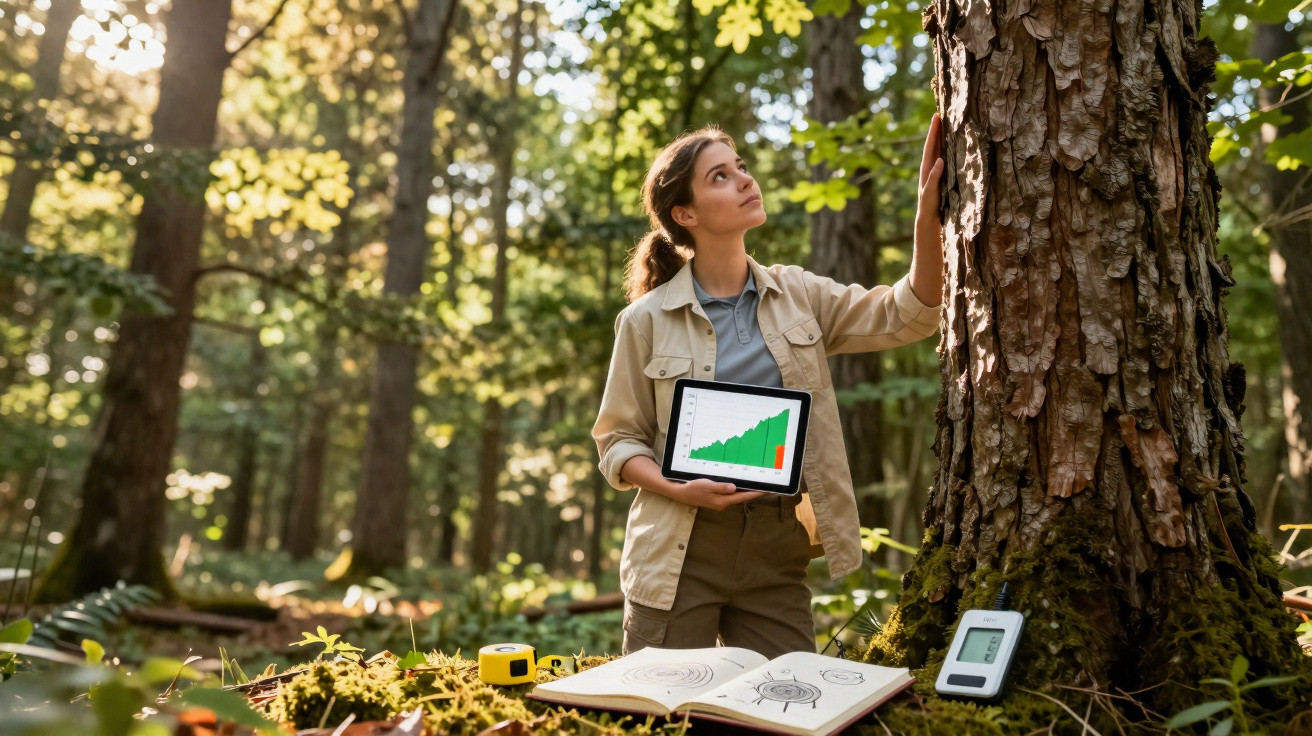
Plants take in carbon dioxide and water, harness sunlight to produce sugars, and emit oxygen. It might therefore seem logical that higher concentrations of carbon dioxide in the atmosphere would make forests grow more quickly, lock away additional carbon and help cool the planet.
Although plausible and widely repeated, that idea has not been borne out by long-running measurements from real forests.
While atmospheric CO2 has risen, tree growth and long-term carbon storage have varied between modest increases, no change and, at times, declines.
Scientists are therefore asking how much of this uneven pattern is genuinely driven by carbon in the atmosphere, and how much results from other influences.
A new view of a biological puzzle
A study led by researchers at Duke University and Wuhan University contends that carbon alone cannot answer these questions: water must also be considered.
The researchers developed a model that views a tree’s daily choice - whether to open leaf pores to take in carbon or shut them to retain water - as a dynamic optimisation problem.
This engineering-inspired approach can replicate observations collected over decades and helps explain why forest growth does not simply rise in step with CO2.
“There used to be a common assumption that higher levels of carbon dioxide will cause trees to grow more and store more carbon,” said Gaby Katul, a professor of civil and environmental engineering at Duke.
“But benchmark experiments showed that while this may be true in isolation, other environmental factors also play a large role. We have now uncovered some of the underlying mechanisms at work.”
Insights from two long-running experiments
The benchmarks cited are drawn from rare and laborious field experiments. One forest plot at Duke was exposed to additional CO2 for 16 years.
At ETH Zurich, meanwhile, scientists increased local humidity. Both locations measured growth, carbon absorption, leaf physiology and a wide range of environmental factors.
The findings were sobering. Trees captured far less additional carbon than earlier, simpler models had forecast. The unexpected aspect was not the outcome itself, but the reason behind it.
Rising CO2 and forest growth
To uncover the process involved, Katul’s group examined the valves behind a tree’s economy: stomata. These minute openings in leaves admit CO2, but they also allow water vapour to escape.
With more carbon in the air, stomata need not open as widely to acquire the same quantity of CO2. In principle, this should improve water-use efficiency and encourage growth.
However, warmer and drier conditions alter that balance. Hot, dry air increases evaporation through exposed pores. To safeguard their internal water-transport system, trees narrow these pores, reducing water loss but also, unavoidably, carbon uptake.
“Stomata are like valves that control how much water is drawn up into the leaves and released into the air,” Katul said.
This “valve” regulates a delicate conflict extending from roots and trunk to canopy. When water is lost too rapidly, the transport columns within the xylem can break like a straw - a threat that intensifies with tree height and heat stress.
Converting physiology into mathematics
The team’s model puts this compromise into formal terms: maximise carbon uptake while limiting water loss to safe levels. It was calibrated using exceptionally detailed data from the Duke and ETH Zurich sites.
At both sites, individual leaves were enclosed and subjected to carefully controlled changes in temperature, humidity and CO2 as researchers monitored stomatal responses in real time.
When used to project outcomes, the model succeeded in two respects. First, it reproduced the restrained carbon gains observed at Duke under higher CO2 levels.
Second, it reflected the humidity experiment’s result: in moist air, stomata can remain open for longer with lower hydraulic risk, enabling greater carbon uptake. Put simply, CO2 is important, but so is the atmosphere’s demand for water.
Uneven global records
With this mechanistic basis in place, the team examined a collection of tropical forest studies conducted over the past 50 years.
These records reveal puzzling variation: some plots became greener more rapidly, others showed almost no change, and some slowed down. Through the new framework, those apparent inconsistencies become less baffling.
Where temperatures and vapour pressure deficit - the air’s “drying power” - increased, trees shielded their water-transport systems by closing stomata more frequently. This reduced or entirely offset any CO2-related growth increase.
Where moisture moderated the heat, improvements were more likely to emerge.
This explanation does not suggest that carbon enrichment never increases growth. Instead, it indicates that the scale - and even the direction - of any increase depends on the local relationship between carbon availability and water demand.
These outcomes are controlled by microscopic leaf valves and the hydraulic systems supporting them.
More than one controlling factor
No single model can represent the full range of constraints affecting a forest. Nutrient shortages, soil-water storage, species composition, pests, changing seasons and stand age all influence growth and carbon storage.
The authors stress that their framework is a starting point rather than a final answer. It accounts for a major, persistent part of the problem - the connection between CO2 uptake and water loss - at the leaf-to-tree scale where these choices occur.
The next task is to incorporate these choices into regional and global climate models without erasing the dynamics that make a difference.
“There is a lot of value in looking at these environmental and biological questions from an engineering perspective,” Katul said.
“Figuring out how best to ameliorate climate change using nature-based green technology in the decades to come is going to take contributions from many disciplines.”
Forest growth as CO2 rises
The central message is not that forests cannot help, nor that CO2 fertilisation is a myth. Rather, nature’s response depends on conditions.
During hotter, drier periods, trees “choose” survival rather than rapid growth. They curb the very intake that could otherwise support faster growth.
For policymakers and modellers, this suggests caution about assuming that rising CO2 will automatically deliver greater forest growth.
It also supports more precise measures to protect the water side of the equation, including preserving soil moisture, reducing heat stress and easing other pressures that push trees into hydraulic triage.
Put briefly, more atmospheric carbon does not necessarily mean more carbon stored in wood. Between those outcomes sits a living system of valves, vessels and trade-offs, evolutionarily tuned to keep trees alive. To help forests store more carbon for us, we need to make them less thirsty.
The complete study was published in the journal Nature Climate Change.





Comments
No comments yet. Be the first to comment!
Leave a Comment