
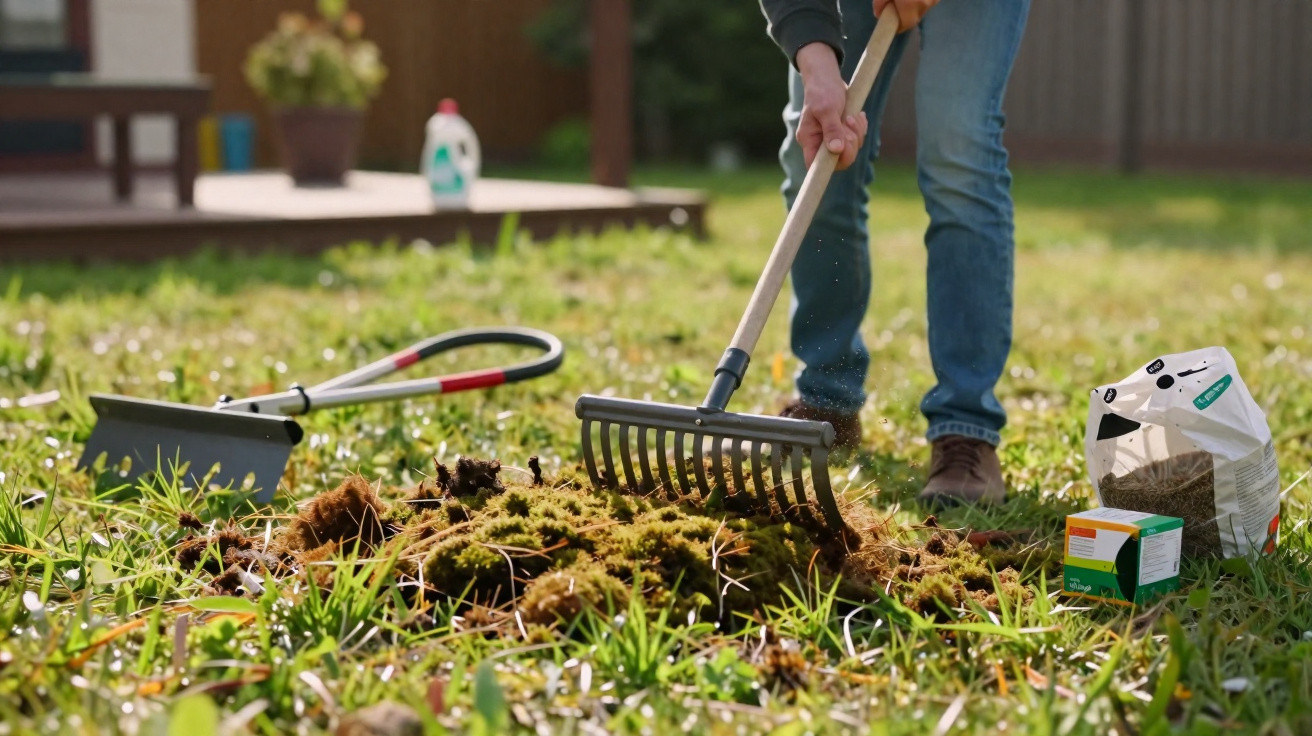
If the lawn takes on a suddenly dark-green sheen after winter, it is usually not the result of a dream lawn but a stubborn layer of moss.
Many amateur gardeners instinctively turn to household-remedy hacks found online – often causing more harm to the lawn than they would like. One supposedly clever solution in particular remains widespread, yet professionals regard it as a genuine no-go for healthy garden soil.
Why moss suddenly grows all over the lawn after winter
A few mild spring days reveal the true state of the lawn. Areas that were lush green in autumn may now be covered with dark, soft cushions. This is especially common beneath trees, beside hedges and in places that remain damp for longer.
The cause lies in winter itself. Cold, wet weather and limited light weaken the grass. Its growth slows and the turf becomes patchy. Moss establishes itself precisely in these gaps: it needs very few nutrients, tolerates shade and thrives in wet, compacted soil.
Soil scientists and garden specialists have stressed for years that grass struggles where soil is poorly aerated, low in nutrients or heavily compacted. Moss consistently takes advantage of these weaknesses.
“Moss is not the cause of the problem, but a symptom of a stressed lawn and weakened soil.”
Simply removing the green cushions without tackling their causes therefore means facing the same issue every spring.
The risky online tip: why washing-up liquid has no place on a lawn
The same recommendation repeatedly appears in forums and videos: dissolve a little washing-up liquid in water and pour it over affected patches, whereupon the moss is supposedly meant to disappear by itself. It sounds straightforward, inexpensive and convenient.
That is exactly where the problem begins. Washing-up liquid was designed for greasy plates, not living soil. Its surfactants can attack not only the moss cushions but also the grass’s fine roots.
Horticulture and landscape-care professionals warn that products like these can disrupt soil life. Microorganisms that break down plant matter and make nutrients available are sensitive to chemical additives from household products.
Regularly tipping washing-up water over the lawn can lead to:
- weakened grass roots
- disrupted soil organisms
- poorer soil structure
- substances leaching into groundwater
Environmental authorities also point out that household products used for purposes they were not intended for can easily enter soil and water in the garden. What seems like a clever shortcut can prove costly in the end: the grass recovers less effectively, while moss benefits from the open ground.
“The quick washing-up liquid trick may save time, but in the long term it costs lawn health and soil quality.”
The simple professional approach: mechanical rather than chemical
The good news is that conventional, proven measures are fully sufficient for many gardens – without any specialist chemicals. The process is essentially straightforward and can be completed on a dry spring day.
Step 1: Mow it properly short
At the start of spring, the lawn can be cut slightly shorter once than it would be in summer. This makes moss cushions and layers of thatch easier to see, allowing the following treatment to work much more effectively.
Step 2: Rake through thoroughly
After mowing, it is worth raking vigorously with a sturdy lawn rake. This loosens many moss patches and dead plant remains. Spending a little time on the task can already noticeably reduce the green layer of thatch.
Step 3: Scarify persistent moss
Where moss and lawn thatch have become deeply established, scarifying is almost unavoidable. The machine cuts a few millimetres into the turf and pulls out moss and old material. Hand-operated versions are available for smaller areas, while powered models suit large gardens.
“After scarifying, the lawn often looks dreadful – that is completely normal and even a good sign.”
Gaps will appear where moss previously covered everything. Dense grass should later fill these spaces again. It is important not to work too deeply, so that grass roots are not damaged unnecessarily.
Step 4: Overseed and add nutrients
To stop moss from reclaiming the bare patches, overseeding is helpful. Special lawn-seed mixtures for repairs germinate quickly and close the gaps.
Moderate feeding with a lawn-suitable fertiliser is also effective. Well-nourished grass becomes denser, shades the soil more effectively and naturally crowds out moss.
What to do when moss has already taken over
In some gardens, moss has spread for years. The question then becomes whether scarifying is still enough or whether stronger treatments are needed.
Products containing iron sulphate are available commercially for targeted moss control. They turn the cushions dark within a few days, after which they can be raked away easily.
Even so, many experts advise caution. If iron sulphate is used too often or at too high a concentration, it can upset the soil’s balance. It may also stain stones or patios if splashes land on them.
Alternative ideas such as wood ash or bicarbonate of soda also circulate. Both can work in isolated cases, but their success rate varies considerably according to soil and weather conditions. Excess ash, for example, raises the pH value sharply and thereby alters soil chemistry.
“Even the best moss treatment does not solve the underlying problem: too little light, too much moisture or permanently compacted soil.”
For this reason, many professionals follow a different order: improve site conditions first, then deal with moss specifically – not the other way round.
Preventing rather than fighting: how to keep a lawn low in moss long term
Anyone who tackles the same moss patches every spring is treating the symptoms. It is far less demanding when conditions are right for grass from the outset.
Useful measures for a resilient lawn include:
- aerating the soil regularly using a lawn aerator roller or garden fork
- avoiding constant wear in the same areas, for example from informal footpaths
- mowing appropriately: cut more often, but leave the grass slightly longer
- applying fertiliser according to the soil’s needs and the lawn’s use
- improving light levels, for instance by carefully thinning dense shrubs
A vigorous lawn can cope with a wet summer or a long winter. Where the turf is closed and dense, moss has far fewer opportunities to spread.
When moss is not simply the enemy
There is one thought that many amateur gardeners initially reject: not every area must necessarily be a perfect lawn. Particularly shady places that stay wet can sometimes work better as a deliberately designed moss area – for example beneath old trees.
Moss cushions the ground, retains moisture and can be visually appealing. Those who can embrace it save work and conserve resources. The traditional lawn for playing or lounging can then be reserved for sunnier, better-drained areas of the garden.
Common misconceptions about moss in lawns
Many myths remain remarkably persistent. Here are three examples:
| Misconception | Reality |
|---|---|
| “Moss grows because the soil is too acidic.” | pH value plays a part, but compaction, moisture and shade are usually more important. |
| “Scarify thoroughly once and the problem is gone.” | Without adapting maintenance, nutrients and use, moss often returns quickly. |
| “The more fertiliser, the less moss.” | Over-fertilising stresses grass, causes disease and can even encourage moss indirectly. |
Ultimately, it is worth taking a close look at your own garden: How wet is the soil? Where does shade fall? How heavily is the lawn used? Those who answer these questions honestly will find suitable measures much more easily – and need neither washing-up liquid tricks nor aggressive quick fixes.





Comments
No comments yet. Be the first to comment!
Leave a Comment