
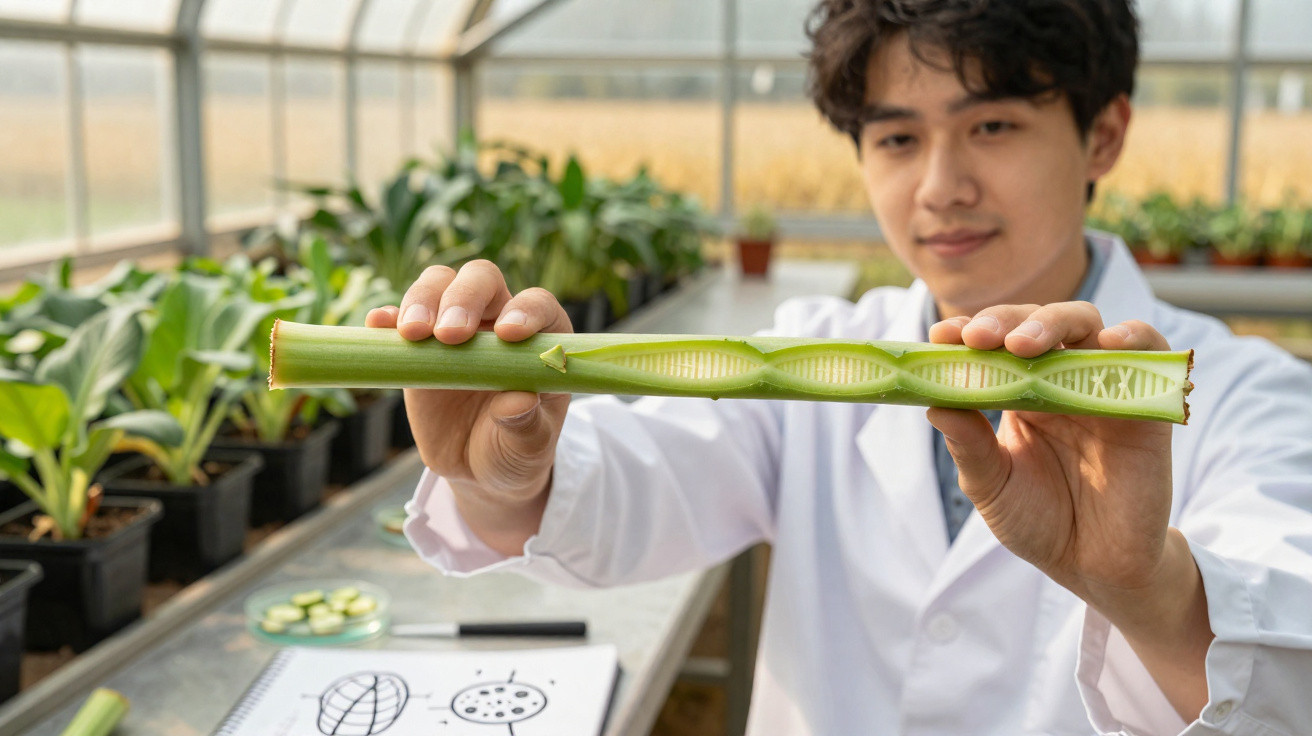
For over a century, biologists have thought that a plant’s outer skin determines the shape of its organs. New research instead identifies genetic activity far within the tissue as the driving force.
Scientists linked a stem’s width to a small group of genes that direct the way its internal cells divide.
The discovery overturns a long-standing model of how plants construct their form.
The same genetic mechanism may also account for why certain melons are round while others are elongated, as well as how breeders have altered the fruits and grains we consume.
A century-old assumption
For many decades, plant biologists believed they knew how leaves, stems and fruits acquire their eventual shape.
The outer layers were thought to take command, either holding back or yielding to pressure exerted by the softer cells within.
Under this model, the epidermis - the plant’s outer skin - was in control.
It aligned with researchers’ measurements: an expanding organ’s surface is under tension, whereas its internal tissue is compressed.
The difficulty has been observing the cells that make the crucial decisions.
These tissues develop in a tight, inaccessible space at the extreme tip of a growing shoot, concealed beneath younger cells and folded leaves.
Inside the stem
Known as the rib zone, this pocket is where a stem starts to form. Its cells divide with remarkable regularity, nearly always at right angles to the stem’s direction of growth.
This creates orderly, parallel files: individual columns of cells placed end to end, which the researchers compare to a bundle of strings.
The team responsible for the study has investigated this region for years.
Professor Robert Sablowski and colleagues at the John Innes Centre developed 3D imaging and cell-tracking methods to follow individual rib-zone cells as they split and proliferate.
In previous work, the researchers found that a regulatory protein establishes these organised division patterns from the outset.
The protein activates and deactivates other genes. Its targets included a family of genes whose role in the stem had not been established.
When cell divisions misfire
To investigate the genes’ function, the team disabled the entire family simultaneously in Arabidopsis - a small mustard-family plant used by scientists as a laboratory model for crops.
They thought the plants might appear normal, because related genes frequently compensate for each other.
Instead, the stems were noticeably thicker. Their length changed very little, but their width increased as additional cell files formed across the stem.
Cell tracking revealed the reason. In the modified plants, some divisions were no longer oriented at right angles to the stem.
Every incorrectly positioned division created a new cell file, causing the tissue to add columns and expand sideways rather than upwards.
Two aspects of this result surprised the scientists. The genes function in deep internal tissue, rather than in the outer skin traditionally believed to control width, and the change starts with the orientation of cell division itself.
This challenges the standard view. For a long time, biologists have regarded the angle of cell division as an outcome of growth: cells first enlarge in a given direction, then divide in line with it.
The study indicates the reverse: cell-division direction occurs first and influences the way the whole organ develops.
Plant growth theory challenged
The findings run counter to decades of textbook teaching.
“The way these genes work challenges the common assumption that plant organ growth is controlled by outer tissues such as the plant epidermis,” said Sablowski.
To observe the process directly, the team attached a fluorescent marker to one of the proteins produced by these genes.
Within dividing cells, the protein accumulated precisely where the cell was preparing to separate, indicating the plane of the forthcoming division.
The possibility that a cell’s division direction can reshape an entire organ is not confined to stems. In tomatoes, a gene from the same wider family turns round fruit into elongated fruit.
Earlier studies found that it achieves this by directing divisions towards the long axis rather than the broad axis.
From stems to crops
The implications extend beyond a single laboratory plant. Closely related genes occur in food crops and have long been associated with the shapes of the plant parts we harvest.
In rice, disabling the closest equivalent makes grains wider without making them longer, by adding cell files across the grain - the same pattern seen in the widened stem.
Genes related to these in melons and cucumbers are linked with whether fruit develops a round or elongated form.
These similarities make the research relevant beyond fundamental biology.
“By understanding how these genes operate to change the shape of the stem, we shed light onto the shape of fruits and seeds that have been modified by humans during crop domestication and breeding,” said Sablowski.
The link could make crop breeding more precise. For thousands of years, farmers have selected plants for their fruit and grain size and shape without understanding the cellular mechanism behind those traits.
Furthermore, one study has already shown that a cucumber gene in this family elongates fruit by favouring divisions along its length.
What scientists still don’t know
The research makes one point clear: a particular group of genes determines how wide a plant organ becomes by controlling the direction in which its internal cells divide.
That control is located deep in the tissue, rather than in the outer skin long considered responsible.
However, one issue has yet to be resolved. The researchers showed that altering cell-division direction changes organ growth, but they do not yet know exactly why this happens.
Their next aim is to determine how a redirected cell division becomes the physical forces that broaden the tissue.
Resolving this could offer plant breeders a more exact means of shaping crops - from grain width to the curve of a squash - by directing cell behaviour rather than depending on years of trial and error.
It may also finally resolve a century-old argument over where a plant’s shape is determined. At present, the clearest evidence points to deep within the tissue.



Comments
No comments yet. Be the first to comment!
Leave a Comment