
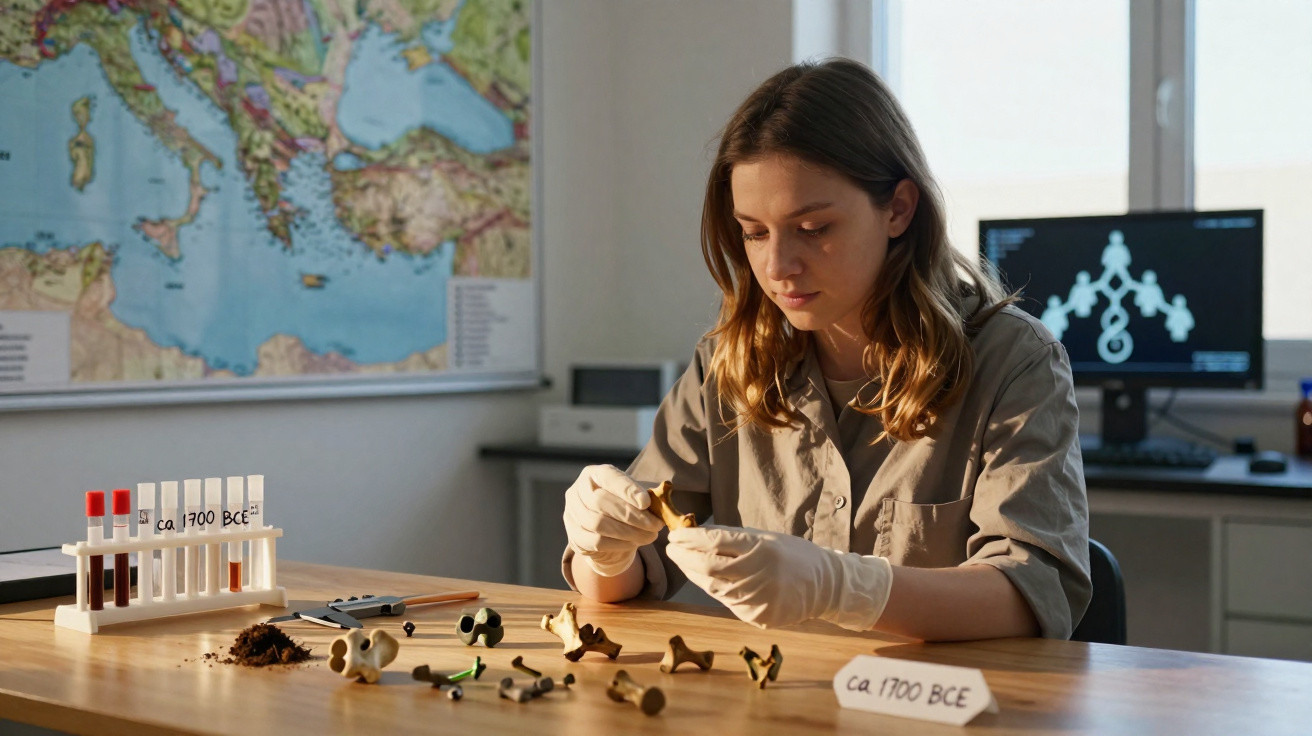
DNA recovered from 3,700-year-old bones in a mountain cave in Calabria has uncovered a family connection so unusual that it remains striking even by deep-prehistory standards.
The remains also offer indications of who was considered part of the community, who came from beyond it, and how its inhabitants lived in a harsh landscape.
Field teams working in Calabria gathered small fragments of bone and teeth from Grotta della Monaca before sending them for laboratory analysis.
The research was headed by Dr. Francesco Fontani, a specialist in ancient Mediterranean communities at the University of Bologna (UNIBO).
As most of the human remains were dispersed, genetic comparisons provided a means of reconstructing family groups without depending on complete skeletons.
DNA from scattered remains
The new dataset contains genetic information from 23 individuals interred at the site between roughly 1780 and 1380 B.C.E.
Scientists recovered ancient DNA and compared genetic variants shared among the individuals.
When two individuals possess lengthy matching sections of genetic code, this generally indicates close biological kinship within a single generation.
Such connections cannot establish motives or social rules, meaning that other evidence from the cave was needed to address some of the uncertainties.
Genetic links across the strait
Many of those buried in the cave showed genetic similarities to Early Bronze Age populations in Sicily, although Calabria lies in south-west Italy on the other side of a narrow strait.
“Our analysis shows that the Grotta della Monaca population shared strong genetic affinities with Early Bronze Age groups from Sicily, yet lacked the eastern Mediterranean influences found among their Sicilian contemporaries,” Fontani said.
Two people also displayed connections with north-eastern Italy, suggesting movement across the peninsula despite the mountainous location.
Burials arranged by kin
The positioning of burials within the cave appears to have followed a pattern, as relatives were commonly placed near one another in the same section.
Combining DNA matches between bones with the recorded locations of fragments enabled the researchers to identify mothers buried close to their children.
One area contained mainly women and young people, while just one adult male was found in this principal funerary zone.
Since the bones were disturbed and intermixed over time, the distribution map probably does not preserve every original position or social convention.
Milk without the gene
Dietary evidence presented an unexpected result: genetic indicators suggested that most adults did not have lactase persistence – the capacity to digest milk sugar in adulthood.
Yet chemical markers in their bones indicate regular consumption of dairy products. This implies that herding practices developed before most people had biologically adapted.
“This paradox illustrates how cultural adaptation can precede genetic evolution,” said Dr. Donata Luiselli, co-senior author of the study.
Turning milk into cheese or yoghurt lowers its lactose content, allowing people without the mutation to obtain calories from it.
A child with doubled DNA
The genome of one boy contained the earliest unambiguous genetic evidence of a father-daughter union in prehistoric Europe.
Researchers examined runs of homozygosity, extensive sections in which both chromosomes are identical, as recent inbreeding preserves these blocks.
The boy possessed so many lengthy blocks that they could only be accounted for by a parent-child relationship or by full siblings.
Reconstructing the family showed that the child was born to a father and that man's own daughter, although the mother's remains were not recovered.
Why incest leaves traces in DNA
Health research involving children born to close relatives shows an increased chance of receiving two harmful copies of the same gene.
This occurs because parents with recent shared ancestors are more likely to pass matching rare recessive variants to a child.
Archaeologists have occasionally recorded sibling unions in elite contexts, whereas parent-child pairings are much less frequently identified in ancient remains.
Even genetic evidence cannot show how widespread these events were, as one case may be preserved while others disappear.
Limits of social meaning
The relationship must be interpreted carefully, as genetics can reveal who reproduced but not whether the relationship was accepted or opposed.
The site offers no evidence of a rigid hierarchy, while the broader gene pool does not resemble that of a very small, isolated group.
“This exceptional case may indicate culturally specific behaviours in this small community, but its significance ultimately remains uncertain,” said Dr. Alissa Mittnik of the Max Planck Institute for Evolutionary Anthropology.
In the absence of written sources, modern readers cannot access the community's rules concerning marriage, consent, or punishment.
Bronze Age mobility in context
The cave is situated around 600 metres above sea level, but its inhabitants nevertheless participated in wider Bronze Age movements.
As caves can accumulate burials over many generations, genome data can provide a picture of a community across centuries, even where nearby settlements have disappeared.
This longer perspective links regional developments – including Calabria's contacts with Sicily and northern Italy – to the lives of individual children.
Nevertheless, intermixed bones form only a partial archive, and future excavations in the region will examine whether the same pattern appears elsewhere.
The genomes from the cave demonstrate how migration, diet and family structure could exist together within a small community.
By genetically examining additional sites, researchers can compare exceptional events with everyday practices without presuming that one valley represents them all.
Image credit: Grotta della Monaca


Comments
No comments yet. Be the first to comment!
Leave a Comment