
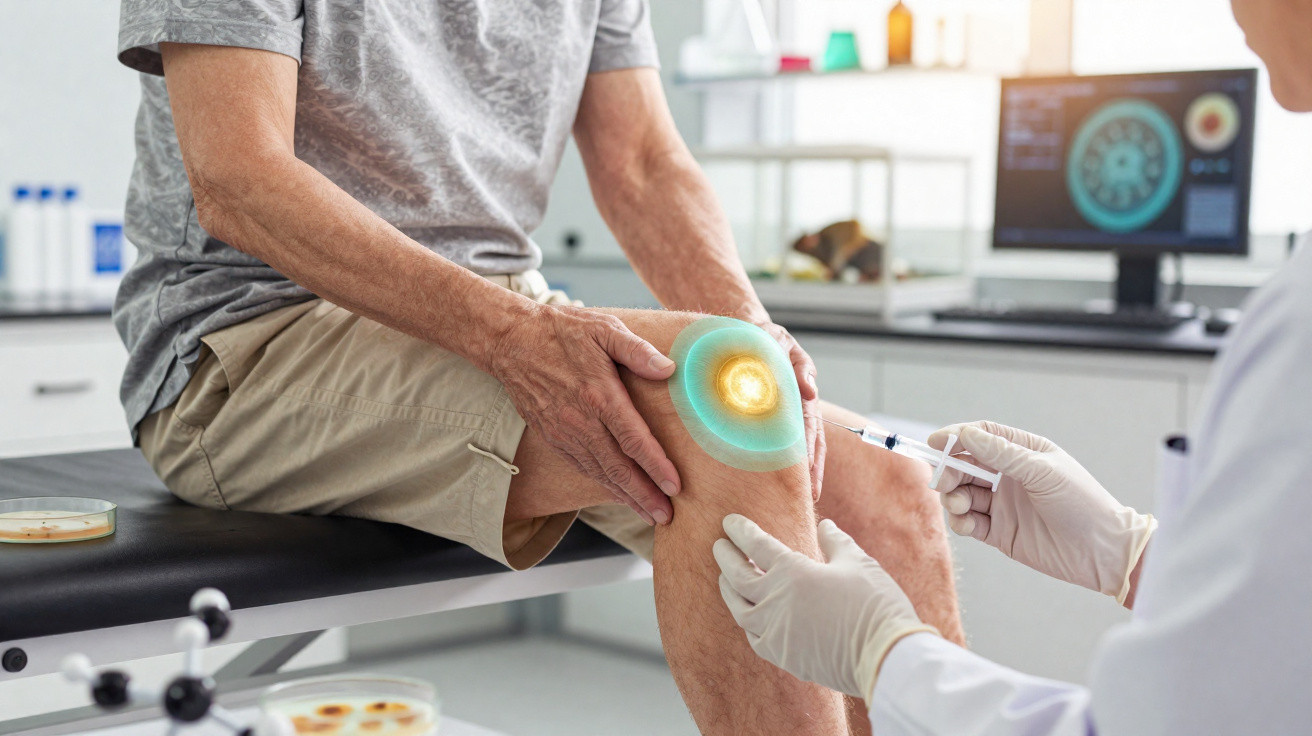
A straightforward injection that inhibits an age-related protein can regrow knee cartilage in older mice and avert arthritis following knee injury.
When human knee tissue was exposed to the same inhibitor, it began producing new cartilage, suggesting a potential alternative to pain medication and joint replacement.
Knee cartilage regrowth in mice
Red-stained sections of mouse knees revealed that the cartilage layer became thicker after treatment, including in animals that were already aged.
By measuring the amount of cushioning restored, Nidhi Bhutani, Ph.D., of Stanford Medicine linked the regrowth to the inhibition of a single protein.
Her researchers trialled injections into both the abdomen and the joint, finding that cartilage regenerated over the full knee surface rather than in only one area.
This level of regrowth runs counter to a difficult reality for knees: after cartilage becomes thin, the body generally cannot restore it when needed.
Why knees deteriorate
Throughout the United States, arthritis affects roughly one in five adults and creates substantial demand in orthopaedic waiting rooms.
In knee osteoarthritis, a gradually progressing joint condition that erodes cartilage, cartilage cells release inflammatory signals and the joint can no longer move as smoothly.
When there is no renewed cartilage layer, bones experience greater friction, swelling develops, and routine activities such as standing up or climbing stairs may feel laborious.
Direct healthcare costs for osteoarthritis total approximately $65 billion annually, without including reduced earnings and the costs of long-term disability.
An enzyme linked to ageing
The new study found that concentrations of 15-PGDH, an enzyme that switches off repair signals, increased by around twofold in ageing cartilage.
The repair signal is prostaglandin E2, a hormone-like molecule that helps tissue react to injury and is normally broken down by 15-PGDH.
Once the researchers inhibited the enzyme, prostaglandin E2 remained present for longer and cartilage cells behaved more as they had when young.
As enzymes can often be targeted with inhibitors, 15-PGDH offered the team a practical drug target.
Resetting cartilage cells
Rather than introducing new cells, the inhibitor encouraged the knee's existing cartilage cells to reconstruct the surface that enables bones to glide past one another.
These repairing cells are known as chondrocytes, which produce and maintain cartilage, and treatment altered their internal programming.
Instead of becoming more resilient, scar-like cartilage, the restored tissue acted like healthy joint cartilage and enabled movement throughout the knee.
“The mechanism is quite striking and really shifted our perspective about how tissue regeneration can occur,” said Bhutani.
Following knee injuries
For many athletes, the ACL is a crucial knee ligament controlling twisting movements; a tear can increase the risk of arthritis for years afterwards.
Long-term research indicates that around half of knees with an ACL injury develop osteoarthritis within five to 15 years.
In the injured-mouse model, twice-weekly injections over four weeks reduced pain linked to osteoarthritis and maintained cartilage after damage.
“Cartilage regeneration to such an extent in aged mice took us by surprise,” said Bhutani.
What happens inside cartilage cells
Cell-by-cell analysis showed that old cartilage contained a mixture of chondrocytes primed for tissue breakdown and others primed for repair.
The treatment shifted gene expression - the way in which cells activate and deactivate genes - away from inflammation and towards reconstructing the cartilage framework.
Following treatment, far more cartilage cells moved into a repair state, while fewer remained locked into degrading tissue.
This shift implies that the drug did not simply fill a defect, but instead guided the entire joint lining back towards normal function.
Human samples tested in the laboratory
In laboratory conditions, cartilage collected during knee replacements began recovering after receiving the same inhibitor used in mice.
After one week, treated specimens had fewer 15-PGDH-positive chondrocytes and reduced signals associated with cartilage degradation.
The supporting framework also resumed growing, allowing fresh cartilage to develop with the structure required to withstand ordinary joint loading.
As the samples were taken from end-stage knees, the laboratory finding is a demanding test but cannot forecast recovery in a living joint.
Route to drug development
Separate Phase 1 research reported that the oral drug MF-300 was safe and active in healthy volunteers.
Its developers are investigating it for sarcopenia, an age-related loss of muscle that reduces strength, as blocking 15-PGDH can increase prostaglandin E2.
For cartilage treatment, an injection might retain most of the medicine around one joint, potentially limiting side effects throughout the body.
A tablet would be simpler to use, although it would need to reach the knee at a sufficiently high dose to have an effect.
Risks and further testing
Mouse knees recover more quickly than human knees, meaning rigorous trials will be required before this inhibitor can be injected in clinical practice.
Precise dosing will be vital, since a drug that changes cell signalling may have adverse effects and an excessive dose in the wrong place could increase pain.
Extended monitoring must confirm that regenerated cartilage remains durable and does not cause unwanted bone growth or joint stiffness.
For athletes with an ACL tear, prompt repair may still be important, although a cartilage-protecting drug could alter recovery plans.
The future of cartilage treatment
By directing old cartilage cells back towards a building role, the inhibitor offers a regenerative approach that could be combined with physiotherapy or surgery.
Human trials will establish whether a simple knee injection can postpone joint replacement, particularly after ACL injuries that currently cause lasting damage.






Comments
No comments yet. Be the first to comment!
Leave a Comment