
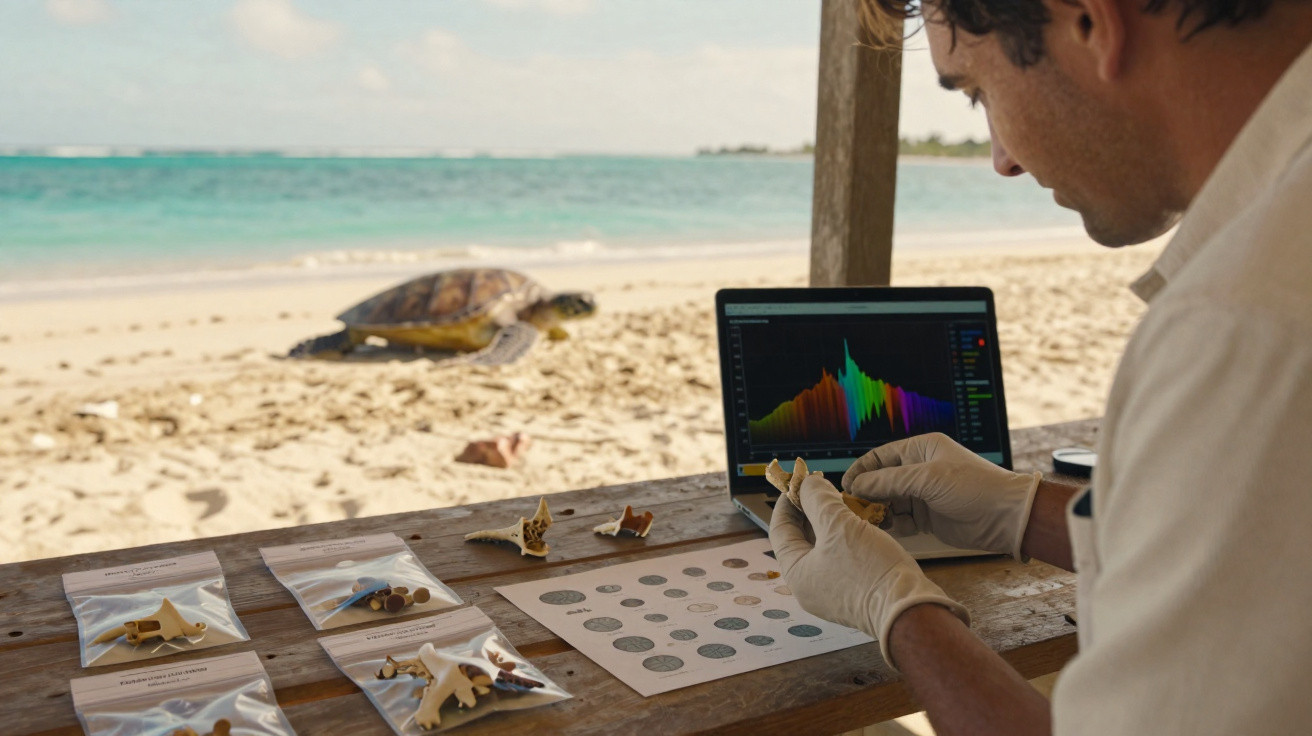
Most sea turtle bones recovered from historic Caribbean sites are small, charred and fragmented.
For years, this marked the limit of what researchers could learn: a broken fragment could be classified only as a sea turtle bone, with no further identification possible.
A new protein test has altered that situation. Scientists can now uncover more about sea turtle history and the connections between people and different marine turtle species.
Bones too damaged to identify
Using a protein-based approach, researchers identified 87 sea turtle bone fragments from Curaçao and Bonaire at species level.
The fragments were recovered from seven sites, with some dating back more than 4,000 years.
Known as zooarchaeology by mass spectrometry, or ZooMS, the method examines type-1 collagen. This protein can remain in bone long after DNA has degraded.
Christine Conlan led the research at Simon Fraser University (SFU) in Canada, while the protein work was carried out at the University of British Columbia (UBC).
The specimens were drawn from collections held by National Archaeological Anthropological Memory Management (NAAM), a Curaçao-based heritage organisation.
Identifying the sea turtle species
Of the 87 bones, 37 proved to come from sea turtles. The analysis identified 13 green turtles, 10 loggerheads and two hawksbills among them.
The bones identified to species date from roughly CE 1040 to 1765, spanning Indigenous life on the islands as well as the subsequent Spanish and Dutch eras.
One species was entirely absent. No leatherbacks were detected in the samples, despite the fact that they nest in the region today.
“When you’re trying to compare archaeological data to conservation data, if it’s really broad, the application isn’t there,” said Conlan.
“What’s impacting a hawksbill sea turtle versus a green sea turtle is going to be really different.”
Green turtles dominate the bone record
Green turtles accounted for a larger share of the record than any other species, consistent with their long-standing role as a preferred food source in the Caribbean.
“We think people were preferentially selecting green sea turtles because they’re just so abundant,” said Conlan.
“There’s also a lot of historic and ethnohistoric documentations about how green turtles taste a lot better.”
Since the arrival of Europeans, green turtle populations have declined by 99.6 percent, while hawksbills have fallen by 99.7 percent. Green turtles, however, have begun to recover.
“Leatherbacks and hawksbill turtles were likely minimally hunted prior to the 16th century, so it could be that their declines are resulting directly from European overhunting and the turtling industry that came around that time,” said Conlan.
She pointed out that humans have exploited green turtles and loggerheads for longer, and suggested that the green turtle recovery could signal an adaptive response.
The loggerhead and the conch
The loggerhead finding was the most unexpected result. Previous Caribbean bone studies using this technique had not identified loggerheads, but they represented 10 of the 25 turtles identified to species here.
Loggerheads are now rare around the islands. Their preferred food, the queen conch, has been depleted from local waters through fishing.
“You see conch shells consistently throughout archaeological sites and over time you see them get smaller and smaller, which could indicate overexploitation,” said Conlan.
“If they’re doing restoration programs, it could trigger more loggerhead turtle foraging to occur, which will have an impact on recovering conch populations.”
Why some turtle bones are rare
Although hawksbills are common around the islands, only two appeared in the bone record.
Their meat can cause a serious form of poisoning known as chelonitoxism, with most documented human cases linked to this species.
Hawksbills also feed at night and rest with their shells low in the water, making them more difficult to see and capture.
Leatherbacks were avoided for different reasons. They live well offshore and were long regarded as unpalatable, meaning hunters seldom caught them.
Nesting beaches used for centuries
The bone evidence also reveals former turtle nesting areas. Green turtles, hawksbills and loggerheads all nested on these islands in the distant past.
“We now have evidence of long-term nesting. We know that since at least CE 1040, green turtles, hawksbill turtles and loggerheads were nesting,” Conlan said.
“Because sea turtles always return to nesting sites, and we see them both in the past and present, it’s likely that they’re continuously going back.”
This tendency to return to established beaches is important for planning, as tourism and construction continue to expand along those same coastlines.
A baseline for living turtles
Sea turtles may live for more than 70 years, meaning the effects of damage can take decades to emerge. Ancient bones offer a much longer perspective than modern surveys can provide.
“Baselines can help us establish what these ecosystems looked like prior to heavy industrialization, heavy modern pollution and increased climate change,” said Conlan.
Understanding past conditions is essential for setting environmental parameters that can help species survive under current conditions.
“Conservationists are increasingly asking for long-term data, especially with sea turtles that can live for 70-plus years. Genetic and population changes aren’t going to show up for a long time, so you really need that long-spanning lens,” she explained.
The technique has uses well beyond Caribbean sea turtles. It could be used for any species with developed ZooMS markers.





Comments
No comments yet. Be the first to comment!
Leave a Comment