
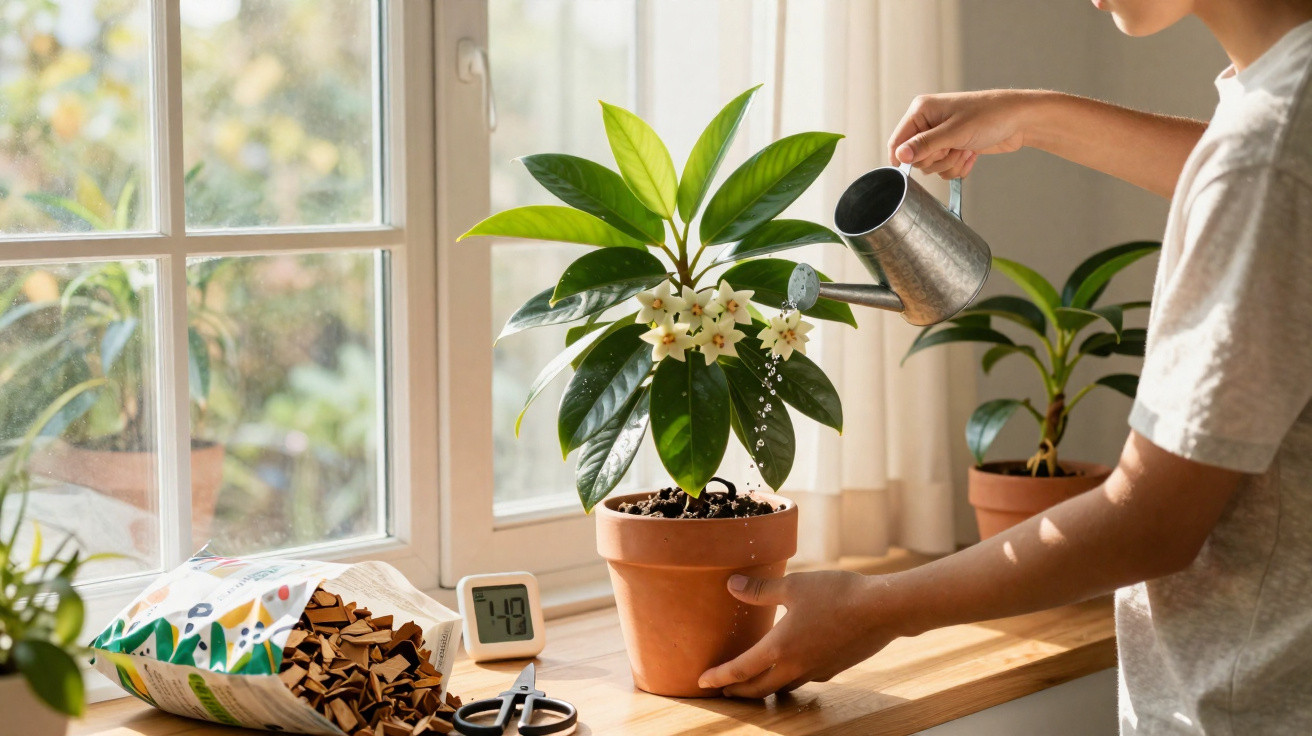
Many people know the so-called wax flower only from photographs in plant forums. Yet in real life, it is one of the most rewarding houseplants around. Anyone who understands its preferences for light, water and pot size can keep it for years and, eventually, enjoy a true explosion of small, fragrant star-shaped flowers.
What makes the Hoya so special
The Hoya genus includes well over 300 species, chiefly from South-East Asia and Australia. The variety most often seen in our homes is Hoya carnosa, with its long, gently trailing shoots, alongside the compact Hoya bella and heart-shaped Hoya kerrii.
They all share one feature: thick, leathery leaves that retain water. This makes their behaviour somewhat similar to that of succulents, so they tolerate missed watering far better than tropical foliage plants with thin leaves.
“Anyone looking for a tough plant that will eventually flower spectacularly will surprisingly often end up with a wax flower.”
Temperatures of 18 to 24°C are ideal. It can also cope with temperatures from 15 to 30°C for short periods, provided it is not exposed to cold draughts. This is precisely why it is such a good choice for normally heated homes, with winter central heating and summer warmth.
The best spot: bright, without fierce midday sun
For a healthy Hoya, its position matters more than almost anything else. It needs plenty of light, but cannot tolerate harsh midday sunshine through glass.
- Ideal: east- or west-facing windows
- Good: set slightly back from a south-facing window, rather than directly against the glass
- Difficult: a dark north-facing aspect or a position several metres away from any window
Gentle morning or evening sunshine benefits the plant because it encourages growth and flowering. Intense midday sun in high summer, however, may scorch the leaves. Pale patches, brown edges and a dull appearance are typical signs.
The Hoya should not sit directly above a radiator. The air becomes extremely dry there, while the root ball overheats, causing stress and attracting pests.
Substrate and pot: loose, free-draining and preferably slightly snug
A wax flower does not want “wet feet”. Waterlogging is among the most frequent reasons a plant gradually declines. Standard houseplant compost can be improved easily:
- 1 part green houseplant compost
- 1 part mineral material, such as perlite, broken expanded clay or orchid compost
- optionally, a small proportion of cactus compost for even better drainage
The pot must have drainage holes. Excess water needs to be able to run out through the base. A decorative outer pot is fine, but any water that collects in it should be emptied after a few minutes.
“For many Hoyas, a slightly confined root zone encourages flowering – overly large pots tend to hold it back.”
Repotting every two to three years is sufficient. If roots are already appearing beneath the pot or the compost seems heavily compacted, move it into a slightly larger pot. Go up by only one pot size, rather than choosing a huge container straight away.
Watering a Hoya correctly: infrequent but thorough
Its fleshy leaves hold water, which means a Hoya copes with dry spells considerably better than permanent dampness. This rough schedule works surprisingly well in many homes:
| Season | Watering schedule | Note |
|---|---|---|
| Spring/summer | every 10–15 days | when the top layer of compost is dry |
| Autumn/winter | every 2–4 weeks | leave longer intervals in cooler rooms |
The “pot test” is even more dependable than following a calendar: lift the pot briefly. If it feels light, water it. If it is still heavy and the compost feels cool and damp, it is better to wait.
Warning signs from the plant:
- Yellow leaves while the compost is damp: too much water; the roots are at risk of rotting.
- Soft, shrivelled leaves and a very light pot: it is thirsty, so give it a thorough watering.
A Hoya responds most gently to lukewarm water that has been left to stand. Cold tap water used straight from the tap can give the roots quite a shock, particularly in winter.
Nutrients, humidity and care mistakes
During the growing season, roughly from March to September, the plant appreciates a little fertiliser. An ordinary liquid feed for foliage or flowering plants is enough, ideally at half strength once a month. It does not need extra nutrients in winter.
The humidity in ordinary living spaces is adequate for most species. Those with a very dry older property, a fireplace or strong central heating can make conditions a little easier for their Hoya:
- Use a saucer filled with expanded clay and water; the pot should sit on it, not in the water.
- Mist it occasionally with a fine spray, but never in strong sunshine.
Common care mistakes include:
- moving the plant to a different place every few weeks
- using pots that are too large and remain damp for ages
- constantly checking it and giving small “sips” of water instead of watering thoroughly but less often
How the wax flower produces its star-shaped blooms
Many owners eventually become frustrated: the plant grows and looks healthy, yet simply refuses to flower. Usually, one of the following causes is responsible:
- too little light, especially during the winter months
- a pot that is far too large, causing the plant to direct its energy into roots rather than flowers
- continually changing its position or turning the pot
Once a Hoya has “settled in” at a particular spot, it forms small knobbly growths known as flower spurs. New clusters of blooms develop from these year after year.
“Never cut off these short, woody stubs on the shoots – this is exactly where the flowers reappear time after time.”
Anyone who accidentally removes these spurs after flowering may wonder why nothing happens the following year. Long, bare shoots can be shortened, but only to just before these growths.
Shape, pruning and propagation
A Hoya works equally well as a trailing plant or as a climbing focal point on a hoop or trellis. Depending on the species, it can be displayed in different ways:
- Trailing: allow the shoots to fall freely, which is perfect for high shelves or macramé hanging planters.
- Climbing: secure shoots to a plant support or wire hoop to create a dense green arch.
If individual shoots become too long or look bare, trim them back just above a leaf node. This encourages fresh side growth, making the plant bushier.
Propagation is remarkably straightforward. Cut a healthy shoot with two to three nodes and remove the lower leaves. Then place it either in a glass of water or in lightly damp, loose compost. At room temperature, and with a little patience, roots will form after a few weeks, creating a new plant.
Why it is called a wax flower and porcelain flower
The names wax flower and porcelain flower are no accident. Its blooms look as if they have been shaped from glossy wax or fine porcelain. Many varieties have a sweet fragrance: some release it only in the evening, while others are more subtle. This is why many owners like to place the plant in a hallway, living room or bright spot in the bedroom, depending on their scent preference.
Those sensitive to strong fragrances should test the final position during the first flowering period. Sometimes moving the plant just a few metres is enough to make the scent feel more pleasant.
When a Hoya is unsuitable – and when it is perfect
This plant is not entirely risk-free either. Anyone who habitually overwaters, struggles to wait and constantly wants to “check on it” can easily harm a wax flower. Extremely dark homes are also problematic, as the plant often remains sparse there and may not flower at all.
It is ideal, on the other hand, for people who:
- are forgetful about watering
- have been looking for a permanent plant spot and do not want to move it continually
- are patient and can appreciate its leaves and growth habit even before it flowers
Anyone with these qualities who follows the straightforward rules on light, water and pot size will eventually be rewarded with an impressive ring of flowers – and will understand why the Hoya has quietly become a favourite plant in so many living rooms.

Comments
No comments yet. Be the first to comment!
Leave a Comment