
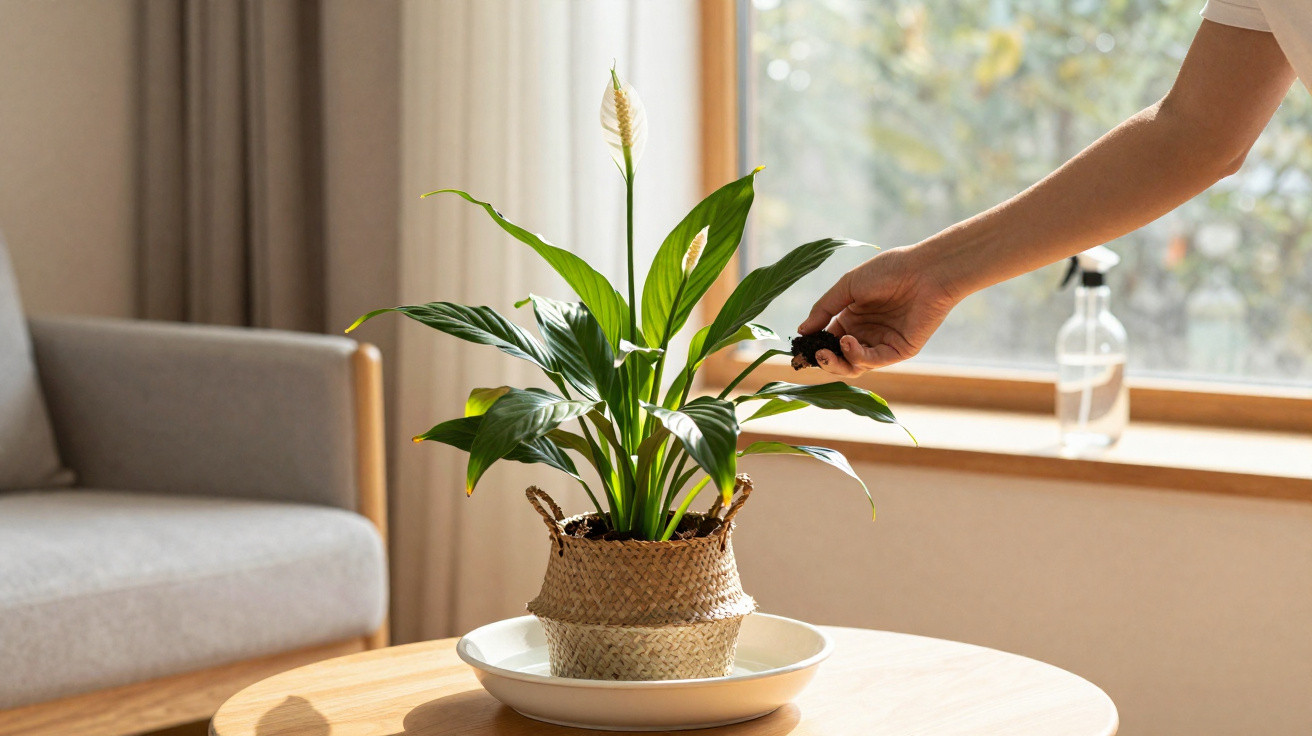
A small change to the way you water it can transform the situation completely.
Countless living rooms contain a lush green peace lily, yet its characteristic white spathes never seem to appear. Although this plant is considered easy to care for and tolerates the occasional mistake, it often flowers very little. The key is usually not fertiliser or repotting, but an inconspicuous everyday habit: watering.
Why your peace lily is not flowering
The peace lily, botanically known as Spathiphyllum, originates from shaded, humid tropical forests. There, it grows in loose soil that remains lightly moist at all times. Replicating these conditions in a pot is only possible to an extent – and this is precisely where issues begin.
Many owners either water too infrequently or overwater. Both can prevent flowering:
- Too little water: The plant switches into survival mode, putting all its energy into staying alive rather than producing blooms.
- Too much water: The roots receive too little oxygen, start to rot and the peace lily weakens. Flowers will not appear in this case either.
What matters is not “a lot” or “a little”, but a consistently lightly moist root zone with a surface layer of compost that is allowed to dry slightly.
The compost should stay soft and moist deeper down, while the top one to two centimetres should dry out. Achieving this balance encourages abundant flowering instead of producing foliage alone.
How your peace lily “communicates” with you
One useful feature of this houseplant is that it clearly indicates how it is doing. A quick look can reveal a great deal about its water requirements.
- Leaves droop limply downwards: The peace lily is thirsty. Once watered, its leaves will usually stand upright again within a few hours.
- Leaf edges turn brown: Either the dry period lasted too long, or tap water with high levels of limescale and salts is putting the plant under stress.
- Leaves turn yellow all over: This is often a sign of waterlogging or compost that has stayed too wet for too long.
Even so, looking at the leaves cannot replace the most important check of all: feeling the compost.
The “finger test”: how to know when to water
Professionals rarely follow fixed watering schedules. Instead, they use a very simple test. It takes less than three seconds and is far more dependable than any calendar-based rule.
The finger test is the safest way to identify the ideal time to water – without any measuring equipment.
Here is how it works:
- Push your index finger two to three centimetres into the compost.
- Check how it feels: is the surface dry while the compost beneath is still slightly moist?
- If it is, this is the time to water moderately.
If the compost is dry lower down as well, give the plant a more generous drink. If it still feels distinctly moist throughout, wait a little longer. This allows you to respond flexibly to room temperature, the season and pot size, rather than reaching for the watering can rigidly every week.
Watering a peace lily like a professional: from below, not above
A common mistake is pouring water directly onto the compost from above until it runs out of the bottom. This can flood some parts of the root system while leaving other areas dry. It becomes even more problematic if water is left standing in the decorative outer pot, as root rot can follow.
A much gentler approach is known as watering from below.
Step by step: watering from below
Use the following method to give your peace lily the water it needs:
- Place the pot in a bowl, bucket or kitchen sink.
- Fill the container with water so that the base of the pot sits in it, without submerging the entire pot.
- Wait for 10 to 15 minutes while the compost absorbs water.
- Remove the pot and allow it to drain thoroughly.
- Tip away any remaining water from the bowl so that waterlogging cannot develop.
When watered from below, the peace lily draws up exactly as much water as it needs – any excess simply remains in the bowl.
This method is particularly helpful for plants that already appear weakened, or for anyone prone to watering too generously. It significantly lowers the risk of root rot and stops the compost surface from remaining soaking wet all the time.
How often does a peace lily need water?
There is no fixed answer, but broad guidelines can help ensure you are not entirely in the dark. Temperature, light levels and pot size are the deciding factors.
| Season | Typical frequency | Note |
|---|---|---|
| Spring | 1–2 waterings per week | The growing period begins, so carry out the finger test more often. |
| Summer | 2–3 waterings per week | Warm rooms cause compost to dry more quickly. |
| Autumn | every 7–14 days | Less light slows growth. |
| Winter | every 10–20 days | Cooler rooms often mean much longer intervals. |
These figures do not replace the finger check; they are simply intended as a rough guide. Relying on calendar dates alone can quickly result in waterlogging or drought stress.
Light and humidity: overlooked factors for success
Even an excellent watering routine will achieve little if the position and indoor climate are unsuitable. The peace lily prefers bright, indirect light. Direct sunshine scorches its leaves, while corners that are too dark inhibit flowering.
An ideal spot is:
- near a window but away from direct midday sun,
- at temperatures between 18 and 24 degrees,
- free from draughts and away from radiators that stay warm continuously.
The plant also benefits from slightly higher humidity. In very dry homes, a simple trick can help: place the pot on a saucer filled with damp clay pebbles. The root ball must not stand in water, but the rising moisture will improve the air around the peace lily.
Should you mist the leaves?
Many people recommend misting the leaves with low-limescale water, especially on hot days. This can indeed be beneficial if the water is sprayed as a fine mist and the leaves dry again quickly. If droplets remain on the foliage for a long time, marks can form easily.
Common mistakes and how to avoid them
Following this straightforward watering method already addresses the biggest issue. A few other pitfalls can also be avoided with very little effort:
- The wrong compost: Very dense, heavy potting compost retains water. Loose, structurally stable substrates that hold moisture while allowing air to reach the roots are better.
- No drainage hole in the pot: A decorative pot without drainage invites waterlogging. A pot with a hole and a saucer is safer.
- A cold location: Below 16 degrees, the peace lily becomes sluggish. Cold draughts directly beside a window are also harmful.
- A saucer that remains wet: Water left in the saucer for hours causes roots to rot – always pour it away.
Adding a lightly diluted green plant fertiliser to the water every few weeks can provide further support for flowering. Patience is still required, however: even under ideal conditions, a peace lily needs time to build up strength and produce new blooms.
Why this method is ideal for beginner plant owners
Combining the finger test with watering from below removes the greatest uncertainty from plant care. There is no need to measure exact millilitres or use an app that reminds you of watering days. The plant and its growing medium provide the signal themselves.
This routine is especially worth trying for people who have had little success with houseplants so far. A peace lily remains more forgiving than many more sensitive species, yet it responds clearly once its water and light conditions are right. Anyone who has seen the change from purely green foliage to recurring white spathes will usually stick with this simple method.


Comments
No comments yet. Be the first to comment!
Leave a Comment