
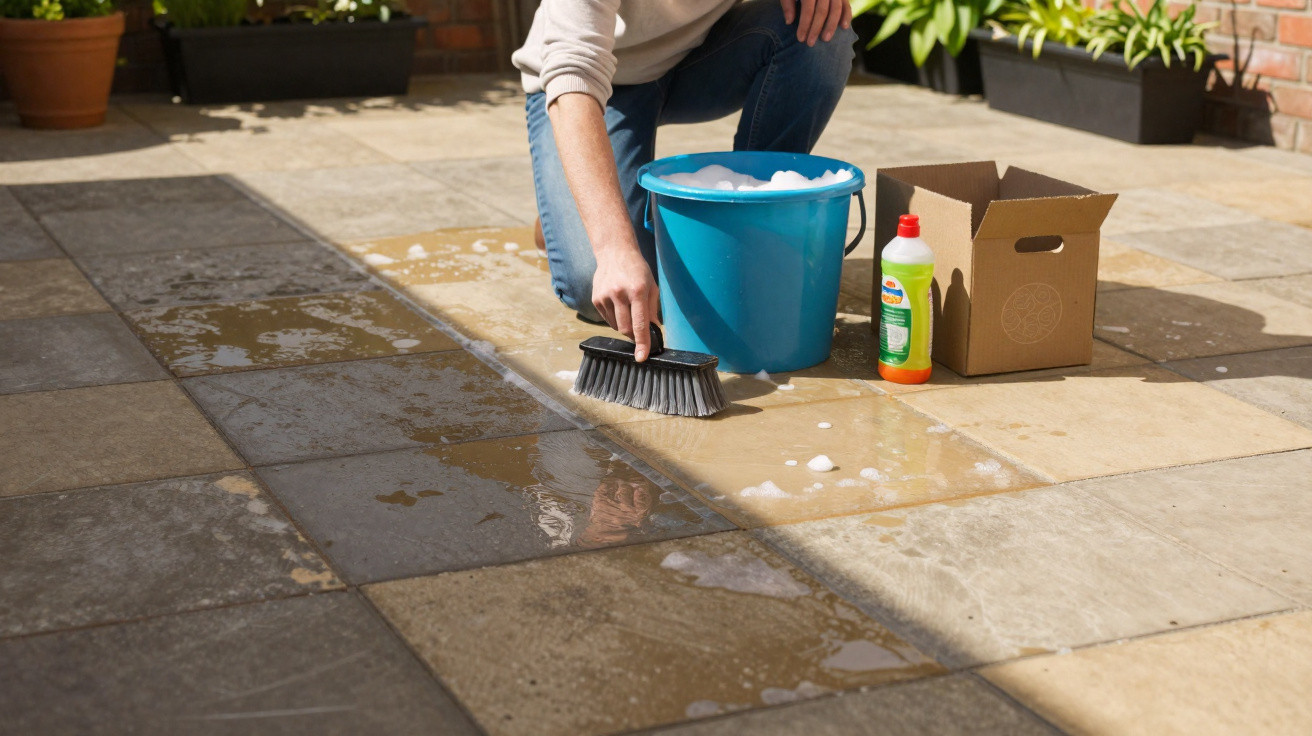
Rather than relying on a noisy machine, a straightforward blend of two everyday household products can do the job.
As soon as the weather turns warmer, every mark becomes visible: green growth, black streaks and rusty rings beneath chair and table legs. Many people instinctively reach for a pressure washer, chlorine cleaner or concentrated vinegar. One British DIY enthusiast instead recommends a surprisingly simple, inexpensive and gentler approach, using just two household products and no pressure washer at all.
Why patios look so bad after winter
For months, paving slabs, block paving and concrete are exposed to rain, frost and shade. Moisture lingers in the joints, fallen leaves rot, and sand and dust become embedded. These are ideal conditions for algae, moss and lichen. The result is a streaky green film that makes the whole outdoor area appear neglected.
Other common problem areas include:
- Rust stains caused by the metal feet of chairs, tables or parasol bases
- Brown marks left by plant pots and water run-off
- Grease and barbecue residue around the barbecue
- Black scuff marks from rubber feet or shoe soles
Many try to tackle this with the harshest possible treatment: a pressure washer at full power, strong bathroom cleaner, chlorine bleach or highly concentrated vinegar. The immediate effect can look dramatic, but over time it damages the paving, the joints and, in some cases, the garden as well.
Why it is best to be cautious with vinegar and similar products
Vinegar is often seen as a “natural” and therefore harmless option. However, it is still an acid. On some natural stones, it can leave fine scratches and dull patches. Repeated use can make the surface increasingly lacklustre and blotchy.
The garden may also suffer. If the acidic solution drains into flowerbeds or lawns, it changes the soil’s pH level. Sensitive plants can develop yellow leaves or struggle to grow, particularly in smaller gardens where everything is close together.
Pressure washers create a different set of problems. Their powerful jet can dislodge jointing material, wash away sand and roughen the stone surface. This allows fresh dirt to cling even more quickly later on. On older patio slabs, the jet may even break small pieces away from the stone.
The mix of two simple household products cleans thoroughly without eating away at stone and joints – while remaining far quieter than a pressure washer.
The surprisingly simple 2-product trick
The British DIY creator “Fix it with Fowlers” relies on a combination of soda crystals and washing-up liquid. Both are available from supermarkets and household retailers, often for just a few pounds.
What soda crystals actually do
Soda crystals, also known as washing soda, are a traditional laundry product. This strongly alkaline substance breaks down grease, dirt and much of the organic build-up. On patio slabs, it can help remove:
- baked-on street grime
- greyed deposits
- green algae growth
Importantly, soda crystals are not the same as caustic soda or drain cleaner containing sodium hydroxide. Those products are much more aggressive and unsuitable for outdoor stone paving.
Why washing-up liquid completes the mixture
Washing-up liquid is familiar from the kitchen: it cuts through grease, dissolves oily films and helps water penetrate dirt more effectively. On a patio, it is particularly useful for:
- barbecue grease and food residue
- oil marks from bicycles, pushchairs or cars
- a fine film of dirt caused by exhaust fumes
Ordinary clear washing-up liquid is entirely sufficient. Anyone wanting an especially environmentally considerate option can choose an ecologically certified product.
How to clean a patio with soda crystals and washing-up liquid
This method depends not on high-tech equipment, but on preparation and allowing enough time for the products to work. The basic routine can be used on almost any patio, whether it has concrete slabs, concrete block paving or durable natural stone.
- Clear the joints: First remove weeds with a joint scraper or narrow trowel. This allows the cleaning solution to reach every corner later.
- Sweep thoroughly: Use a stiff broom to clear away sand, leaves and loose dirt. The cleaner the starting surface, the better the result.
- Wet the area: Evenly soak the slabs with a garden hose or watering can. This helps the soda crystals dissolve more readily.
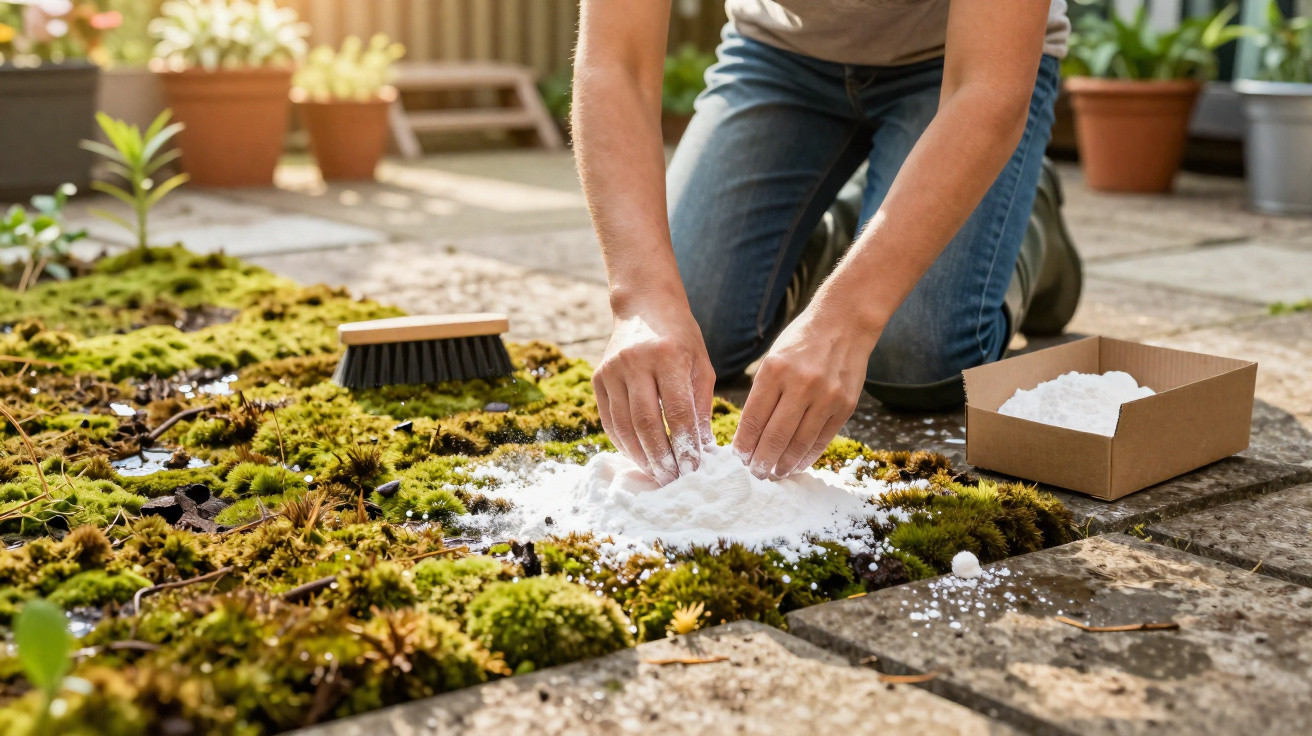
- Scatter the soda crystals: A light covering across the entire surface is enough. Avoid making thick piles.
- Apply washing-up liquid: Drizzle a few lines of washing-up liquid over the area; do not use too much, or it will foam excessively.
- Scrub it in: Work the mixture in with a stiff scrubbing brush using circular movements, until a light film forms across the slabs.
- Leave it to work: Let the mixture sit on the surface for up to 48 hours. Ideally, there should be no heavy rain during this period.
- Rinse afterwards: Finally, rinse the patio thoroughly with the hose until no foam or residue remains.
Patience replaces the pressure washer: the soda crystals and washing-up liquid mixture needs time, but it works gently and quietly.
Safety and common patio-cleaning mistakes
Although soda crystals are considerably gentler than many specialist cleaners, several points still need attention:
- Avoid contact: It is best to wear gloves while mixing and scattering the product. The alkaline solution can further irritate dry skin.
- Keep children and animals away: Pets and playing children should stay off the area while it is wet.
- Test sensitive stone: On pale sandstone or highly polished slabs, first clean a concealed corner and check whether the colour or surface changes.
- Do not mix with other chemicals: Do not add bleach, drain cleaner or aggressive bathroom cleaners. Combining them may cause unpredictable reactions.
A major mistake made by many homeowners is returning to the pressure washer after a gentler clean, or using harsh mould remover in between. Each time, the patio loses a little more material, joints start to crumble and nearby plants suffer.
How to keep the patio clean for longer
Once a thorough initial clean has been completed, the effort required for the rest of the season can be reduced significantly. A few simple habits will help the area stay tidy for longer:
- give it a quick sweep every two weeks, especially after storms and heavy pollen fall
- move plant pots occasionally so that permanently damp patches do not form underneath
- place the barbecue and fire pit on a fireproof base
- deal with heavy stains such as red wine, oil and bird droppings as soon as possible using water and a little washing-up liquid
In late autumn, it is worth repeating a lighter version of the 2-product trick. This means the patio enters winter much cleaner, less algae settles, and the work required in spring remains manageable.
What algae, moss and lichen really are
Many people mistake the green growth on a patio for “mould”. In reality, it is usually algae and moss, which thrive in damp, shady spots. Lichen – the white or light-grey crusty marks – consists of fungi and algae living together, and grows extremely slowly.
None of the three takes any notice of attractive garden furniture. The rougher and dirtier the surface, the more easily they take hold. This is precisely why a gentle cleaning method that does not make the stone even rougher delivers better long-term results than any drastic treatment involving acid or high pressure.
When a pressure washer is still worthwhile – and when it is not
A pressure washer should not be dismissed entirely. It can be useful for thick layers of mud after building work or hardened clumps of soil. When using one, you should:
- set the pressure as low as possible
- work at a sufficient distance from the surface
- avoid sensitive joints or cover them
On older patios, where joints are loose or natural stone is delicate, the gentler 2-product mixture is the far better choice. It cleans deeply enough for a well-kept appearance without “blasting away” parts of the patio every year.
Ultimately, the method shows that there is no need to buy half the DIY shop to keep an outdoor area in good condition. A pack of soda crystals, a bottle of washing-up liquid and a sturdy scrubbing brush are usually all that is needed to make slabs and paving look as though they have only just been laid.
Comments
No comments yet. Be the first to comment!
Leave a Comment