
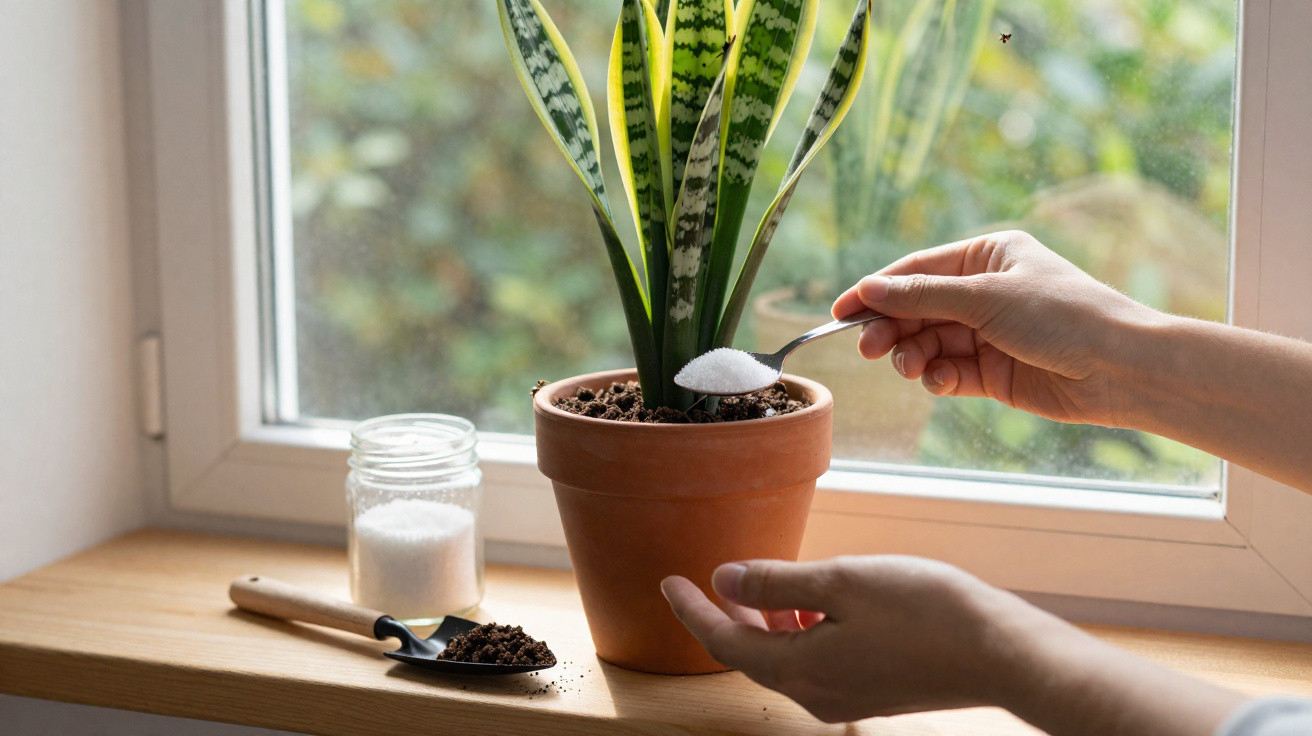
Adding sugar to a mother-in-law's tongue has become a popular tip, supposedly encouraging microorganisms in the growing medium and improving the plant's vigour. There is some truth behind the idea: sugar provides a readily available source of carbon for microorganisms. However, it does not feed beneficial organisms alone; it may also encourage fungi, unwanted bacteria and insects. It is therefore neither necessary nor particularly advisable for keeping this plant healthy.
What is the purpose of putting sugar in a mother-in-law's tongue pot?
Supporters of this method say that small amounts of sugar can feed the microbiota living in the growing medium. Some microorganisms do indeed use simple sugars as an energy source, contributing to organic-matter breakdown and nutrient cycling.
That does not, however, make sugar a fertiliser for the plant itself. A mother-in-law's tongue makes its own carbohydrates through photosynthesis, while its main requirements from the growing medium are water and mineral elements.
- Sugar provides carbon for microorganisms in the growing medium;
- It does not give the plant balanced nutrition;
- It cannot replace nitrogen, phosphorus, potassium or micronutrients;
- There is no known need to add sucrose to the pot;
- Reports of more attractive leaves after using it are anecdotal rather than a guaranteed result.
Why can feeding soil microorganisms become a problem?
Sugar in the growing medium cannot distinguish between useful bacteria and fungi and those that may create difficulties. A concentrated carbon source can rapidly increase microbial activity, use up oxygen and encourage fermentation, particularly in a damp pot with poor airflow. This is an unfavourable environment for a mother-in-law's tongue, as its roots are quite sensitive to excess moisture.
Does sugar make a mother-in-law's tongue grow faster?
There is no strong evidence that sprinkling household sugar into the pot makes the plant grow faster or develop stiffer leaves. The species, now classified as Dracaena trifasciata and formerly called Sansevieria trifasciata, naturally grows fairly slowly and depends chiefly on suitable light, healthy roots and a balanced supply of nutrients.
For more reliable healthy growth, the following measures are far more effective:
- Keep the plant somewhere with plenty of bright, indirect light;
- Allow the growing medium to dry before watering again;
- Choose a pot with drainage holes;
- Use an airy growing medium that does not stay waterlogged;
- Feed moderately during the growing season when required.
Why can sugar also attract ants and fungus gnats?
Sugar left on a moist surface can feed insects and increase microbial activity at the top of the pot. Fungus gnats are mainly linked to damp growing media containing decomposing organic matter, while available sugary sources may attract ants.
- Do not leave sugar crystals on the soil surface;
- Avoid keeping the pot constantly damp;
- Remove decaying leaves and other debris;
- Check the growing medium if small insects appear;
- Do not try to revive a weakened plant by adding more sugar.
The best care for a mother-in-law's tongue is still to avoid overdoing it
The mother-in-law's tongue became popular precisely because it tolerates dry spells and needs comparatively little maintenance. Its most common problem indoors is virtually the opposite of a lack of sugar: overwatering can deprive the roots of sufficient oxygen and promote rot. Letting the growing medium dry between waterings is usually far more important than adding kitchen ingredients.
The sugar trick may have a possible microbiological basis, but that does not make it a gardening necessity. Indiscriminately feeding the microorganisms in a pot can lead to unpredictable effects and does not provide complete nourishment for the plant. To maintain firm leaves and healthy growth, appropriate light, effective drainage, moderate watering and balanced fertilisation remain safer options than scattering a spoonful of sugar over the growing medium.




Comments
No comments yet. Be the first to comment!
Leave a Comment