
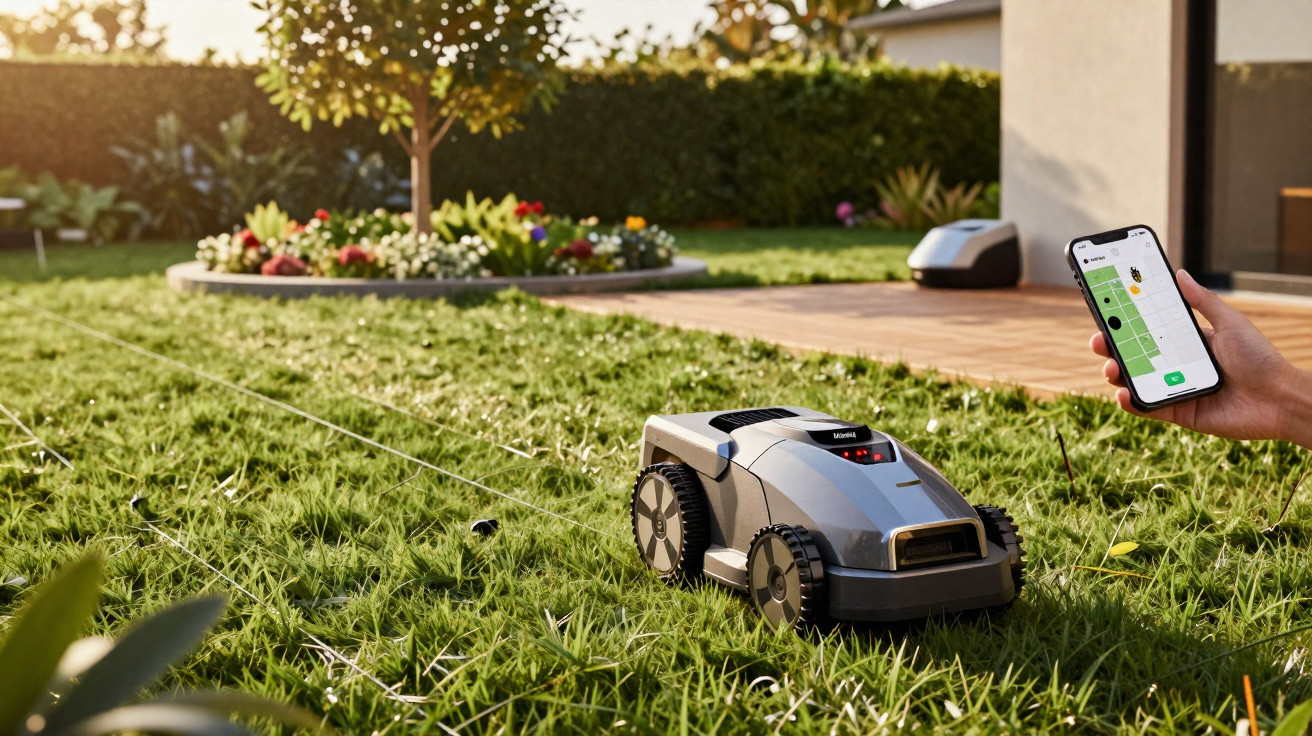
Cordless robotic lawnmowers can now take care of garden maintenance without requiring any perimeter wire to be buried. After testing them for several weeks, we selected in this comparison a specialist for every budget and lawn type: from a small suburban patch of grass to a large, uneven property, including gardens split into separate areas.
Choosing a robotic lawnmower has never been more difficult. The market has expanded dramatically in recent years. In France, sales rose by a further 8.4% in 2025 and by 66% over three years, according to research firm NielsenIQ. This growth brings new players into the market each spring while encouraging established brands to expand their ranges and product line-ups.
As a result, entry prices have dropped sharply. Some wire-free robots are now available for under €600, while the most ambitious machines comfortably exceed €3,000. For a first-time buyer, however, understanding what accounts for such large price differences is far from straightforward.
What are the main buying criteria for a robotic lawnmower?
As robotic lawnmowers become more sophisticated, they combine technologies hidden behind sometimes confusing terminology. An RTK antenna, NetRTK, LiDAR and AI-controlled cameras all influence how a robot positions itself and identifies obstacles.
Traction matters just as much. Between conventional two-wheel-drive models, three-wheel designs and all-wheel-drive machines, it is not always obvious what these differences will mean in an actual garden.
The same applies to mowing. A single disc with three blades remains perfectly adequate, yet more advanced models add a second cutting deck, increase the cutting width or position the blades further out to deliver neater edges. The app can also transform the ownership experience. Automatic mapping, separate settings for every zone, 4G connectivity and remote video feeds can make the choice feel overwhelming.
Installation simplicity, the ability to create several maps, battery life, charging time, noise levels, maintenance and spare-parts availability also need consideration. To understand the technology behind these machines and determine which criteria matter most for your plot, see our buying guide to choosing the right robotic lawnmower.
Before getting into this comparison, one point is essential: a clear, level 800 m² lawn will often be easier to maintain than a 300 m² garden full of flowerbeds, roots, narrow passages and separate sections.
Rather than ranking models from best to worst, we have selected the most accomplished options for each garden type. Every one of them was tested by our editorial team for several weeks, and sometimes several months.
Mova ViAX 250: the best entry-level robotic lawnmower
With a launch price of €579, the Mova ViAX 250 is one of the most appealing ways to buy a first robotic lawnmower. At this price, it requires neither a buried perimeter wire nor an antenna installed in the middle of the garden. Simply position its base station, connect the robot to the app and guide it around the lawn boundaries once using the virtual joystick.
To keep costs down, Mova has omitted LiDAR navigation. The ViAX 250 relies solely on its two HDR cameras and AI-assisted recognition system to find its way. This approach works well on a small, clearly defined lawn, but it requires careful initial mapping and precisely drawn exclusion zones around trees, flowerbeds and garden furniture.
This model is therefore best suited to gardens that are fairly level, uncluttered and smaller than 250 m². A square or rectangular lawn at the front or rear of a town house is its ideal environment. On more uneven ground with roots or difficult transitions, its two-wheel drive will soon reveal its limitations.
Despite its low price, mowing quality is entirely satisfactory. Its app is also feature-rich, including a surprising “Patrol” mode with video feedback and a manual control option. The latter is particularly useful for tidying up edges and corners.
What we liked about the Mova ViAX 250
- Installation without a perimeter wire or antenna for under €600.
- An app featuring “Patrol” mode and manual mowing.
- Even mowing on small, level lawns.
Read our full Mova ViAX 250 review.
Roborock RockNeo Q105: perfect for well-kept gardens
Having only recently entered the robotic lawnmower market in 2026, Roborock has not forgotten the qualities that made its robot vacuum cleaners successful. From its first runs, the RockNeo Q105 covers the lawn in neatly ordered parallel stripes, creating an attractive “stadium-lawn effect”. Priced at €799 and designed for areas of up to 500 m², it is primarily suited to maintained gardens with few trees and gently uneven terrain.
Its large rear wheels enable it to clear obstacles measuring 4 cm and tackle stated slopes of up to 45%. Large roots require caution, however. During our test, they damaged its blades enough to require replacement after only three mowing sessions.
For closer mowing alongside walls, Roborock offers a separately sold PreciEdge module for around €99. It brings the cutting line to roughly 3 cm from the edge, although we would have preferred it to be included in the box.
The brand performs more convincingly on the software side. Its app can manage up to 15 zones, schedule mowing sessions and adjust obstacle avoidance. The Q105 nonetheless retains two somewhat dated choices: it needs an RTK antenna installed in an open area, and its cutting height can only be adjusted using its physical dial.
What we liked about the Roborock RockNeo Q105
- Very tidy mowing with an attractive “stadium-lawn effect”.
- A clear, well-equipped app.
- Good capability on gently uneven ground.
Read our full Roborock RockNeo Q105 review.
eufy E18: the best automatic mapping
There is no wire to bury and no RTK antenna to install. On that basis, the eufy E18 looks like any other modern wire-free robotic lawnmower. Its real distinction becomes clear during installation: there is not even any need to drive it around the garden with a joystick to mark out the lawn boundaries.
Once its station has been placed at the lawn edge, the eufy E18 sets off alone to explore its new working area. Its cameras identify boundaries, flowerbeds, trees and obstacles before automatically creating a map.
This function is not exclusive, of course, but it is generally most relevant for simple, rectangular lawns. During our testing, however, the E18 successfully mapped a more complicated garden independently, requiring only a few minor adjustments to the resulting map.
Its entirely vision-based system then avoids obstacles effectively and delivers a clean cut, including in dense or slightly damp grass. Another welcome point is that the E18 is among the quietest robotic lawnmowers in this comparison. This is a genuine advantage for anyone who does not want every session to turn their garden into a building site.
Built for areas of up to 1,200 m², it also benefits from a comprehensive app with video feedback and 4G connectivity. That ease of use comes at a considerable cost, though, as the E18 launched in 2025 at €1,799.
It is a shame that, at this price, its vision-only navigation becomes less effective as light levels fall. Its maximum slope capability is also limited to around 40%, a figure that quite a few cheaper competing robots exceed without difficulty.
What we liked about the eufy E18
- Truly convincing automatic mapping.
- Particularly quiet operation.
- Clean cutting, even in dense grass.
Read our full eufy E18 review.
Segway Navimow i208 LiDAR: the specialist for complex gardens
Narrow passages, flowerbeds, trees, roots and garden furniture can turn some gardens into obstacle courses. This is exactly the kind of setting where the Segway Navimow i208 LiDAR is at its most comfortable. Unlike robots that rely mainly on satellite positioning, it combines LiDAR with a wide-angle camera to build an understanding of its surroundings. Consequently, it retains its bearings even beneath trees and alongside walls.
During our test on a particularly intricate 250 m² plot, it did not require any manual intervention to escape an awkward situation. Installation remains fairly straightforward, too. The first map can be drawn with the joystick or generated automatically by the LiDAR, after which the app allows users to add exclusion zones, connecting routes and several mowing areas. This flexibility is welcome when a lawn is arranged around a patio, parking area or multiple paths.
Its 22 cm cutting width produces consistent results, and its operation is reasonably quiet. Its weaknesses mainly emerge on very steep or waterlogged ground. It is also not flawless at the edges, leaving around 5 cm of grass alongside paths and 10 to 15 cm against walls.
At €1,199 and able to manage up to 800 m² on a single map, the Navimow i208 LiDAR will not be the cheapest choice for a simple lawn. It is, however, one of the most reassuring models once a garden becomes more complicated, particularly when it includes numerous corners, obstacles and hard-to-reach areas.
What we liked about the Segway Navimow i208 LiDAR
- Extremely precise navigation in complex gardens.
- Quick installation without a wire or antenna.
- Neat mowing and careful build quality.
Read our full Segway Navimow i208 LiDAR review.
Dreame A3 AWD Pro 5000: ideal for large, sloping grounds
At almost 24 kg, with four driven wheels each powered by an independent motor, the Dreame A3 AWD Pro 5000 resembles a small off-road vehicle more than a conventional robotic lawnmower. This abundance of traction allows it to clear obstacles 5.5 cm high and tackle stated slopes of up to 80%.
Its navigation system is equally ambitious. The robot combines 360° 3D LiDAR with two cameras. In other words, everything it needs to navigate is carried on board. It therefore has no dependence on a satellite-based NetRTK service. Its built-in 4G connection is used for remote control and location, never for navigation. Its twin cutting deck offers a 40 cm cutting width, nearly twice that of most robots in this comparison.
Combined with its generously sized battery, this enabled it to cover between 800 and 900 m² per charge in our test. Such endurance is essential when taking on the claimed 5,000 m² capacity, although maintaining a surface of that size will inevitably take several days.
That power has drawbacks, however. Its weight quickly marks wet ground and makes it awkward to move manually. At €2,999, we would also have liked a shelter for the base station to be supplied in the box.
Ultimately, the Dreame A3 AWD Pro 5000 would be vastly oversized for a flat, open lawn. It comes into its own on large properties that are sloping, uneven and strewn with obstacles.
What we liked about the Dreame A3 AWD Pro 5000
- Formidable 4×4 traction on uneven ground and slopes.
- A 40 cm cutting width suited to large areas.
- Fully onboard navigation (LiDAR and two cameras), effective even beneath trees and close to buildings.
Read our full Dreame A3 AWD Pro 5000 review.
A comparison that will continue to evolve
This selection will be updated regularly as we complete further tests and new models arrive on the market. For a clearer understanding of the differences between an RTK antenna, NetRTK, LiDAR and camera navigation, our robotic lawnmower buying guide is available; it also explains traction, mapping and apps.





Comments
No comments yet. Be the first to comment!
Leave a Comment