
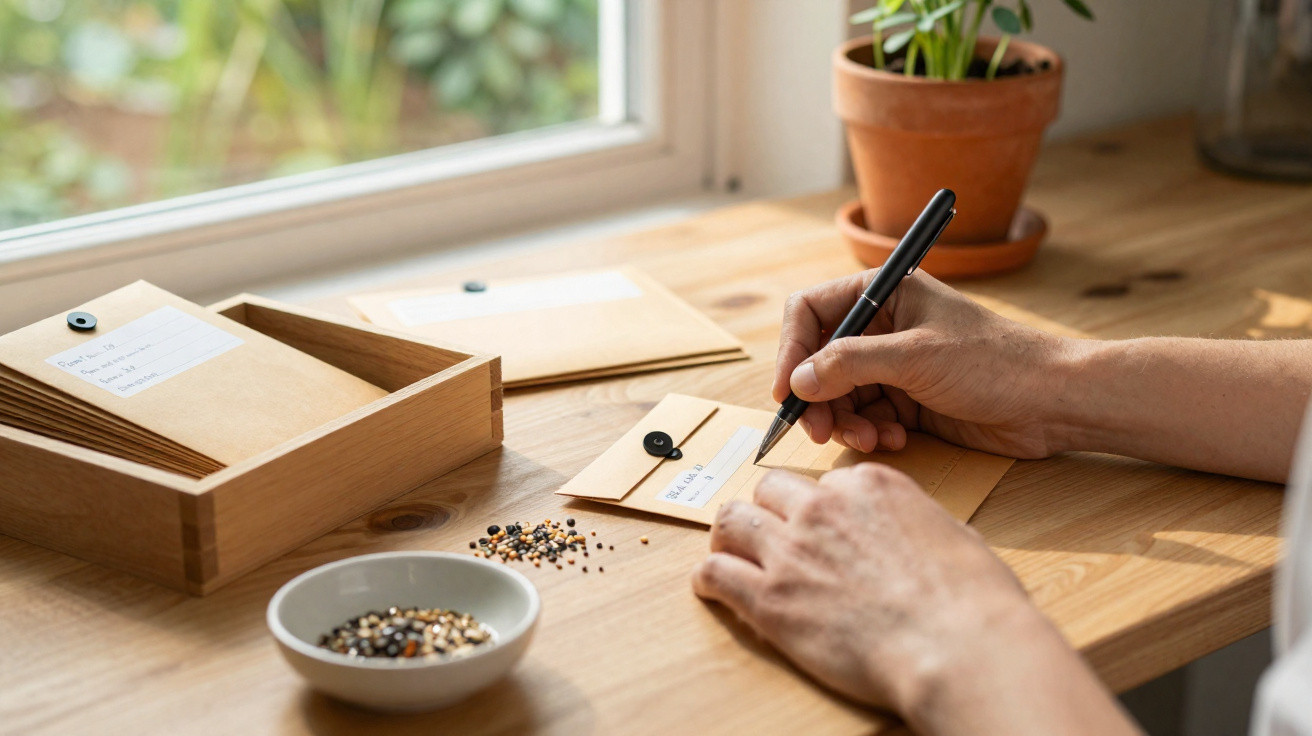
When it was time to plant again, Clara opened the box where she kept her seeds and spotted the problem: small packets had become mixed together, some without labels and others bearing names she could no longer link to the plants. Rather than searching for each variety whenever she wanted to sow, she chose to set up a straightforward system using labelled paper envelopes.
Why can organising seeds make growing easier?
Storing seeds without labels can quickly turn a modest collection into a real muddle. After several months, it is easy to forget the species, the variety or even when a particular seed was put into storage.
A simple arrangement makes it quicker to see what is available while helping to track key details, such as the date seeds were collected or bought. Storage therefore becomes more than a tidying task: it becomes part of planning the growing season.
How can paper envelopes help separate seeds?
Small envelopes act as individual compartments. Each species can have a dedicated envelope, preventing seeds of different shapes and sizes from being mixed together.
Clara realised that elaborate containers were unnecessary. She only needed to select suitable envelopes, ensure the seeds were completely dry before storing them and write the essential details on the outside. What matters is that the label remains readable throughout the storage period.
What should be written on each seed envelope?
Once she had sorted the collection, Clara established a consistent format for every packet. She could then tell exactly what each envelope contained at a glance, without opening several packets.
- Plant name: clearly state the species or variety.
- Collection date: use this when seeds have been produced in your own garden.
- Purchase date: useful for seeds bought ready to use.
- Notes: record important details about the seed’s origin or cultivation.
Envelopes can also be numbered alongside a short inventory list. For larger collections, this approach makes finding particular varieties even easier.
Where should envelopes be kept to preserve seeds better?
Organisation works best when it is combined with suitable storage conditions. Seeds should be shielded from moisture, excessive heat and direct light, as these factors can affect how well they keep.
After sorting the envelopes, Clara began keeping them in a sealed container in a cool, dry, dark place. This made the collection easier to check, while the seeds no longer ended up scattered around the house. A simple paper-based solution had created a small growing archive for the next season.

Comments
No comments yet. Be the first to comment!
Leave a Comment