
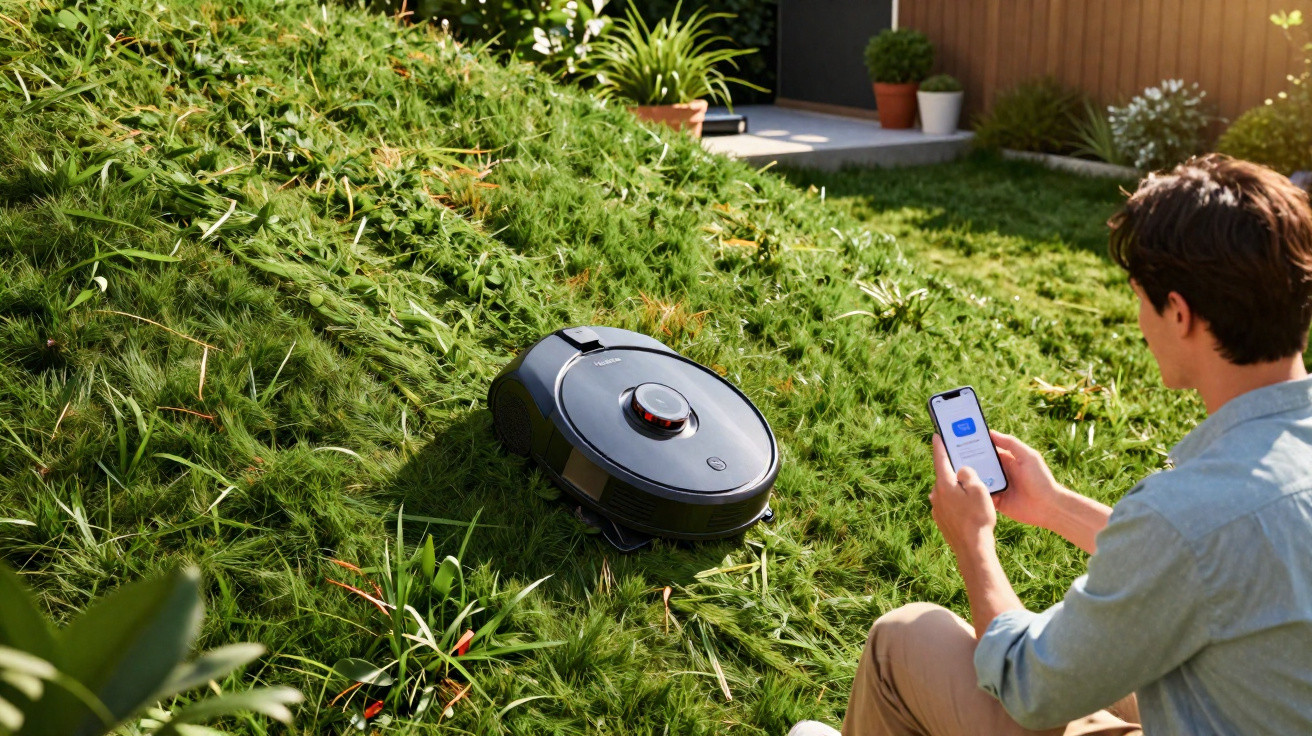
After four months of testing across a very steep 500 m² garden, here is my verdict on the RockMow Z1 LiDAR: Roborock’s robot lawn mower needs neither boundary wire nor antenna, and succeeds where other machines have failed.
My garden is a nightmare scenario for robot lawn mowers. It covers 500 m², includes several serious slopes, raised sections and a small isolated patch of grass by the parking area. I have watched several models give up: they could not climb, including the Husqvarna 405XE Nera, which was unable to tackle my main slope. So, as someone who has used Roborock robot vacuum cleaners for years, I was naturally intrigued when the company entered the lawn-mowing market.
The sector has certainly gathered pace. Major robot vacuum brands are arriving in our gardens one after another, and Roborock has finally made the move with two ranges of robot lawn mowers. The RockNeo models use RTK navigation, while the RockMow range is LiDAR-guided. This Z1, also known as the Z120 LiDAR, is the top-of-the-range model, designed for plots of up to 2,000 m².
There is no need to keep you in suspense: the RockMow Z1 LiDAR is the first robot to conquer my garden, and it is the most impressive garden product I have used. Two genuine questions remain: how does it perform in daily use, and can its €2,799 price be justified? This review has the answer.
What I liked about the Roborock RockMow Z1 LiDAR
Outstanding on slopes
This was the issue that ruled out every previous machine in my garden. A substantial part of the plot rises sharply, and every robot I had tried before eventually spun its wheels, displayed an error or simply avoided the area. The RockMow Z1 LiDAR, by contrast, travels everywhere as though the gradients were irrelevant. Over four months, I have never seen it give up on a slope or become trapped by a difficult layout. Its uphill mobility is genuinely remarkable, and it does not leave marks behind.
Roborock has clearly paid close attention to the mechanical design, which is obvious at first glance. Sitting on the lawn, the Z1 looks unlike anything else: it has two powered, steering front wheels topped by large motor units, plus rear wheels fitted with visible spring suspension, rather like an XXL radio-controlled car. Its 21.7 kg weight sits firmly on the grass. This is excellent in use, although prepare yourself before delivery: the box is very heavy and extremely bulky.
The brand claims it can manage slopes of up to 80% and climb obstacles measuring 8 cm, and, unusually, the specification sheet matches real-world garden performance. It even climbs the raised parts of my plot, which is ideal for reaching my upper garden. That suspension travel is not merely decorative: it allows all four wheels to remain in contact with ground that rises, falls and becomes uneven.
Wire-free, antenna-free installation with no fuss
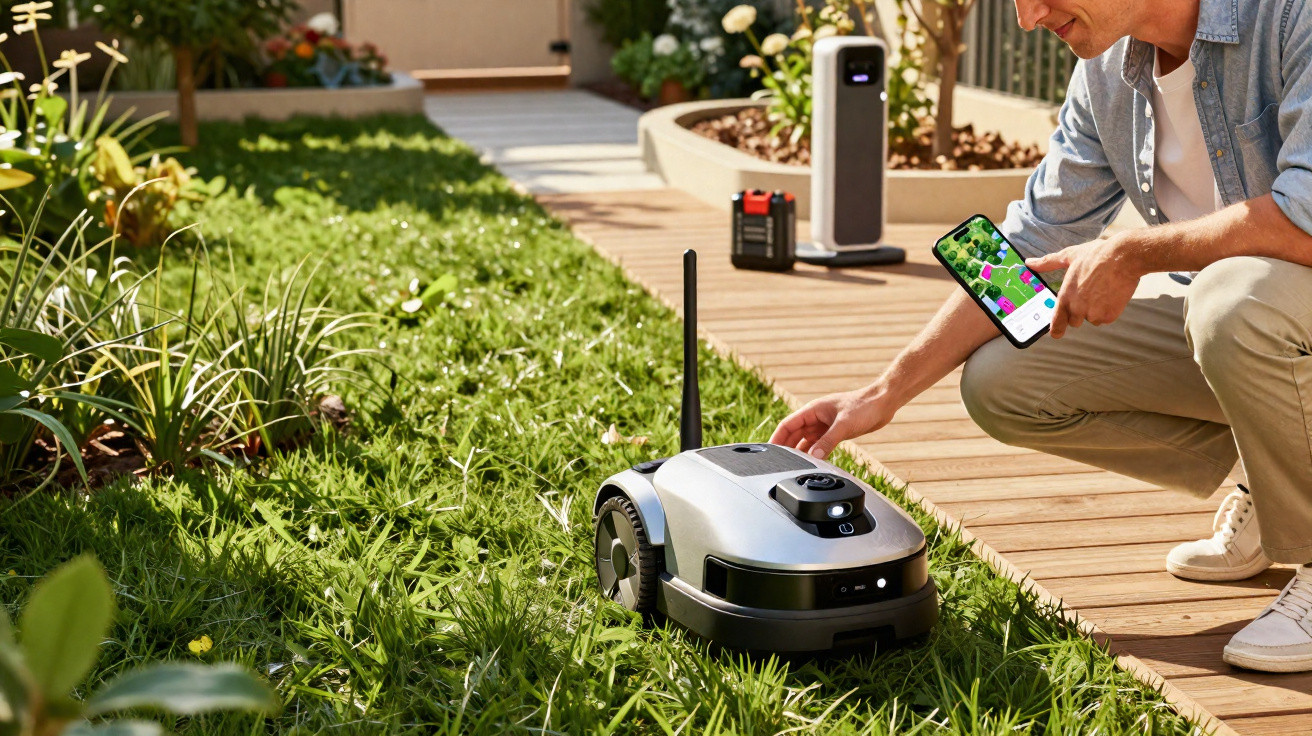
The second welcome surprise comes during setup. There is no perimeter wire to lay and no RTK antenna to install in the middle of the lawn, which was one of our criticisms of the RockNeo Q105, the brand’s other robot lawn mower. Navigation relies on its LiDAR dome and onboard sensors, and that makes a major difference.
Setup simply involves guiding the robot around the areas to be cut, and that is all. I found the process easier than Husqvarna’s, while remote-zone management is a real advantage: the small lawn area beside my parking space receives the same regular cut as the rest of the garden. The highly intuitive app then handles every setting, from schedules to exclusion zones.
One piece of advice, however: take the time to define those exclusion zones properly, because the Z1 is a brute. At my home, it drove over a very low edging strip, which it did not recognise as an obstacle, and knocked over a miniature olive tree in the process (it survived). It was nothing serious, and since I properly marked out the boundaries, it has recognised its surroundings very effectively and avoided what it should. Still, when more than 21 kg of machine is moving near your flower beds, prevention is preferable.
Fast, tidy and quiet cutting
This is where Roborock’s experience with robot vacuum cleaners becomes obvious. The RockMow Z1 LiDAR cuts in exceptionally neat parallel stripes, following intelligent routes rather than passing over the same area ten times. Beneath the housing, a 24 cm disc with six blades does the work. I have never seen mowing completed so quickly: this morning, it took 3 hours 10 minutes, including 2 hours 17 minutes of mowing, to cover roughly 260 m², charging included. My entire 500 m² garden is finished within half a day, including recharges; allow just under an hour for a full charge.
In everyday use, I run it every other day with the cutting height set to 40 mm. The height can be adjusted to the nearest millimetre between 20 and 70 mm. That routine keeps the lawn immaculate without requiring any effort from me. During the heatwave, I reduced the mowing frequency to avoid stressing the grass, and the app is extremely useful for starting it remotely. This morning’s run was its first in two weeks, yet the garden looks tidy. Another key point is that the robot does not operate in the rain. Special mention must go to the sound, or rather lack of it: it is almost silent, to the extent that you can completely forget it is working.
As for the finish, the optional PreciEdge module brings cutting closer to edges and produces a slightly more precise result. It cannot work miracles everywhere: around my patio, I still need to use a manual edge trimmer. That is the only place where the robot leaves me work to do.
What I liked less about the Roborock RockMow Z1 LiDAR
The price, inevitably
You knew this was coming: here is the disappointing part. The RockMow Z1 LiDAR has a recommended retail price of €2,799, excluding the PreciEdge module. That is very expensive, even if it is in line with other premium robot lawn mowers built for large gardens. I would add one lesson from experience: supposedly more affordable models that cannot climb your slope are simply money wasted.
The real question lies elsewhere: do you need it? If your garden is flat, open and reasonably sized, a considerably cheaper model will do the job, starting with the brand’s RockNeo range. The Z1 makes sense for complicated, steep and fragmented plots: precisely the places where other robots give up. In this niche, I do not think it has an equal. That said, knowing Roborock, prices can fall very quickly, at which point it will come close to perfection.
My verdict after four months with the RockMow Z1 LiDAR
After more than four months of use, I am still looking for genuine shortcomings in the RockMow Z1 LiDAR. A garden I had considered unsuitable for robotic mowing has become a textbook case: setup was completed quickly, slopes were effortlessly handled, mowing is fast, neat and quiet, and the app is as good as Roborock’s best software. You simply need to accept the price and keep an eye on its exclusion zones during the first few weeks.
Currently rated 9.5/10, I will update that score in a year, once I have enough perspective on maintenance and durability, both of which are essential considerations for robot lawn mowers. For now, if your lawn resembles a mountain stage more than a golf green and your budget can stretch to it, go for it: I have never used a garden product like this.
Roborock RockMow Z1 LiDAR
€2,799
Overall rating
9.5/10
What we like
- Perfect for steep gardens
- Fast and effective mowing
- Comprehensive app
- Simple, quick installation
What we like less
- The edge-cutting function requires an additional purchase
- Stratospheric price
Buy at the best price





Comments
No comments yet. Be the first to comment!
Leave a Comment