
With temperatures rising and electricity bills soaring, here is how to get through heatwaves without spending a fortune.
No, you have not tried everything to cope with a heatwave. Tired of having to keep their shutters closed all day and live in darkness, some people in France are turning to a little-known method reported by 20 Minutes.
According to our colleagues, the Ministry of Health advises reducing sources of heat inside the home:
“To do this as effectively as possible, the guidance is very clear. During periods of extreme heat, electrical appliances that give off heat should be switched off rather than left plugged in. Cutting power to screens and other boxes using extension leads stops standby equipment from acting like invisible radiators. Modern living can therefore be combined with more minimalist and clever habits.”
In any case, France is currently experiencing very hot weather, and it is unlikely to improve as summer progresses. If, like us, you are suffering because of the heat, you may be tempted to leave your shutters partly open during the day to create a draught.
As Futura Science explains, this is clearly not a good idea, because shutters have an essential role during a heatwave:
“This external protection is especially important because, once the sun’s rays pass through the windows, they heat the walls, floors and furniture. The heat stored in this way then remains trapped indoors, creating what is known as a domestic greenhouse effect.”
Therefore, when the outdoor temperature is higher than the indoor temperature, gaps in shutters must not be left open during the day.
Natural ventilation: the most effective weapon
Once temperatures have fallen, ventilation remains the ultimate low-cost weapon against the heat. The principle could not be simpler: open your windows wide when it is cool, usually overnight, then close them before temperatures start rising again. Creating a through-draught can cool your home without costing a penny.
You simply need to retain that cool air during the day by closing every window, shutter and curtain, creating a barrier against the sun’s rays. Yes, your summer may be rather dark, but at least your poorly insulated home will not reach 30°C, and you will not spend a fortune on electricity while the air conditioning runs flat out.
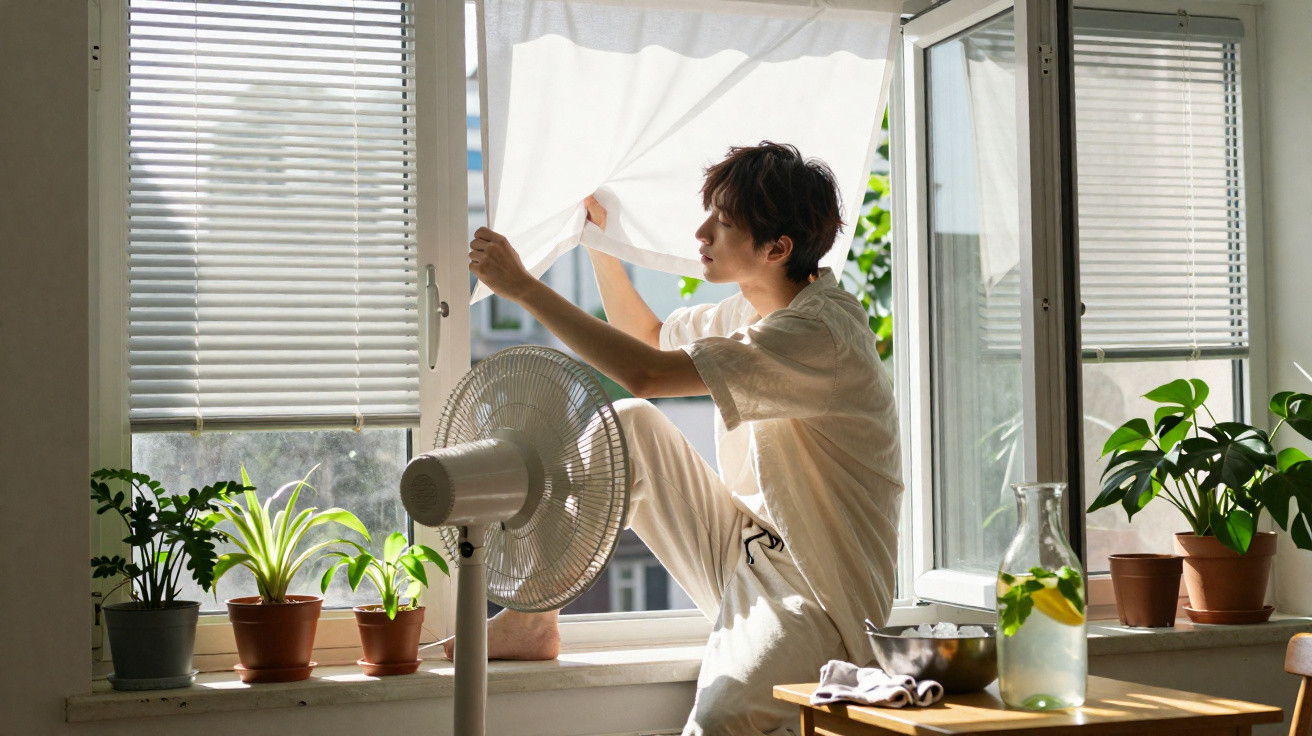
You can also use a fan, a formidable ally when it is used properly. Placed in front of an open window in the evening, it draws in the outdoor air as it begins to cool. The insider tip? Put a container filled with very cold water in front of the blades.
Evaporation turns a modest tabletop fan costing only a few pounds into a makeshift air conditioner. The cooling effect is felt immediately, and a fan heater uses more than 10 times less electricity than a portable air conditioner.
There is also the wet-sheet technique, used in traditional Maghreb architecture. Damp fabrics are hung in air currents to cool the atmosphere. The modern version involves soaking an old sheet in cold water, lightly wringing it out and hanging it in front of an open window. Evaporation draws heat from the incoming air and can lower the temperature by 4 degrees.
Barricade your home against the sun
If you are facing an emergency and have very little money, aluminium foil could save the day. Applied with its shiny side facing outwards to every sun-exposed window, it turns the glass into a reflective mirror.
This option costs virtually nothing compared with professional solar films sold at a high price. However, the best approach is still to close your shutters and curtains before the sun returns, after airing your home with cool air throughout the night.
Hunt down hidden heat sources
As explained above, household electrical devices behave like radiators in disguise. A laptop produces as much heat as a 150-watt radiator, while internet routers also give off a constant and unexpected amount of heat. Systematically unplugging all non-essential equipment during heat peaks makes a noticeable difference to the ambient temperature. So do not hesitate to unplug every device you are not using: your electricity savings will be even greater.
Also take care with halogen bulbs, which convert electricity into heat. Modern LEDs use ten times less energy and produce negligible heat.
It is rarely considered, but the kitchen becomes a major issue during a heatwave. An oven turns any home into a stifling hot room, while hobs release intense heat. The winning strategy is to prepare meals very early in the morning, when temperatures are still bearable, and favour cold dishes, salads and gazpachos that require no cooking.
Adapt your routine like people in hot countries
Mediterranean populations have developed a way of life suited to high temperatures over centuries. Their secret? Completely changing their daily routine to avoid the hottest hours. Get up at 6 am to enjoy the morning coolness, take a siesta from 2 pm to 4 pm when temperatures are at their highest, then resume activities towards the end of the day as the sun goes down.
When resting, the human body produces far less heat and uses less energy. The Mediterranean siesta falls exactly during the hours when outdoor temperatures peak. Naturally, this will depend on your work situation, but it is a good way to adapt your routine in summer.
Choose your clothes strategically
Textile materials directly affect how hot you feel. Polyester and synthetic fibres trap perspiration, creating a greenhouse effect on the skin. By contrast, linen, cotton and bamboo allow the skin to breathe and support natural evaporation.
Colours also have an important physical effect. Light shades reflect the sun’s rays, whereas dark colours absorb them and turn them into heat. A black T-shirt in 35°C heat turns its wearer into a walking radiator.
The chilled-laundry technique brings immediate relief. Sheets, T-shirts and underwear can be put in the fridge for thirty minutes before use. That instant coolness against the skin temporarily offsets the ambient heat and makes thermal peaks easier to endure. Otherwise, there is always Sony’s personal air-conditioning device, although it is not cheap.
Turn your nights into a refuge
Heatwave nights call for minimal but appropriate bedding. Duvets and blankets should be replaced with a simple linen or cotton sheet. These natural materials wick away body moisture more effectively than synthetic fibres. In extreme cases, sleeping directly on the mattress avoids layering fabrics altogether.
A chilled pillow works wonders against heat-related insomnia. One hour in the freezer before bedtime is enough to create a cool spot that lasts for several hours. This method helps you fall asleep despite night-time temperatures above 25°C, and it is not especially expensive.
A hot-water bottle in summer - surely you would have to be mad? In fact, an iced hot-water bottle filled with cold water and placed in the freezer for two hours releases coolness into the bed for hours. Its gradual cooling effect helps you drift off without causing thermal shock.
Summer means staying hydrated
Hydration in high heat follows some counter-intuitive rules. Iced drinks, despite their immediate appeal, hydrate less effectively than lukewarm liquids. They cause thermal shocks that disrupt the body’s temperature regulation. Fresh mint herbal teas and cucumber-infused waters, consumed at room temperature, provide longer-lasting refreshment.
Frequency matters more than quantity. Drinking small sips very regularly enables optimal absorption. The body handles a steady intake of fluids better than occasional large amounts. This approach maintains stable hydration, even in very hot weather.
Food also actively helps to cool the body. Watermelon, cucumber, tomato and courgette contain more than 90% water and perfectly complement liquid hydration. These water-rich foods quite literally cool you from within while providing the mineral salts lost through perspiration.
Invest wisely without breaking the bank
Some modest items can radically improve thermal comfort. A £35 electric misting fan combines ventilation with water evaporation to create a natural air-conditioning effect. Provided it is kept nearby, as it cannot cool a large space, it offers immediate relief.
A fan uses 50 watts, compared with 2000 watts for a portable air conditioner. Over three months of intensive use, the electricity saving exceeds £200. The tip for remote workers or people stuck in offices where colleagues fight over the temperature is a desk fan.
This personal fan keeps you cool throughout the day while using particularly little electricity. You now have all the techniques needed to cool down at low cost.


Comments
No comments yet. Be the first to comment!
Leave a Comment