
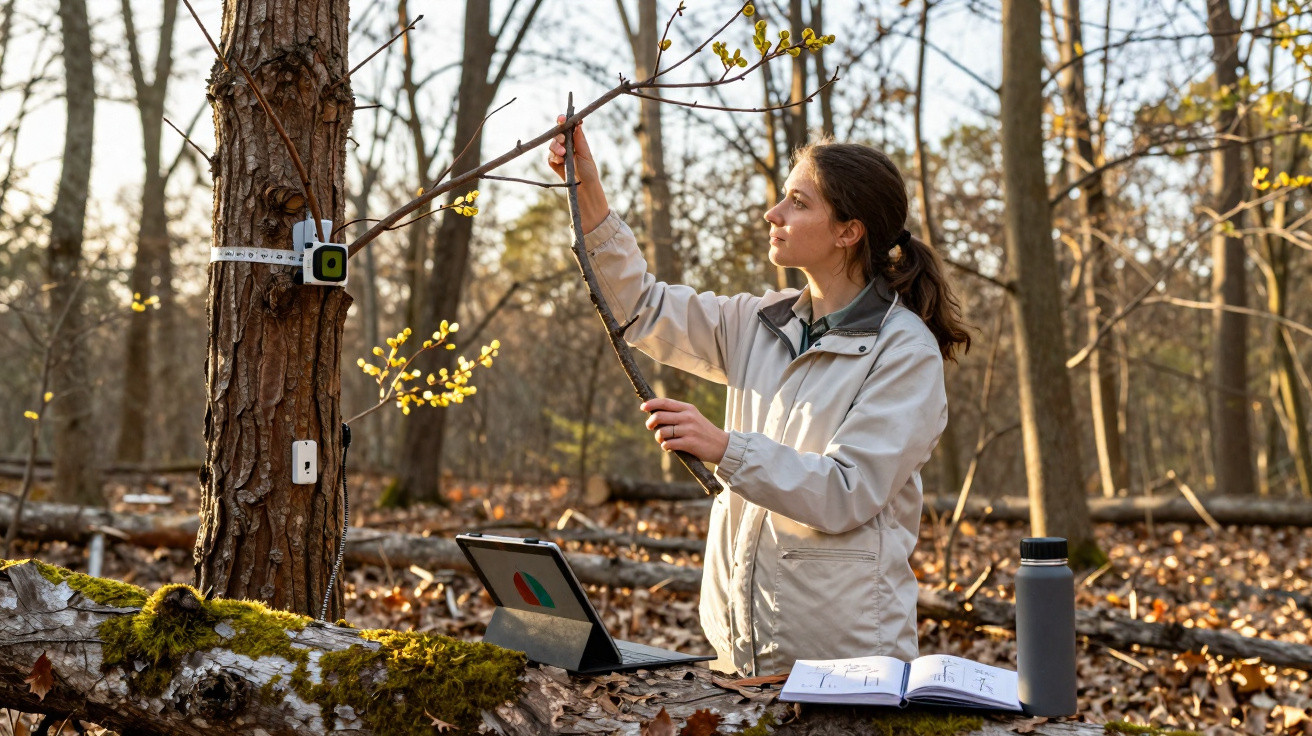
When spring comes, most people first spot the familiar changes: buds appearing, new colour, and the sudden impression that the forest is coming back to life.
However, a UBC Okanagan researcher says that some trees may send out a quieter signal that is unexpectedly simple to see. As they replenish water after winter, particular branches rise. As the trees begin to lack water, those branches gradually hang lower.
Magali Nehemy, a forest hydrology researcher in UBCO’s Department of Earth and Environmental Sciences, has been examining the processes within trees as winter gives way to the growing season. Her latest research investigates branch movement as trees rehydrate in spring.
“Spring rehydration is one of the key transitions in forest ecosystems,” Nehemy said. “It marks the moment when trees begin to restore internal water reserves and prepare for the growing season.”
Observing trees as they rehydrate
The research followed balsam firs in Ontario’s Muskoka area between early March and mid-May, when melting snow and the first rainfall events started restoring water reserves.
Nehemy’s researchers fitted tree stems with high-resolution sensors and used time-lapse images to compare the trees’ internal water condition with visible alterations in branch position.
The instruments recorded stem radius at 15-minute intervals, detecting minute expansions and contractions as water moved out of and back into the trees’ tissues.
Meanwhile, the time-lapse cameras recorded small yet reliable changes in branch angles.
The trend was unmistakable: branches slowly rose during snowmelt and rain, then drooped as conditions became drier.
What stem size can reveal
Stems do not expand and contract at random; these shifts occur as a tree’s water balance changes.
As a tree loses water, its tissues shrink slightly. Once water is restored through snowmelt, rainfall and uptake by the roots, those tissues enlarge again.
For this reason, dendrometers, or stem-radius sensors, are commonly used in forest hydrology and ecophysiology: they provide a high-frequency indication of water stress and recovery.
Nehemy’s research found that branch posture closely follows these internal shifts. What appears to be a minor physical droop may therefore indicate a significant change in the tree’s hydration.
Why the timing of water is important
This has practical relevance because climate change is changing the way northern forests receive water. Milder winters may affect snowpack, earlier spring thaw can alter when moisture is available in soils, and longer dry periods can arrive at difficult points during the growing season.
Against that background, the ability to “read” a tree’s water condition is valuable not just to scientists, but potentially to land managers and field observers assessing how forests are responding.
Nehemy suggests that observable signs such as branch posture could provide another view of forest responses, particularly where conventional measurements are hard to install across large areas.
Tree branch posture reveals water stress
One important complication is that trees react to more than water availability. Spring also brings abrupt temperature swings, with cold nights and warm days producing freeze–thaw cycles that can cause striking short-term changes in stem size.
Nehemy says the study detected these sudden stem-size shifts on cold spring nights, but branch orientation did not react in the same manner.
“Interestingly, freeze–thaw cycles on cold spring nights caused sharp changes in stem size but had little effect on branch orientation,” Nehemy said. “This suggests that branch posture reflects longer-term water status rather than short-term temperature fluctuations.”
In other words, a drooping branch is not simply a response to a cold night. Instead, it may be a gradual sign that water stress is increasing within the tree.
Different tree species, different signals
The team also found that the effect does not apply equally to every tree type. In the same woodland, nearby leafless deciduous trees showed little or no branch movement, whereas evergreen conifers displayed much clearer posture changes.
This prompts further questions about differences between species in branch biomechanics, leaf structure and water-transport strategies.
It also raises the possibility that branch posture could serve as a wider monitoring method for certain forests, but not for others.
A visual clue at low cost
Nehemy is keen not to make excessive claims. Observing branches is not equivalent to measuring stem water potential or using comprehensive arrays of sensors.
“Branch movement is not a replacement for scientific instruments such as dendrometers or plant water sensors,” she said.
“But it could offer a visual, low-cost indicator of tree hydration, and this is especially useful for field observations or ecosystem monitoring.”
Plants move more than expected
Plant movement has intrigued scientists for centuries, yet much remains unknown about how and why plants alter their form in response to surrounding conditions.
This study contributes another useful detail: for at least some conifers, it may be possible to observe the spring “refill” as it occurs. Branches lift as water returns, and they sag when the tree begins to run short.
The movement is slight, but in a warming world where the timing of water matters increasingly each year, it may be a useful sign to watch.





Comments
No comments yet. Be the first to comment!
Leave a Comment