
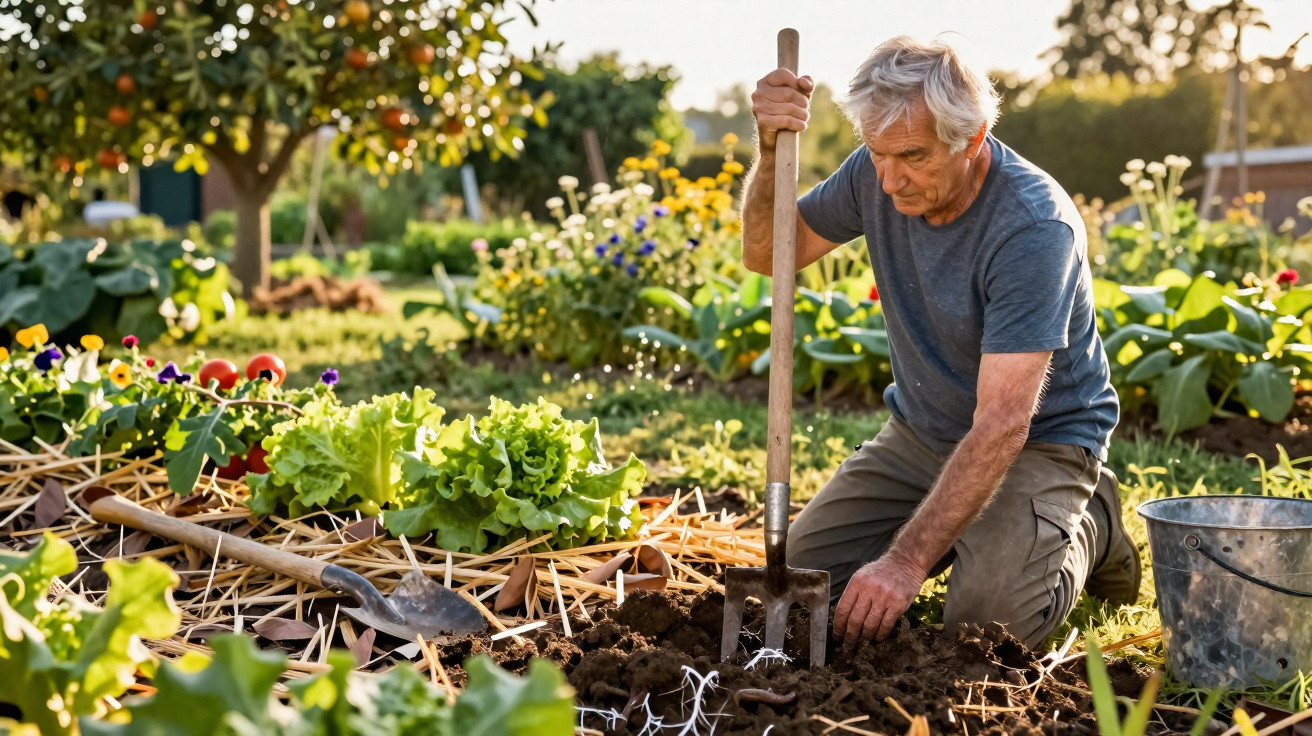
The first sunny day arrives, the ground begins to dry and the spade is ready: for generations, digging over the garden in spring has marked the traditional start of the new gardening season. Yet what was once seen as an essential task is increasingly being recognised as a risk to soil life, your back and, ultimately, the harvest.
Why traditional digging causes so many problems
Far more life exists beneath our feet than is immediately apparent. A single gram of healthy soil contains hundreds of millions to billions of bacteria, along with fungi, nematodes, tiny arthropods and earthworms.
Soil is not an inert growing medium but a living ecosystem – and it responds sensitively to rough intervention.
These organisms are not spread through the soil at random. Every layer has its own conditions of moisture, oxygen and temperature. This is exactly why deep digging with a spade is so problematic:
- Organisms from deeper, oxygen-poor layers are suddenly brought to the surface, where they die.
- Creatures from the well-aerated upper zone are buried at depths in which they cannot survive.
- Delicate fungal networks are torn apart, soil crumbs break down and the structure collapses.
This creates a real underground clear-out, especially in spring when soil life should be becoming fully active. The result is reduced nutrient cycling, poorer water absorption and plants under stress.
Mycorrhiza: the plants’ invisible supply network
So-called mycorrhizal fungi are especially vulnerable. Their fine filaments effectively surround and extend plant roots. They access nutrients that roots could not reach on their own and draw water from the tiniest pores.
When soil is aggressively turned over, this network is broken. Vegetables, fruit bushes and perennials are then literally less well “connected” and must slowly establish a new partnership with fungi. During this period, they grow more hesitantly and are more susceptible to disease and drought stress.
Gentle on the soil: how a broadfork changes everything
Rather than turning the soil upside down, more and more gardeners are using a broadfork-style tool that loosens the ground without inverting it. It has several sturdy tines and two handles, allowing it to be used as a lever.
The principle is simple: loosen the soil without turning it, so the layers remain where they belong.
This is how to use it in a bed:
- Push the tool vertically into the soil.
- Pull the handles backwards until the soil lifts slightly.
- Leave it in place, move along a short distance and repeat the action.
The soil structure is loosened, compaction is broken up and air reaches deeper layers. Crucially, however, most organisms remain in their existing habitat and the soil’s horizontal arrangement stays intact.
A major advantage for older gardeners: less strain on the back
This approach is particularly appealing for older gardeners. Instead of lifting heavy clods of earth with a spade, you use leverage with both arms. This noticeably reduces strain on the lumbar spine.
Anyone who develops back pain quickly, or simply wants to garden more gently, can benefit greatly. Many people say they can work in their beds for longer and more comfortably with the broadfork-style method, without “falling apart” the following day.
Timing matters: soil that is slightly moist is ideal. Very dry ground can be rock-hard and may bend the tool’s tines, while waterlogged soil smears and compacts again as it dries. In many gardens, the day after a good spring shower is perfect.
Mulching: the quiet revolution in the vegetable garden
Anyone who genuinely wants to care for their soil should think beyond loosening it and focus on lasting protection: mulch. This means covering the ground with organic material, much as the forest floor is continually covered by fallen leaves.
Suitable materials include:
- Straw or hay, preferably slightly wilted rather than fresh
- Leaves, ideally shredded or chopped
- Dried grass clippings applied in thin layers
- Woodchips, especially for paths and beneath shrubs
Mulch acts like a protective blanket: it keeps the soil moist, cool and alive.
The benefits are often apparent after only one season:
- Soil retains moisture for longer, greatly reducing the need for watering.
- Temperature fluctuations are less severe, allowing micro-organisms to work more consistently.
- Weeds are less able to germinate through the covering.
- The surface does not form a crust after rain, so water penetrates more easily.
- Earthworms pull mulch into deeper layers and turn it into fertile humus.
This saves both time and energy, particularly for anyone who no longer wants to spend hours weeding and carrying materials. Less hoeing, less watering and less bending means the garden increasingly runs “in the background” because the soil itself is doing the work.
Soil biology: why less intervention can mean greater yields
Research is showing ever more clearly that plants do not live as isolated individuals. They are in constant exchange with bacteria, fungi and other tiny soil organisms. Through root exudates, plants “feed” these partners, which in return provide nutrients or help repel pathogens.
Examples of this collaboration include:
- Bacteria fix nitrogen from the air and make it available to plants.
- Fungi extend the reach of roots many times over and transport minerals.
- Earthworms incorporate organic matter and leave behind nutrient-rich castings.
When soil is not completely turned over every year, stable and complex communities can develop. You notice the difference in daily gardening: plants grow more evenly, cope better with dry spells and need less added fertiliser.
Practical changes: what to do instead of digging
There is no need to transform the entire garden overnight. A gradual change is entirely sufficient. One possible approach for this year is:
- Loosen beds only with a broadfork-style tool rather than turning them over.
- Apply a thin layer of mature compost, around five centimetres deep, to the surface.
- Cover bare areas immediately with mulch so they do not dry out or form a crust.
If the ground is heavily compacted or very heavy, meaning highly clay-rich, an initial one-off deeper intervention may be necessary. The important thing is not to treat this as an annual ritual, but as a starting point. With every season in which more organic material remains on the surface and less deep disturbance takes place, the structure improves naturally.
How healthy soil reveals itself in everyday gardening
Several signs show that you are on the right track:
- When working by hand or with a small spade, the soil breaks into stable crumbs rather than hard lumps.
- Earthworms appear within just a few centimetres of the surface.
- After heavy rain, water does not remain standing for long but drains away quickly.
- The surface dries out while the soil underneath remains pleasantly moist.
Soil like this practically carries the plants. Roots penetrate more easily, nutrients are distributed more effectively and the bed can be worked comfortably for almost the entire year.
Common mistakes – and how to avoid them
When switching from conventional spade work to gentler methods, it is easy to make mistakes at first. Frequent pitfalls include:
- Mulch layers that are too thick: More than 10–15 centimetres can easily rot, especially when fresh grass clippings are used.
- The wrong material around young plants: Coarse woodchips directly in a vegetable bed tie up nutrients; fine compost or leaves are better choices.
- Working when the soil is wet: Every step on wet ground causes compaction, so wait until the soil appears “crumbly”.
- Avoiding all loosening altogether: In severely compacted soil, roots initially need help simply to get started.
Keeping these points in mind allows you to build, step by step, a system that delivers less work and higher yields over the long term.
Why it is worth saying goodbye to the spade ritual
Many older gardeners report that spring becomes noticeably less demanding after making the switch. Instead of spending days lifting heavy clods of earth, a few hours of gentle loosening and spreading mulch are enough.
The real transformation, though, happens beneath the surface: more earthworms, fine humus and better water absorption. This is particularly clear in dry summers, when mulched beds are still thriving while unprotected areas have long since dried out.
Treat your vegetable garden as you would any living organism – carefully, respectfully and without harsh intervention – and the reward comes in the form of more reliable harvests and less physical strain. The old spring ritual involving the spade can then become a thing of the past.
Comments
No comments yet. Be the first to comment!
Leave a Comment