
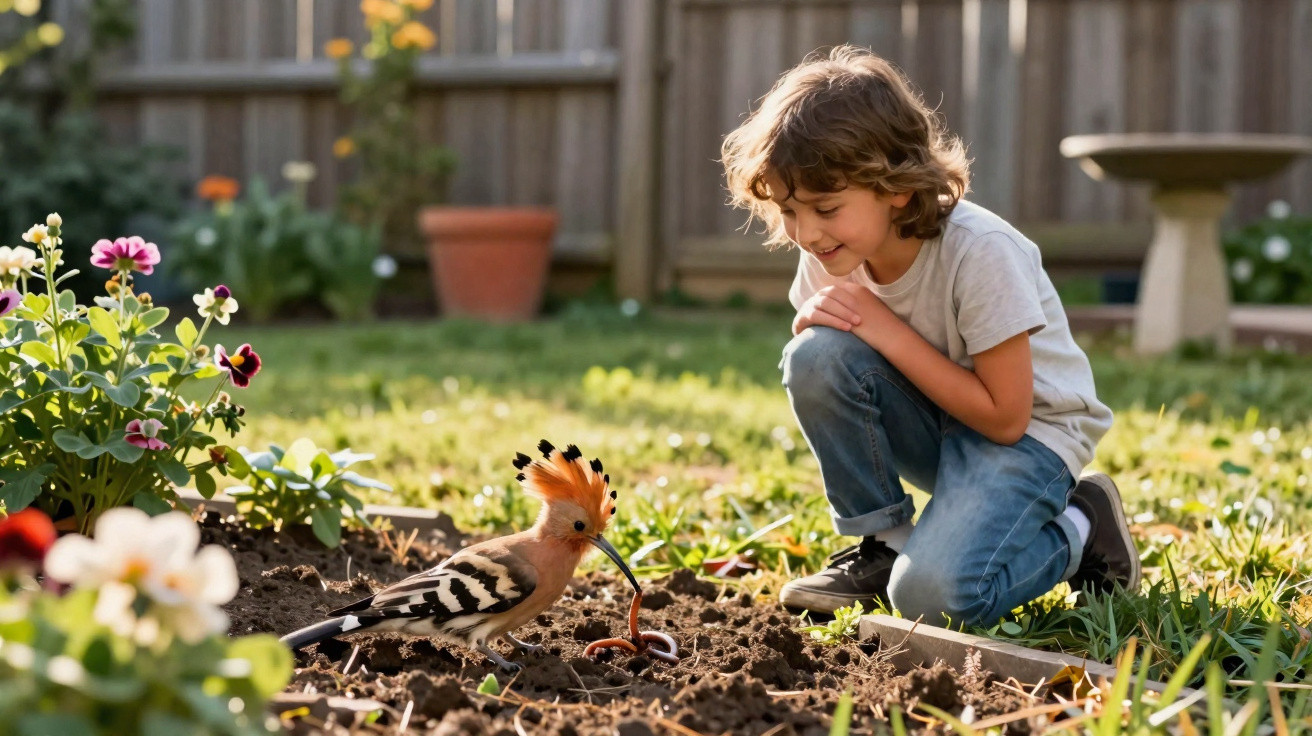
Many amateur gardeners immediately sense that it means something.
With its raisable crest and black-and-white barred wings, the hoopoe can look almost like a tropical stray. Yet its appearance represents far more than an attractive photo opportunity. Anyone who spots this rare bird in their garden receives a fairly clear indication of the soil’s condition – and of the future of their own patch of green space.
A remarkable visitor: what the hoopoe reveals about your soil
To biologists, the hoopoe is above all a highly specialised insect-eater. Using its long, gently curved bill, it probes the ground and loose cracks in the earth. It searches there for:
- Cockchafer grubs and other beetle larvae
- Mole crickets
- Caterpillars, including processionary moth caterpillars
- Beetles and crickets
- Various other ground-dwelling insects
This diet is possible only where the soil is teeming with life. A hoopoe does not simply settle anywhere by chance. It needs areas with abundant insects that have not disappeared because of poisons or overly frequent mowing.
If a hoopoe remains in a garden for several days or even weeks, this points to healthy, living soil without widespread pesticide use.
It typically favours open, sunny spots with relatively short grass and patches of bare ground. Traditional habitats include traditional orchards, vineyards and extensively grazed pasture – or gardens where not every square metre is mown to “golf-course perfection”.
Garden habitat: what the bird specifically needs
To understand why a hoopoe is drawn to a particular garden, it is worth considering three factors: soil, structure and peace.
Examining the soil
The bird avoids ground that is heavily compacted, regularly turned over or treated with chemicals. It favours:
- Loose, lightly worked soil that its bill can penetrate
- Soil containing organic matter, where many larvae can develop
- Corners where leaves are allowed to remain and small creatures can find shelter
If the hoopoe appears several times a day, garden owners can be almost certain that little or no synthetic insecticide has been used there in recent years. Where insects are scarce, this bird soon moves on.
Lawns, beds and fallow patches: the right balance
A mixture of short lawn and bare patches is typical, for example along path edges, in beds or beneath fruit trees. These are the places where the hoopoe can find prey most easily. Suitable features include:
- Open traditional orchards with old trees
- Beds with strips of exposed soil between plants
- Unsealed paths and dry, sandy areas
- Log piles, cracks in walls or old tree holes as potential nesting sites
Anyone who covers the entire garden with gravel, concrete blocks or a thick layer of bark mulch loses this opportunity. The bird needs transitional areas, not a sterile “stone desert”.
A journey from African savannahs: why its visit is no coincidence
The hoopoe spends the winter mainly south of the Sahara. In spring, it migrates to Europe, including central Europe. In warmer areas it can appear from late February, while in cooler regions it is seen mainly from April to September.
Here, it is encountered more often in southern parts of the country and climatically favourable areas. In more northerly regions, it remains a rarity in many places. When a hoopoe lands in a garden there, it shows that the location meets several conditions at once:
- Sufficient food in the soil
- Suitable features for foraging and resting
- Relative quiet, without continual disturbance
Research data from several countries show that, after major population declines during the 1990s, the species has recovered somewhat. One reason is a moderate reduction in pesticide use, alongside increased nature conservation measures. Nevertheless, the hoopoe remains one of the less common breeding birds and is subject to strict protection.
Anyone observing one in the garden is witnessing more than a visual highlight – they are also encountering a protected species with relatively demanding requirements.
Symbolism: what the “bird with a crown” has represented for millennia
The hoopoe has fascinated people since antiquity. Its distinctive feather crest resembles a small crown, which is why some cultures gave it the nickname “king bird”. It also has a striking call: a three-syllable “hoop-hoop-hoop” that was once among the familiar sounds of spring in many rural areas.
In ancient texts from the Persian world, it appears as a guide and companion in the inward search. There it symbolises direction, leadership and renewal. In ancient Egypt, it entered written symbols and was regarded as a sign of gratitude and family connection.
These interpretations still shape many people’s view today: when a hoopoe arrives in the garden, many see it as a positive sign – an indication of an approaching favourable change or of a “right” way of living in harmony with nature.
What gardeners can do to encourage its return
Anyone who does not want to regard the visit as a one-off honour, but hopes to see the bird more often, can make a number of changes. A few simple but effective choices in everyday gardening are central:
- Avoid pesticides: Insect killers, chemical lawn treatments and many soil poisons destroy the hoopoe’s food supply.
- Leave some areas “imperfect”: A closely cut section is fine, but wilder zones should remain alongside it.
- Provide nesting opportunities: Retain old trees with cavities, do not seal every gap in walls, and if necessary install special nest boxes.
- Maintain peace and quiet: Continuous loud noise and constant activity in the garden deter sensitive species.
One detail can occasionally cause irritation: close to its nesting holes, the hoopoe may produce a rather strong smell. Both young and adult birds have glands whose secretions help keep predators away. This once earned it nicknames such as “stink bird” and “stinking cock”. Anyone wishing to support it should tolerate this somewhat pungent scent, at least during the breeding season.
An ally in the fight against pests
For gardeners, the bird also has a very practical significance: it eats a range of insects that could otherwise cause damage. These include large beetle grubs that feed on roots and caterpillars that harm trees and shrubs.
Naturally, a hoopoe is no replacement for professional pest control in fruit growing. Instead, it acts more like a free helper, regularly removing larvae and insects from the menu before they become abundant. The more varied a garden’s layout, the more effectively such natural allies can work.
| Indication from the hoopoe | Meaning for the garden |
|---|---|
| Regular visits | The soil is rich in insects and not heavily poisoned |
| Foraging in particular places | Larvae and beetles are concentrated there; the soil is especially alive in this area |
| Attempted breeding in the garden | The surroundings provide food, quiet and suitable structures over the longer term |
What its appearance says about your garden’s future
A visit from a hoopoe can also be read as a small forecast. A garden that attracts this bird has good prospects of remaining stable and resilient in the long term. Diverse soil life provides not only more insects, but also better structure, more humus and greater water-holding capacity.
By consciously preserving these conditions, you prepare your plot for dry spells and heavy rainfall. Earthworms and other soil organisms loosen the ground, roots can grow deeper, and plants cope better with stress. In this way, the hoopoe indirectly represents a style of gardening based on resilience rather than perfection.
Practical tips for anyone now curious about hoopoe-friendly gardens
Those wishing to assess whether their garden is suitable for hoopoes can ask themselves several specific questions:
- Are there exposed areas of soil that are not covered over?
- Are chemical products largely avoided?
- Are there old trees, dry-stone walls or log piles that could serve as possible refuges?
- Are there areas that remain relatively quiet during the day?
Even small adjustments – such as mowing an edge strip less often, leaving a pile of leaves in autumn or dispensing with insecticide – can make a major difference. Even if a hoopoe does not appear straight away, many other species benefit: hedgehogs, lizards, wild bees and ground beetles.
For many people, the bird therefore becomes a symbol: anyone who designs their garden so that a hoopoe can find food and peace is also setting the course for a different kind of future – one with more nature on the doorstep, fewer chemicals and soil that is not merely a surface, but a living foundation.

Comments
No comments yet. Be the first to comment!
Leave a Comment