
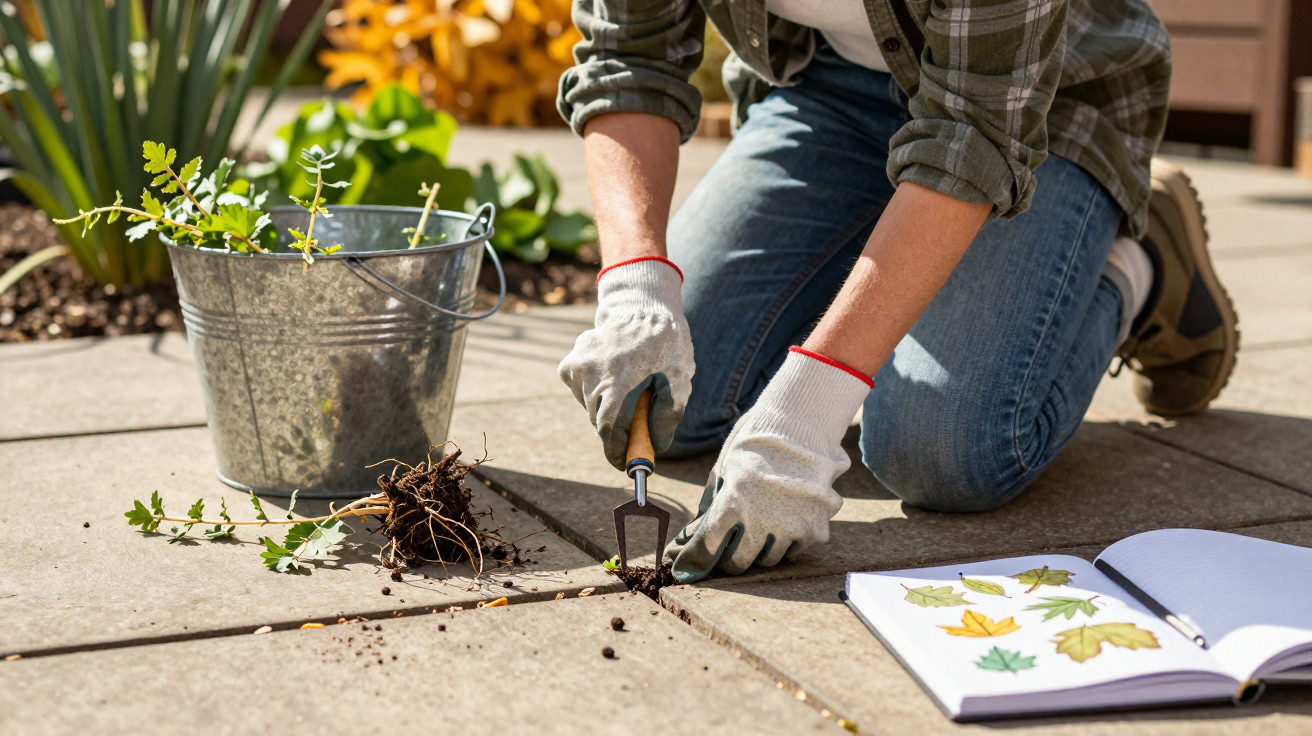
If you have paving stones around your home, you will know the routine: you scrape, brush and spray with household remedies, briefly feel victorious – and before long everything is green again. The real mistake is often not the tool or treatment, but the timing. Start at the wrong time of year and you can practically set up the next wave of weeds yourself.
The real reason weeds keep returning
Between patio slabs and paving stones, it is mainly tough pioneer plants such as dandelions, thistles and plantains that take hold. They survive not because of the leaves visible above ground, but because of their powerful roots deep beneath the surface.
A taproot is typical: a dandelion's can extend roughly 15 centimetres down. If the plant is simply pulled off or cut back at the top, around 90 per cent of its biomass usually remains in the ground. In response, the plant produces even more vigorous new growth.
“If you only pull it off at the top, you are often simply giving your weeds fresh energy – their real strength lies in the root.”
Garden specialists and professional associations therefore repeatedly stress that the key is to remove the plant as completely as possible, including the root. Even so, many people fail despite having suitable tools because they do not work with the season and weather conditions.
Spring: why you should wait until after mid-May
Most people reach for vinegar, soda mixtures, boiling water or other biological contact treatments in March or April. Yet this is precisely when the weather regularly undermines their efforts.
Rain showers and spells of sleet are frequent during these months. Contact treatments, including vinegar solutions and plant feeds, remain only on the surface of the leaves. They need to stay on dry plant tissue for several hours to damage the protective layer and effectively “burn” the plant.
If rain falls within one or two days, the water washes the active substance away before it can work. The result is that little appears to happen, while the plants continue growing as before.
The ideal spring window for paving-stone weeds
To achieve a noticeable result, follow the traditional seasonal rule and wait until after the Ice Saints period, around the middle of May. By then, showers have reduced considerably, dry spells are more reliable and there is sufficient sunshine.
“Schedule your spring treatment no earlier than mid-May – and only when three dry days are forecast.”
For vinegar, boiling water or other contact-based treatments to work rather than fade away, it is worth following a simple routine:
- Check the weather forecast for at least five days.
- Begin only when at least 72 hours without rain are forecast.
- Wait until the ground has dried out properly.
- Try the “tissue test”: place a paper tissue on the joints; if it remains dry, you can start work.
- Treat in the morning so that the midday sun reinforces the effect.
- Target only the joints and plants rather than spraying widely.
A common situation illustrates the issue: the sun shines on Easter Sunday, the patio is sprayed, then a shower arrives that evening – and two weeks later the yard looks exactly as it did before. The problem is not the weed treatment, but poor timing.
Autumn: the quiet “secret weapon” against roots
The second, frequently overlooked period for keeping joints clean over the long term is autumn, broadly from early September to late October. At this point, very different processes are taking place inside the plants than in spring.
In spring, energy travels upwards from the root into the foliage; in autumn, stored substances move downwards instead. The plant stores sugars and nutrients in its roots to survive winter. Taking action at this stage directly affects those reserves.
“In early autumn, every targeted attack on the root weakens the plant twice over – it loses not only greenery, but also its stored reserves.”
The effect is clear in everyday practice: those who clean paving joints systematically in September or October find that fewer plants return the following year, with longer intervals between treatments.
How to tackle weeds properly in autumn
No sprays are needed for an autumn session; good manual work is what matters:
- Choose the tool: use a weeding knife, joint scraper or narrow root fork, such as an asparagus knife.
- Work after rain: slightly damp soil releases roots more easily.
- Position the tool alongside the plant: push the blade vertically into the joint close to the stem.
- Lever rather than pull: tilt it gently and lift out the root with the surrounding soil.
- Finish the job: remove remaining debris and moss using a wire brush or joint brush.
Afterwards, one step is particularly worthwhile, although many people skip it: refill the joints. Clean, well-compacted jointing sand is much less likely to take in weed seeds.
What does not belong in paving joints
Using table salt may seem clever at first. Scatter salt between the stones and the visible parts of plants quickly dry out. However, the real problem develops underground.
Salt moves into the soil with water and draws moisture out of cells. This dries out not only the weeds, but also the soil itself. It becomes hard, silts up and loses its structure. Joints break away more quickly, and paving stones may become loose.
“Salt in paving joints is a chemical sledgehammer with long-term consequences – for soil, groundwater and the stability of the surface.”
There is another issue: when rainwater carries salt into nearby beds or lawns, ornamental plants and micro-organisms suffer too. It can also occupy a legal grey area, as many local authorities do not permit salt outdoors beyond paths and roads.
Another common mistake is spraying before expected rain or onto joints that are already wet. Contact treatments are diluted immediately, run downwards and no longer reach the leaves where they are needed. More time and money are spent without leaving the patio genuinely cleaner.
How to reduce weed pressure in the long term
Anyone wanting to make a patio, driveway or garden path easier to maintain over time needs to think one step ahead. Three adjustments make a substantial difference:
- Improve the jointing material: clean, washed sand that is swept in thoroughly and compacted offers fewer gaps for seeds.
- Carry out regular, short sessions: two targeted treatments a year – in mid-May and early autumn – are usually enough, rather than constantly pulling weeds out “just quickly”.
- Keep an eye on edges: weeds spread first along borders with beds and lawns. Clear separation is worthwhile here, for example through lawn edging stones or low bed edging.
In many cases, weeds seem “impossible to stop” because hurried weeding has been done only in spring for years. Once an autumn session is added consistently, the picture changes noticeably: pressure from below decreases and the plants remain weaker.
Why paving joints are so vulnerable – and what causes it
The conditions between paving stones are unusual: the ground is compacted, dust and organic material accumulate, and joints warm up faster than a flowerbed. For many spontaneously growing species, this creates an ideal habitat.
These plants are known as pioneer species. They are adapted to survive even in poor, compacted material. Short life cycles, strong roots and masses of seeds mean that even small gaps in a joint are enough for a new generation to establish itself.
Understanding this makes the task easier to approach calmly: a completely “sterile” paved surface is rarely achievable in everyday life, but the right timing and sensible techniques can reduce the workload considerably. Two well-planned sessions each year achieve more than five spontaneous attempts at the wrong time.


Comments
No comments yet. Be the first to comment!
Leave a Comment