
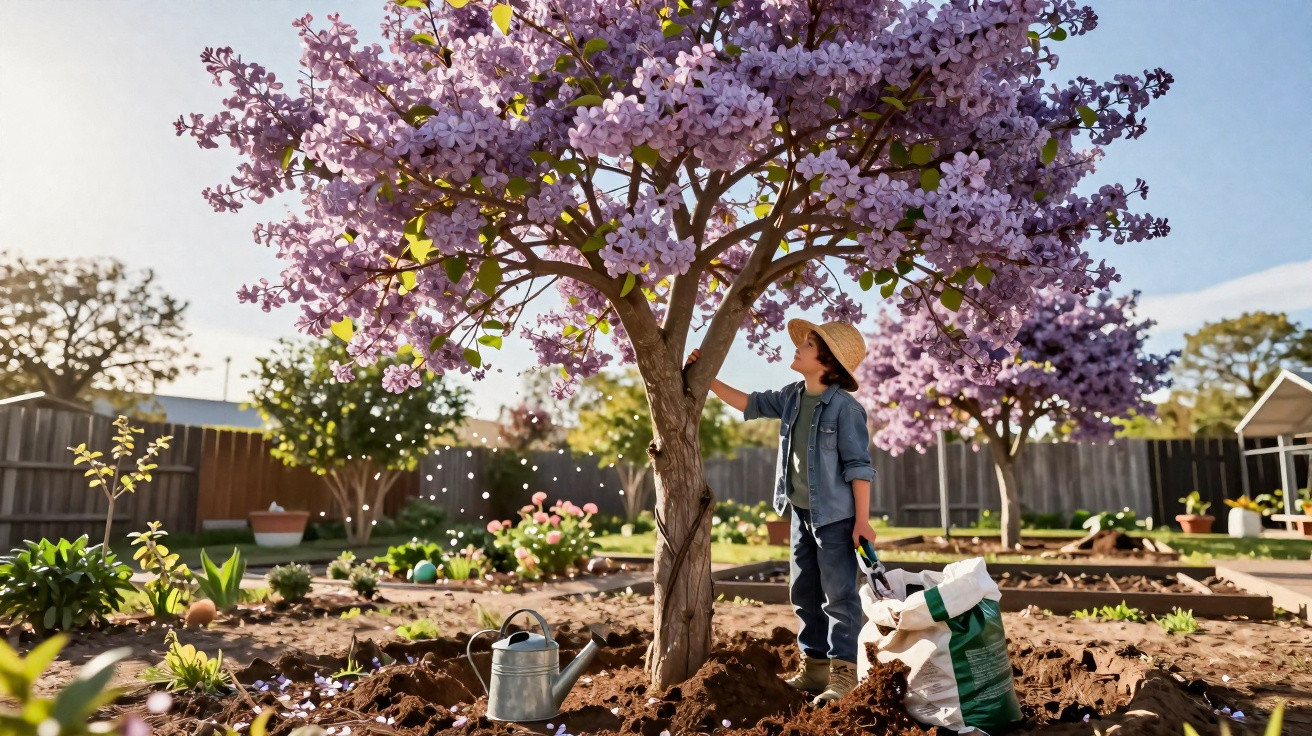
A tree that can shoot up by several metres within only a few years and hang over the garden like a perfumed purple haze in spring is still unknown to many people.
Those seeking rapid shade, structure and spectacular flowers in the garden often choose bamboo or fast-growing hedges. Yet there is an alternative that makes a far greater visual impact while remaining manageable: Paulownia, also known as the empress tree or foxglove tree. It grows at remarkable speed, but can still be kept under control, turning the garden into a stage for thousands of scented flowers in spring.
Paulownia at a glance: turbocharged growth
Paulownia is regarded as one of the quickest-growing trees still suitable for ordinary private gardens. In favourable conditions, a young tree can grow by around 1.5 to 2.5 metres each year. Reaching a height of 5 to 7 metres within three years is entirely realistic.
After only a few seasons, the slender little stem that once stood there has become a proper tree with a dense crown and a striking outline.
Mature specimens generally grow to 10 to 12 metres, depending on the variety and site. Its defining features include:
- a straight, relatively slender trunk;
- exceptionally large, heart-shaped leaves;
- the rapid formation of a broad crown that provides shade.
For many homeowners and gardeners, the shade it creates is a key benefit. Rather than waiting years for a substantial canopy, Paulownia often produces a pleasant, light leafy roof in a short time – ideal beside a patio or above a seating area.
Why it does not cause the problems associated with bamboo
Unlike many bamboo species, Paulownia does not produce invasive underground runners. It does not create an aggressive web of roots that suddenly emerges in a neighbour's garden or spreads through flower beds.
This makes it particularly appealing for smaller plots and terraced-house gardens, where every square metre matters. Its root area remains relatively predictable. Once planted, the tree does not require the ongoing battle with an elaborate root barrier.
Spring spectacle: flowers like a purple veil
Its greatest asset is displayed not in summer, but shortly beforehand. Before the foliage emerges, dense panicles carrying hundreds of bell-shaped flowers in delicate violet and lilac shades appear in spring. Seen from a distance, the crown looks as though someone has draped it with a cloud-like purple veil.
The flowers have a distinct scent, attract bees and butterflies, and make the tree a genuine insect magnet in the garden.
Gardeners describe it as a “melliferous” plant, meaning a species that is especially valuable to bees. Anyone committed to wildlife-friendly gardening and wishing to bring more life into their garden will find the empress tree a good choice.
Flower shades and varieties: from delicate lilac to softly blue
Depending on the variety, flower colours range from pale lilac and violet to almost bluish tones. Common species available from retailers include:
- Paulownia tomentosa – the classic foxglove tree, with abundant lilac-coloured flowers;
- Paulownia fortunei – often with slightly finer blooms and, in some cases, subtly different shades.
The blooms form dense clusters that cover large parts of the crown. Since the leaves have not yet fully emerged at this stage, their colours stand out particularly clearly.
The right location: helping Paulownia reach its growth potential
Choosing the site and preparing the planting hole
For Paulownia to perform at full speed, it needs as sunny a position as possible. The ideal site has:
- full sun for much of the day;
- protection from icy easterly or northerly winds;
- deep, free-draining soil.
The tree does not tolerate waterlogging well. Soil that remains wet throughout winter slows its growth and may damage the roots.
It is worth putting in a little extra effort when planting:
- Dig a planting hole measuring roughly 60 x 60 x 60 centimetres.
- Mix the excavated soil with 10 to 20 litres of mature compost.
- Position the tree, backfill with the mixture and firm it gently.
- Water it in thoroughly with around 20 litres of water.
- Create a mulch ring 5 to 8 centimetres deep around the trunk.
Mulch retains moisture in the soil and shields young roots from major temperature fluctuations.
Care during the first years: water, pruning and protection
During its first two to three years, Paulownia lays the groundwork for its later growth performance. It needs support, particularly in dry summers:
- provide around 10 to 20 litres of water each week, according to heat and soil conditions;
- water less frequently but deeply, encouraging roots to grow downwards;
- top up the mulch ring regularly and remove weeds.
Light formative pruning after flowering helps establish a strong crown. Remove dead or crossing branches and encourage even branching. Drastic pruning is usually unnecessary.
In very cold areas, young trees benefit from winter protection. Garden fleece around the crown and a thicker mulch layer, 10 to 15 centimetres deep at the base of the trunk, reduce frost damage.
Risks and limitations: where the dream of a flowering tree can falter
Frost and flower buds
Paulownia produces its flower buds early. Late overnight frosts in spring can kill these buds. In such years, flowering is often much weaker or may not occur at all.
The tree itself usually copes with cold quite robustly, but its flower buds are more sensitive than its wood and roots.
After a frost period, cut back frozen shoot tips once milder weather has settled in. The tree will often produce strong new growth from healthy wood and resume its rapid development.
Self-seeding and possible restrictions
The empress tree produces numerous lightweight seeds that can be carried by the wind. In suitable soils, it may reproduce by itself in some regions. This remains manageable in many areas, but amateur gardeners should pull out young plants promptly if they appear where they are unwanted.
Anyone living in a nature reserve or near sensitive habitats should check with their local authority or environmental body before planting to establish whether restrictions apply. In some countries, there are discussions about severely restricting certain exotic woody plants in protected areas.
How much space does a Paulownia really need?
Although young specimens initially appear delicate, the tree later expands considerably in width. The following distances are sensible when using it as a specimen tree on a lawn or near a patio:
- allow 6 to 8 metres of clear space around the tree when grown as a standalone specimen;
- leave at least 6 metres between several trees planted in a row;
- keep sufficient distance from house walls so that neither the crown nor roots become problematic.
When incorporating the tree into a designed garden scheme, it can provide high shade above low-growing perennials or grasses. Shade-tolerant ground cover and early-flowering plants can be combined beneath its crown.
More than decoration: timber, climate effects and garden benefits
Alongside its appearance, the timber also has a role. Paulownia wood is very light yet relatively stable, and is valued as a material in some countries, including for furniture and interior fittings. Although this is rarely the priority in a private garden, it demonstrates how versatile the tree can be.
Its fast growth enables the tree to absorb larger amounts of carbon dioxide within a relatively short period. It is not a “climate saviour” in a small private garden, but the empress tree fits into approaches that favour more trees and shade in built-up areas to soften periods of extreme heat.
Practical advice for amateur gardeners
Anyone considering planting a Paulownia should keep several practical points in mind:
- Before buying, assess honestly whether there is space for a tree 10 to 12 metres tall.
- In very windy locations, consider securing it to a support stake during its first years.
- Apply around 10 litres of compost at the base of the trunk each spring to support growth.
- Mark dry summers in the second and third years after planting in the calendar, and water purposefully.
A term often used in this context is “melliferous”. Specialists use it for plants whose flowers provide plentiful nectar for honey bees, wild bees and other pollinators. Paulownia belongs firmly in this category and can be one element of an insect-friendly garden.
Households with children will usually appreciate the quickly established shade too. After just a few years, it can be possible to hang a hammock beneath the tree or create a small seating area. Combined with spring flowers in the lawn, such as crocuses or daffodils, it creates a garden scene that remains varied from March into early summer.
For very small gardens, it may be sensible to choose less vigorous varieties or train the crown into a more compact shape. With some pruning technique, the tree can be kept smaller without losing its characteristic flowers. This delivers the purple spring cloud, but in a scale suited to the individual plot.




Comments
No comments yet. Be the first to comment!
Leave a Comment