
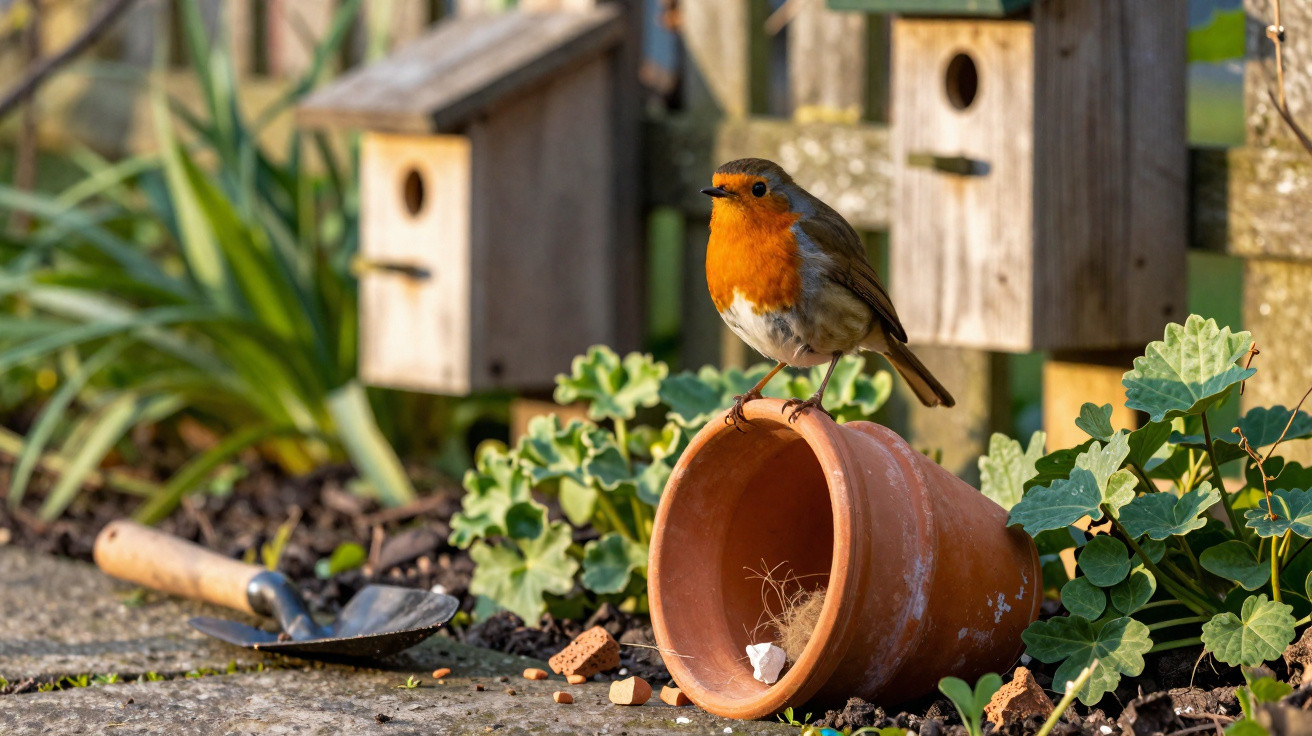
A plain terracotta pot can transform the situation entirely.
Many gardeners buy attractive wooden nest boxes, carefully hang them in a tree canopy, then wait in vain for a pair of robins to move in. This is less a matter of bad luck than a simple misunderstanding. Anyone who understands this bird’s nesting habits and positions an ordinary terracotta pot intelligently can greatly improve the chances of welcoming feathered residents.
What robins actually need – and why standard nest boxes fail
The European robin (Erithacus rubecula) is considered a familiar garden visitor: it follows a spade, hops close to people and can appear almost tame. When selecting a nest site, however, this small songbird is far more particular than many people realise.
Most commercially available nest boxes are designed for tits or sparrows. They are usually mounted fairly high, have a small entrance hole and a largely enclosed interior. That is precisely the sort of arrangement a robin has little use for.
“The robin is not a traditional cavity nester; it looks for low, wide-open and well-concealed niches.”
It favours features such as:
- dense shrubs and hedges
- ivy growing on walls or trees
- wood piles, root areas and banks
- concealed spaces close to the ground
Boxes installed 3 metres up are simply of little interest to robins. They prefer to remain near the ground, with good cover but a wide entrance that allows them to dart in and out quickly.
The terracotta pot trick: simple, inexpensive and remarkably effective
This is where the terracotta pot comes in. Although it may sound like a makeshift craft solution, it can work surprisingly reliably in practice, provided that the pot is prepared and positioned correctly.
An unglazed clay flowerpot offers several advantages at once:
- natural moisture regulation: porous clay absorbs moisture and releases it again, so condensation rarely forms.
- a pleasant climate: the material stores a little warmth during the day and gradually gives it off at night – helpful for eggs and nestlings.
- a wide opening: rather than a narrow entrance hole, it provides a large, partly open entrance of the kind robins favour.
- an unobtrusive appearance: terracotta looks natural in a garden and blends readily into hedges, ivy and ground-level planting.
“The cost of the nest site is irrelevant – it is the logic of its location that matters.”
Compared with many shop-bought nest boxes, there is therefore much to recommend an old flowerpot from the garden shed.
Choosing and preparing a terracotta pot for robins
A traditional, unglazed terracotta pot measuring 15 to 20 centimetres in diameter is ideal. This gives a robin enough room to build and breed comfortably without making the space excessively large.
Preparation in a few steps
- Clean the pot: rinse it with clean water and remove old compost and algae residue. Do not use washing-up liquid or chemicals.
- Remove labels: peel off all stickers, price labels and plastic film completely, so that nothing smells or reflects light.
- Tilt rather than stand the pot upright: lay it on its side or angle it slightly downwards to prevent rainwater from collecting inside.
- Secure it firmly: wedge it in place with wire, stones, branches or pieces of wood so that it cannot wobble.
A small starting layer inside can help with nest building. Robins are happy to use available materials and adapt them to suit their own requirements.
Suitable materials include:
- a thin layer of dry leaves
- a little dry moss
- fine blades of grass
Nothing more is necessary. The pot should resemble a partly formed niche, not a fully furnished luxury nest.
The ideal location: low, concealed and with morning sun
The chosen position determines whether the terracotta pot becomes a nesting site or remains a useless decorative item. Several criteria are essential.
Height and surroundings
Robins do not nest in the treetops but within the lower layers of vegetation. The best mounting height is around 1 to 1.50 metres above ground level. It may be lower on a sheltered bank or within dense ivy, but it should not be placed higher.
Suitable locations include:
- dense hedges with some undergrowth
- ivy on walls or fences
- banks or small slopes with shrubs
- concealed corners behind garden equipment or wood piles
A certain depth of greenery is important. A pot lying exposed in an open flower border appears easily accessible to predators. Its entrance should be lightly screened by twigs, leaves or grass, without being blocked completely.
Orientation and weather protection
Ideally, the opening should face roughly south-east. This allows gentle morning sunshine to reach the nest while heavy rain and cold westerly winds are unlikely to blow directly into the pot. Fully sunny positions can make the interior very hot in summer, so choose a spot with partial shade instead.
“Even the best terracotta pot is useless if it bakes in the midday heat or sits directly in a draught.”
Noisy, frequently used paths, seating areas and places near a sandpit are poor choices. Robins tolerate people at a certain distance, but they need peace and a sense of security around their nest.
The right timing: when the pot needs to be ready
Robins begin breeding early in the year, so the pot must be prepared in good time. The ideal period is from late February to mid-March. This gives a wandering pair a good chance to inspect the new shelter before settling on a site.
Anyone making rushed adjustments in April is usually too late. It is better to plan the pot and its location during the winter months, then install it when the first milder days arrive. Afterwards, leave the site undisturbed and avoid continual alterations or moving it around.
If the pot remains unused in the first year, patience is worthwhile. Sometimes slightly denser planting nearby or a small relocation within the same hedge is enough for the nesting place to be accepted in the second year.
Alternative shelters that can work alongside a terracotta pot
Anyone without a suitable terracotta pot can use comparable containers, as long as they are sturdy, discreet and partly open. Examples include:
- an old metal watering can laid on its side and well camouflaged
- an upturned bucket with a side opening beneath shrubs
- discarded balcony planters tilted on their side and concealed with branches
The same rules apply here: avoid bright colours, plastic smells and direct scorching sun; place them close to shrubs and the ground, and ensure that the setting is quiet and sheltered.
Practical advice: safety, hygiene and garden behaviour
Where birds breed, predators are rarely far away. Cats, martens, magpies and crows will take every opportunity, so it is worth considering the surrounding area.
- Make access harder for cats: dense, thorny shrubs, such as barberry or blackthorn, in front of or beside the pot make approaching it less comfortable for cats.
- Do not put food directly beside the nest: feeding stations also attract competitors and predators. Position them some distance away instead.
- Avoid disturbance during breeding: do not shine lights inside, lift or move the pot, or make “inspection visits” with children immediately in front of it.
After the breeding season, basic cleaning is enough: remove old nesting material in late autumn or winter, rinse the pot with water, allow it to dry and put it back in place. Strong disinfectants are more likely to cause harm than provide a benefit.
Why the effort is worthwhile – and what children can learn
Being able to watch a robin rear its young offers a direct lesson in nature just beyond the patio door. From a respectful distance, children can see how often the adult birds bring food, how long the young remain in the nest and when they finally leave it.
At the same time, a terracotta pot nesting site demonstrates ecological connections within the garden: dense, mixed hedges rather than sterile gravel areas; leaves and dead wood as habitat rather than “perfect” tidiness; quiet corners instead of constant mowing. All of this helps robins and many other garden birds to breed more often again.
Anyone who then discovers soft chirping coming from a simple, well-hidden terracotta pot will understand immediately: a successful year for birds does not necessarily require expensive nest boxes, but rather a little knowledge, good timing and the willingness to let parts of the garden become deliberately wilder.
Comments
No comments yet. Be the first to comment!
Leave a Comment