
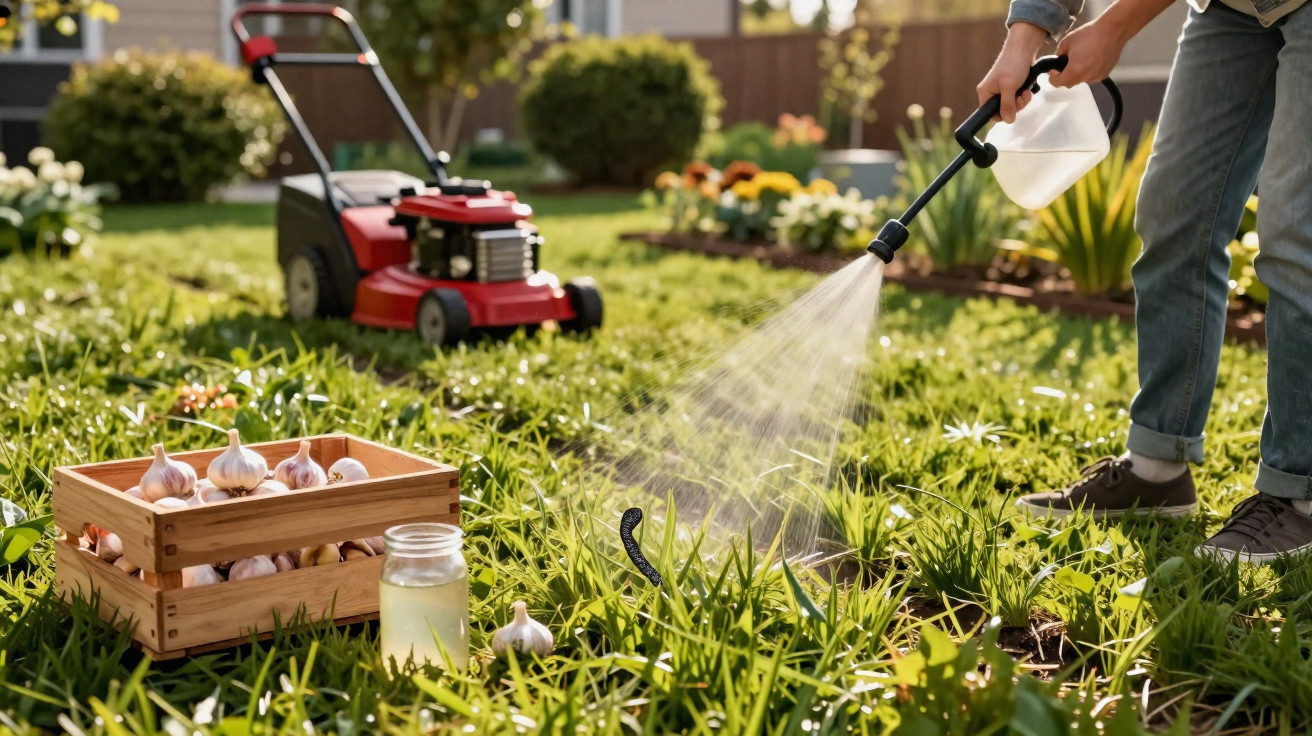
As we look forward to the first warm days and walking barefoot across the lawn, snakes are beginning to make their way through gardens again. March in particular, when the sun returns, can bring animals hiding between wall bases, driveways and lawn edges that may bite if startled. The good news is that a straightforward natural kitchen remedy, together with a few sensible habits, can make the lawn considerably safer for children, pets and visitors – without chemicals and without harming the animals.
Spring in the garden: why snakes return from March
As soon as temperatures start to rise, snakes emerge from their winter shelters. They use cracks in walls, woodpiles, thick clumps of grass and gaps beneath patios to warm themselves and hunt. Many will be harmless species, but venomous snakes may also enter gardens and can bite when suddenly disturbed.
The greatest risk arises when somebody steps directly on a snake or startles it with their hand, whether while weeding, playing or mowing the lawn in sandals. Swelling, severe pain and panic in children or dogs are common consequences of a bite. The aim, therefore, is not to eradicate these animals, but to keep them away from vulnerable areas such as lawns, play spaces and seating areas at an early stage.
“Anyone who takes action in good time in March can greatly reduce the risk of unexpected encounters on the lawn – without harming nature.”
This is where a simple combination comes in: a strongly scented barrier made from a kitchen product, alongside carefully used vibrations in the ground.
Garlic as a natural protective boundary: how the barrier works
The key principle is to create an invisible scented wall around the lawn, patio and vegetable beds using a strongly smelling garlic infusion. Snakes rely heavily on scent for orientation and avoid certain scent zones that they find unpleasant.
Garlic infusion recipe
Even a modest quantity is enough for an average-sized garden. Prepare the infusion as follows:
- Roughly crush 10 garlic cloves, preferably including any that have already started sprouting, with their skins on.
- Pour over 1 litre of boiling water.
- Cover the container and leave it to infuse for 48 to 72 hours.
- Strain the liquid and transfer it to a clean spray bottle.
- Add 1 tablespoon of liquid soft soap, or a similar mild soap, to help the scent remain for longer.
The protection normally lasts for two to three weeks. Following heavy rain of more than around 10 millimetres, the treatment should be repeated. For larger plots, the mixture can simply be increased: use 1 kilogram of garlic for 10 litres of water, then apply it soon after the infusion period.
Apply it properly: create lines, not a “shower gel for the lawn”
Many householders are inclined to spray everything over a wide area. It is more effective to use the infusion specifically as a sharp scent line. Apply the garlic infusion in strips rather than misting the whole garden.
Important locations include:
- Entrances and thresholds leading into the house
- Window sills and the areas around basement steps
- Driveways and garage doors
- The bases of walls and steps
- Outer edges of lawns and vegetable beds
- Play corners, trampolines, sandpits and seating areas
From March, once the garden is being used regularly again, it is worth creating an initial garlic “border”. Reapplying it every two to three weeks helps maintain a fairly consistent protective line. In practice, thinking in terms of boundaries works much better than trying to “perfume” the entire lawn.
Why garlic repels snakes: chemistry and senses in detail
There is chemistry rather than superstition behind the garlic approach. Crushed garlic cloves release a substance which may smell unpleasant to people but creates a powerful scent signal for snakes.
Allicin – garlic’s pungent signalling substance
Garlic initially contains an odourless component called alliin. Only when the clove is damaged or crushed is allicin formed: a highly volatile, sulphur-containing compound with an intense smell.
“Allicin covers the ground with a scent cloud that snakes detect strongly and instinctively avoid.”
Snakes use specialised sensory organs to detect chemical signals in their surroundings. The powerful smell of garlic masks these stimuli, creating a type of olfactory wall: the animals change direction and avoid the treated area without being harmed in any way. In gardens where children play or pets roam, this option is far more acceptable than poison bait or harsh traps.
Ground vibrations: the lawnmower as a discreet snake deterrent
Garlic on its own is not always enough. A second measure can be just as effective: vibrations. Snakes barely hear airborne sound, yet they are extremely sensitive to the slightest vibrations in the ground. A bone in the jaw, often referred to as the “quadrate bone”, passes these vibrations on directly.
When the ground is regularly made to vibrate, snakes interpret this as the approach of a large predator. They move towards quieter areas – usually to the edge of the property or beyond it.
How to use vibrations deliberately
Small everyday habits can already make the lawn area less appealing:
- Use the lawnmower regularly during spring, roughly every 10 to 15 days.
- Begin mowing close to the house, then work outwards in circles – this “pushes” animals towards the perimeter rather than in the direction of the patio.
- Before working by hand in flower or vegetable beds, firmly tap the ground several times with your foot or a stick, then wait 30 seconds.
- Take heavy steps across the lawn before children play there barefoot to send clear signals.
A loud machine is not essential. What matters is repeated vibration in the soil, not noise. Even a small electric mower has sufficient effect when used consistently.
Keep the garden structured: shift habitats rather than destroying them
Anyone seeking to make the lawn safer should also consider where the animals will retreat to instead. There is no benefit in forcing every snake into the next-door play area. A better approach is to make selected corners appealing on purpose, well away from the patio and lawn.
Practical measures for greater safety around the house and lawn include:
- Cut back tall clumps of grass, dense bramble growth and overgrown corners near paths and seating areas.
- Do not keep wood and leaf piles directly beside the lawn; move them to the edge of the plot instead.
- Seal cavities beneath timber patios, steps and walls wherever construction allows.
- Keep basement window wells and garden sheds properly closed.
- Clear away food leftovers outdoors promptly, so that mice do not settle there – as they in turn attract snakes.
Leaving a few deliberately wilder areas at the edge of the property directs animals there. Combined with the garlic barrier around the lawn, this creates a buffer: snakes have places to retreat to, while people can walk barefoot with relative peace of mind.
How do children and pets respond to the garlic method?
Many garden owners wonder whether the strong smell could cause problems for dogs, cats or young children. At the diluted concentrations normally used, the infusion is considered unproblematic.
A few points should nevertheless be kept in mind:
- Do not spray dogs or cats directly from the bottle; treat the ground only.
- Tell children about the measure and explain why parts of the garden may smell more strongly for a short time.
- Put spray bottles away safely after use so that nobody drinks the liquid.
The garlic smell usually fades relatively quickly for people, while the remaining concentration in the ground is still enough for snakes to identify the scent line. Anyone especially sensitive to smells can place the barrier nearer the garden’s outer boundaries.
When professional help is worthwhile and which alternatives exist
Despite every precaution, a snake may appear close to the house or remain in a difficult-to-reach corner. In such cases, nobody should try to be a hero. Specialists from local nature conservation authorities or specialist pest controllers can identify the species, assess the risk and, where necessary, relocate the animal.
Some garden owners also use technical aids such as vibration stakes placed in the ground. These create mild tremors at regular intervals. Their effectiveness varies according to soil type and positioning, but they can be combined effectively with the garlic barrier. The basic principle is that the lawn becomes an uncomfortable route for snakes, while calmer, undisturbed areas at a greater distance become more attractive.
Those who understand the mechanisms involved – scent and vibration – can design their property so that people, pets and wildlife can coexist. A little garlic, a regular mowing schedule and a tidy lawn area are often enough to make time in the garden from March onwards feel much more relaxed.

Comments
No comments yet. Be the first to comment!
Leave a Comment