
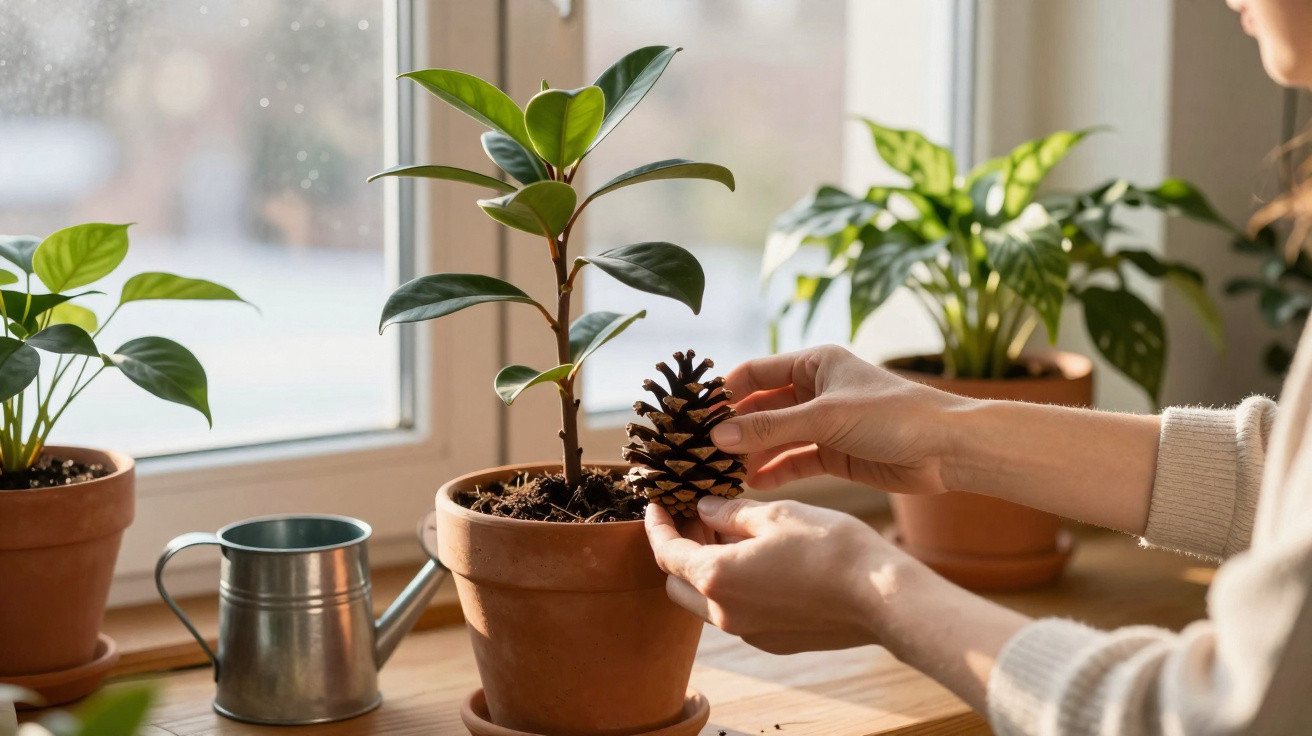
When radiators are blasting and windows remain shut, houseplants can quickly become stressed – and an unassuming pine cone may become a lifesaver.
In many homes, the first green plants begin to collapse in January: leaves turn yellow and stems become soft. Most people instinctively reach for the watering can, only making matters worse. Experienced gardeners have relied for generations on a remarkably simple aid: placing a dry pine cone directly on the potting compost. Although it may look decorative, it actually serves a very specific purpose.
Why houseplants suddenly struggle in winter
Winter creates unusual conditions for houseplants. While the garden and balcony lie dormant outdoors, indoor plants face an artificial climate. Central heating dries the air, yet the compost in a pot can remain wet for days. This can lead to a common misunderstanding: the surface feels dry, so the plant is watered, even though its roots are already sitting in water at the bottom of the pot.
At the same time, windows usually stay closed. With little air movement, minimal evaporation and continually damp compost, conditions are ideal for fungi and rot. Many plants do not die from “thirst” during winter, but from gradual root damage caused by waterlogging.
The greatest winter danger for houseplants is not dryness, but permanently wet compost around the roots.
Once roots begin to rot, they can no longer absorb nutrients. The plant appears sluggish and its leaves droop – so it is often given even more water because it looks “thirsty”. This creates a vicious circle.
How a pine cone controls moisture
This is where the traditional household method comes in: a dry pine cone placed on top of the potting compost. At first it may sound like folklore, but there is a straightforward explanation. The wood in the cone’s scales absorbs moisture from its surroundings, much like a sponge, and responds to it mechanically.
When laid on the compost, the cone draws up excess moisture directly from the surface. This creates a kind of buffer zone between the damp compost and still air. The upper layer dries more evenly, without developing a soggy area that remains wet for long periods. Fungi and mould then find it considerably harder to establish themselves.
The pine cone acts as a small, natural drainage aid exactly where mould and rot develop.
The cone also shields the growing medium from condensation, which readily settles on the surface in poorly ventilated rooms. The thin white film of mould familiar to many plant-pot owners is less likely to form.
Pine cone as a natural moisture indicator
Its most useful feature is that a pine cone can even reveal how damp its surroundings are. Rather than simply being decorative, it acts as a small measuring device that costs nothing.
Open scales: a comfortable zone for roots
When the scales are widely open, the pine cone looks loose and airy. This indicates a relatively dry or well-balanced environment at the compost surface. Air can circulate freely, the compost receives oxygen and fungi have little opportunity to thrive.
In this position, the cone indicates that there is currently no risk of waterlogging. The plant can breathe normally and no immediate action is needed – but it is not an automatic instruction to water.
Closed shape: a warning sign of excess water
If the scales fold together and the pine cone suddenly appears compact and smooth, it is a clear alarm signal: moisture around the cone is too high. The air immediately above the compost is saturated, and the surface is barely drying out.
A closed pine cone means: stop, put the watering can away – let it dry first.
Continuing to water at this point risks rot. The pot should be left undisturbed until the cone opens again. This is often more accurate than the traditional “finger in the compost” test, which assesses only one spot in the pot and can easily be misleading.
How to choose the right pine cone
Suitable cones can often be found on walks beneath pine or spruce trees. Preparing them properly is important, so that no unwanted visitors are brought indoors.
- Collect only dry cones that have already opened.
- Choose specimens without resin residue, so that nothing becomes sticky.
- Brush the cones roughly to remove loose soil and needles.
- Leave them to dry in a warm place for a few days, such as on a windowsill.
If you are unsure, the cone can also be dried briefly in an oven at a low temperature, around 60–80 degrees. This lowers the risk of bringing insects into the home.
Positioning the “guardian” in the flowerpot
The best location is in the centre of the pot, as close to the stem as possible without touching it. This is where moisture levels are most informative. For large containers or long planters, use several pine cones, distributed across three or four positions.
| Container size | Recommended number of pine cones |
|---|---|
| Small pot (up to 15 cm in diameter) | 1 cone |
| Medium-sized pot (15–25 cm) | 1–2 cones |
| Large container / planter | 2–4 cones |
Once the cone has been positioned, the key is observation. During the first few weeks, it is worth checking regularly whether the cone is open or closed before reaching for the watering can.
Which plants especially benefit from the pine cone method
Species that are particularly sensitive to waterlogging can gain noticeably better odds of survival from the pine cone trick. Typical candidates include:
- Succulents and cacti
- Ficus species, such as rubber plants and weeping figs
- Orchids in pots containing bark-based growing medium
- Monstera, philodendron and other fashionable plants with thick roots
- Herbs on the kitchen windowsill during the heating season
The method is also suitable for thirsty plants such as indoor ferns or papyrus. For these, the cone mainly acts as a warning system if watering starts getting out of hand.
A natural defence against mould and fungal diseases
When compost becomes mouldy, many people quickly turn to chemical products. Fungus treatments from garden centres are not only expensive; they can also affect indoor air quality. A dry pine cone addresses the cause: less waterlogging means less mould growth.
Anyone who keeps moisture under control removes the breeding ground for fungi and mould – entirely without chemicals.
A lower level of fungal infestation also means less stress for the plant. It does not need to repair damaged roots and can direct its energy towards new leaves or buds when more light reaches the room in spring.
Common winter watering mistakes – and how the pine cone helps
A pine cone’s reaction can identify many problems early on. Here are three everyday examples:
- Watering to a schedule: Anyone who waters “every Sunday” overlooks how slowly plants grow in winter. The cone stays permanently closed, providing a clear warning.
- A saucer full of water: Even if the surface appears dry, a closed cone shows that moisture is rising from the saucer below.
- Changing locations: If a plant is moved from the window to the radiator and back again, moisture levels fluctuate sharply. The cone “responds” too, making those changes visible.
Those who adjust their watering habits according to the cone’s response will soon develop a better sense of what their plants genuinely need.
Guidance, limitations and useful combinations
A pine cone is not a replacement for sound basic care; it is an addition to it. A pot without a drainage hole, or a decorative outer pot that remains wet, is still risky no matter how many cones are placed on the surface. Likewise, unsuitable compost – such as heavy garden soil in a closed container – cannot be fully corrected by this method.
The trick is particularly effective when combined with a few simple measures:
- Loosen the potting compost rather than pressing it down firmly.
- Water only when the cone is open and the top layer of compost is dry.
- Air the room briefly every few days to refresh the indoor air.
- Fertilise plants sparingly during winter.
You can also test different cone sizes. Smaller specimens often respond more quickly to changes in moisture, while larger ones work more strongly as surface moisture stores.
For many people, this blend of tradition and understandable physics is precisely what makes the method appealing: a natural product from the forest performs a kind of high-tech function in the living room. Instead of expensive measuring devices or apps, a glance at the cone’s shape is enough – and houseplants have a much better chance of getting through winter in good health.


Comments
No comments yet. Be the first to comment!
Leave a Comment