
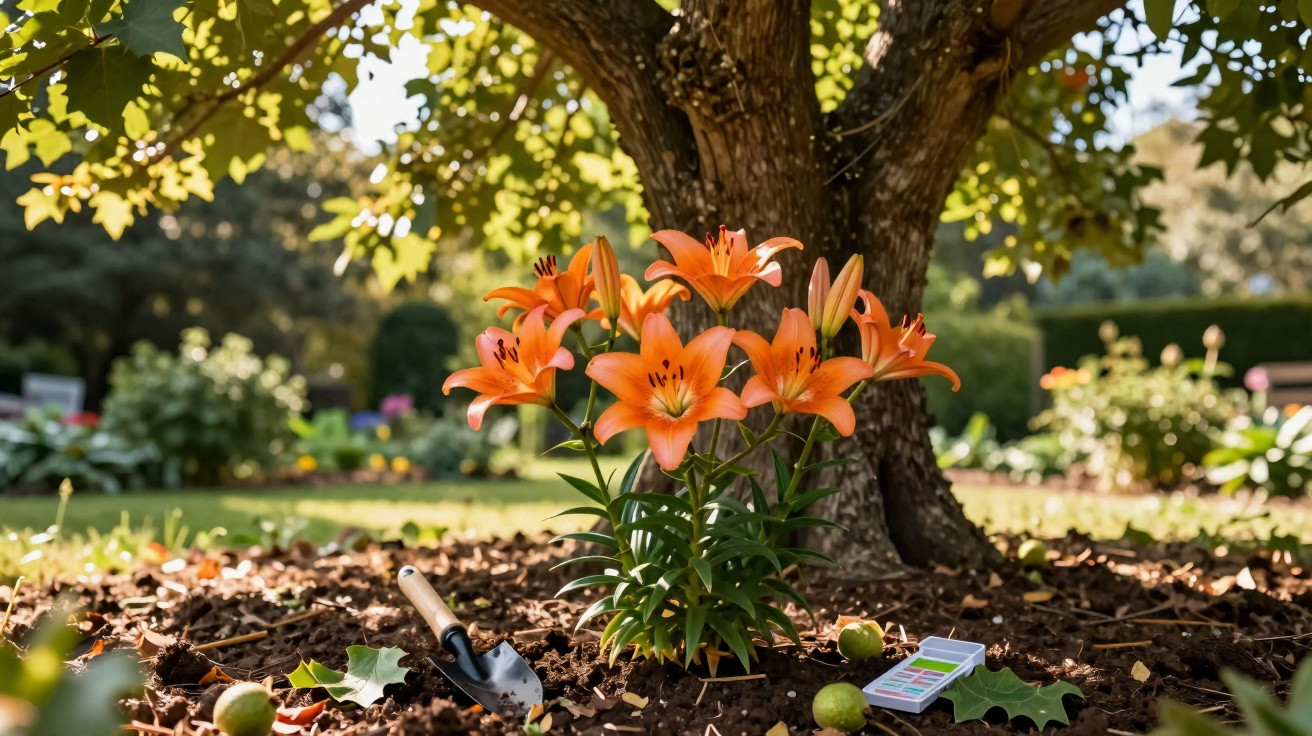
Many amateur gardeners will recognise the pattern: around a black walnut, butternut or walnut tree, some plants thrive while others suddenly die back. The cause is juglone, a plant toxin in the soil. This raises an important question: can Asiatic lilies tolerate this “walnut toxin”, or will they fail? The reassuring answer is yes, although it is not quite that straightforward.
What juglone does in the garden
Members of the walnut family, including black walnut, butternut and walnut, produce juglone, a naturally occurring toxin. It is found in:
- roots
- bark
- leaves
- husks
Rain and decomposition carry juglone into the soil. In susceptible plants, it disrupts cellular respiration there. Roots absorb the compound, cells are left with too little energy, and the plants effectively collapse from within.
Typical symptoms: limp shoots first appear within one to two days, followed by yellowing foliage and, ultimately, collapse and death.
How severely the toxin affects plants depends chiefly on:
- Soil type – heavy clay soils retain juglone for longer than sandy soils.
- Drainage – waterlogged areas increase contact between roots and the toxin.
- Distance from the tree – the root zone may extend well beyond the canopy.
The critical zone of influence generally reaches about 15–25 metres from the trunk. Within this belt, sensitive species such as tomatoes, peppers, potatoes and rhododendrons regularly fail.
How Asiatic lilies cope with juglone
The key message for lily enthusiasts is that Asiatic lilies, or Asiatic hybrids, are among the tougher garden plants for areas around walnut trees. They are considered moderately to highly tolerant of juglone.
Several university extension services and horticultural trials include them among “juglone-tolerant ornamental plants”. Observations from gardens with walnut trees indicate that, given suitable site conditions, they flower reliably even within the walnut zone.
Asiatic lilies are far less likely to wilt suddenly beneath walnut trees than well-known problem plants – but the location is not entirely risk-free.
Their internal characteristics appear to help: their cell structure and metabolism seem less vulnerable to juglone. Apparently, the plants can continue energy production and growth even when the toxin is present in the soil.
Differences between lily types
Not all lilies respond in the same way. Tolerance varies between groups:
| Lily type | Assessment of juglone tolerance | Recommended planting area near walnut trees |
|---|---|---|
| Asiatic hybrids | Moderate to good | Suitable within roughly 15–25 m |
| Oriental lilies | Moderate | Preferably at the edge of the affected zone, with very good drainage |
| Trumpet lilies | Moderate | Better at the outer edge of the walnut root zone |
| Species lilies | Varies, usually good | Often acceptable in the juglone zone |
For the safest approach, plant mainly Asiatic hybrids and hardy species lilies in the inner area. Oriental and trumpet lilies are better placed towards the boundary of the walnut tree’s zone of influence.
Site conditions for Asiatic lilies: drainage is the real game changer
Whether Asiatic lilies genuinely perform well under walnut trees is determined above all by the soil. Water movement through it is particularly important.
The better the soil drainage, the less time juglone remains at high concentrations around lily roots.
A simple check before planting is entirely sufficient:
- Dig a hole around 30 cm deep.
- Fill it with water.
- Check after 24 hours whether water remains.
If water is still standing in the hole, the site needs improvement. Suitable measures include:
- Mixing in plenty of compost to open up the soil.
- Creating a raised bed where soil is particularly heavy.
- Incorporating coarse material, such as grit or coarse sand, sparingly and always together with organic matter.
Asiatic lilies should ideally be planted 15–20 cm deep. This depth offers some protection from fresh leaf fall and surface accumulations of toxins without burying the bulbs excessively deeply.
Gardening methods: helping lilies grow reliably despite walnut toxin
Actively reducing the juglone burden gives lilies a genuine advantage when establishing. The following strategies have proved useful in practical gardens:
- Clear fallen walnut leaves and fruits promptly rather than allowing them to rot directly in the lily bed.
- Apply a mulch layer 5–7 cm deep each year and top it up regularly.
- Water deeply during dry spells to dilute toxins in the soil.
- Monitor lilies especially closely in their first year after planting, and take early signs of stress seriously.
- Feed according to need to encourage strong growth.
A vigorous, well-fed planting copes with mild juglone stress far better than plants that are already weakened.
Thoughtful positioning lowers the risk further. Many gardeners plant Asiatic lilies at the outer edge of the walnut zone: still visually connected to the tree, yet slightly farther from the densest roots.
Sensible companions: plants that can grow alongside lilies
A bed containing lilies alone can soon look rather rigid. In walnut gardens, it is worthwhile combining species with varying levels of resilience. Reliable partners for Asiatic lilies include:
- Hostas – hardy foliage perennials that are relatively tolerant.
- Astilbes – they prefer humus-rich, moister soil and often cope well.
- Ferns – many woodland types have adapted to walnut locations.
- Spring bulbs such as daffodils and crocuses – these are generally considered unproblematic.
Together, these plants create a varied semi-shaded garden, with lilies providing deliberate accents through their clear flower colours.
Resistant lily species for challenging locations
Alongside Asiatic hybrids, there are species lilies that developed in North America in direct proximity to members of the walnut family. For example, Lilium canadense and Lilium superbum show noticeable resilience because they have been able to adapt to juglone sites over a long period.
Anyone with a garden containing several mature walnut trees is well served by a mix of:
- Asiatic hybrids for dependable abundance of flowers.
- Selected species lilies with proven tolerance.
- A few trial plantings of other groups around the outer edge.
Regular checks make it easier to identify weakening bulbs early. If an established group suddenly declines after several years, inspect nutrient supply and soil condition, as nutrient deficiency can look similar to juglone stress.
When juglone is most active – and how gardeners can use this
The toxin level in the soil fluctuates through the year. It usually increases during periods of strong walnut tree growth and after leaf fall. During transitional periods, such as early spring or late autumn, the level tends to be lower.
Planting lilies in spring or late autumn makes use of a calmer period of juglone exposure and helps the plants establish.
In practical terms, avoid planting lilies during a heatwave or immediately after heavy leaf fall. Instead, wait until cooler weather and increased rainfall can help reduce toxin concentrations in the root zone.
Additional practical insights
The term “juglone-tolerant” can easily be misunderstood. It does not mean that a plant remains completely unaffected; rather, it means that under realistic garden conditions it will usually survive and can still perform attractively. Compared directly with identical varieties in juglone-free locations, however, flowering or height may still be slightly reduced.
For amateur gardeners, a small field trial is worthwhile: plant some Asiatic lilies within the walnut tree’s zone of influence and others in a “neutral” part of the garden. This quickly reveals how much the individual soil and particular tree actually restrict the planting – or whether they do not.
By using this flexibility, paying close attention to soil structure, water balance and maintenance, and deliberately avoiding juglone-sensitive species in the walnut area, it is possible to establish a surprisingly lush lily bed directly beneath imposing walnut canopies despite the toxin.





Comments
No comments yet. Be the first to comment!
Leave a Comment