
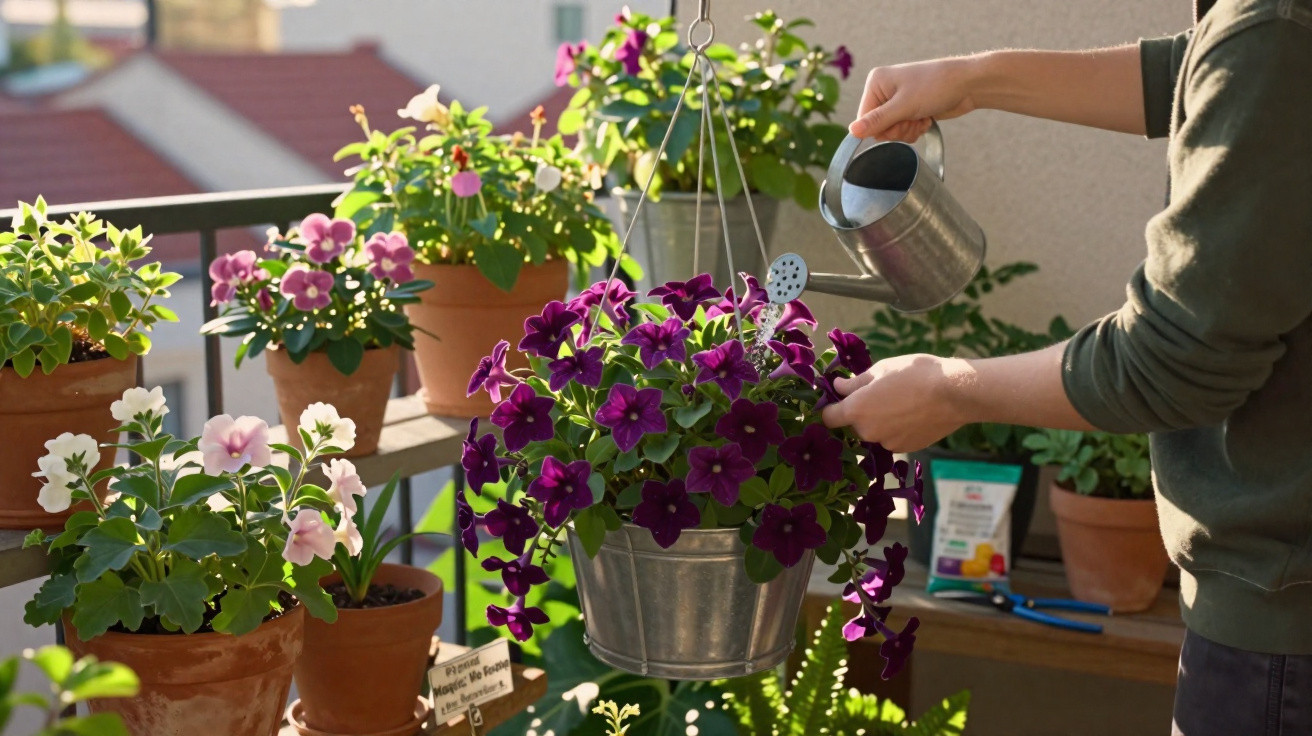
Anyone who begins spring with lavishly planted hanging baskets and window boxes will know the issue: by late summer, petunias and similar plants start to flop, containers look bare or need laborious replanting. Gardeners therefore look for tough varieties that last for a long time, require little attention and still make a real impact. This is where an understated yet exceptionally rewarding perennial comes in.
Meet Plectranthus ‘Magic Mona Purple’
Behind the slightly unwieldy name is a cultivar from South Africa: Plectranthus ‘Magic Mona Purple’, which is also frequently sold under the cultivar name ‘Mona Lavender’. It was bred by the team at De Wet Plant Breeders, specialists in decorative ornamental plants.
Part of the Plectranthus genus, this plant is generally grown here as a frost-tender perennial and has a pleasingly compact habit. It develops into an upright, densely branched bush measuring around 60 to 70 centimetres high and roughly as wide. Rather than producing long, trailing stems, it fills pots and hanging baskets with a lush, cushion-like shape.
Its hallmark is its dark green foliage with strongly purple undersides – providing colourful interest even when no flowers are on show.
Its real distinction is that it holds back its main display until many other summer flowers are already fading. Long, slender flower spikes then emerge, covered in individual purple blooms. Together, they create a dense sea of flowers that gives window boxes the feel of a second season.
Why Plectranthus ‘Magic Mona Purple’ suits hanging baskets
At garden centres, people often automatically reach for fuchsias or petunias. Although they flower generously, they demand substantial watering, feeding and regular deadheading. Plectranthus ‘Magic Mona Purple’ offers a different approach: less effort and enjoyment for longer.
- Long season: Ornamental appeal from early summer well into autumn, thanks to its decorative leaves and late main flowering period.
- Minimal maintenance: Average watering needs and no complicated pruning routine.
- Compact growth: Quickly fills containers without becoming rampant or trailing downwards.
- Bee-friendly: Its purple flowers attract bees and other pollinators.
- Ideal for shaded balconies: Flowers in places where many classic choices struggle.
Those with a shadier balcony often feel overlooked by the range available in shops. This Plectranthus variety fills precisely that gap, bringing bold colour to partially shaded and shaded corners.
The best position: partial shade rather than midday heat
The plant originates from frost-free regions with filtered light beneath trees. It therefore appreciates warmth in the UK, but not intense heat. A bright position away from scorching sun is the best option.
Suitable places on balconies and patios
- An east- or north-facing balcony
- Beneath a canopy or roof overhang
- Against a sheltered house wall where it is not exposed to direct midday sunshine
- In the shade or dappled shade of a larger tree
Full midday sun, particularly when reflected from concrete or pale stone, puts the plant under considerable stress. Leaves may scorch, the pot dries out extremely quickly and flowering suffers. In bright, indirect sunshine, by contrast, it grows vigorously, its leaf colouring is shown to best effect and the flowers last longer.
Temperatures and overwintering
In its subtropical countries of origin, this perennial copes easily with mild winters. In our climate, however, the situation is different. Temperatures around freezing point can already become critical.
| Temperature range | Plant response | Recommended action |
|---|---|---|
| above 10 °C | optimum growth, flowering stage depending on the season | Keep outdoors or on the balcony, with normal care |
| 5–10 °C | growth slows, but remains stable | Move to a sheltered place and avoid waterlogging |
| 0–5 °C | high-stress zone, with a risk of damage | Bring indoors by this point at the latest |
| below 0 °C | frost damage, potentially leading to plant death | Keep only in a frost-free indoor space |
Many amateur gardeners give the plant a “double life”: a lush outdoor hanging plant in summer, followed by a decorative houseplant on a windowsill during the colder months. A bright room that is not too warm is ideal.
Planting in a pot or hanging basket: the essentials
For Plectranthus ‘Magic Mona Purple’ to show its full potential, it needs a suitable container and the right growing medium. The good news is that the work involved remains manageable.
Choosing the right container
- Choose a pot or hanging basket with several large drainage holes.
- Allow enough volume for a bushy root ball to form: at least 25–30 cm in diameter.
- Use a sturdy hanging support for baskets, as the plant becomes relatively heavy.
For the growing medium, it is worth combining standard multipurpose compost with materials that improve its structure, such as expanded clay, lava granules or coarse sand. This keeps the compost open, allows roots access to air and prevents waterlogging from developing in the first place.
Step-by-step planting guide
- Place a drainage layer of expanded clay or gravel at the bottom of the container.
- Fill the pot halfway with the compost and drainage-material mix.
- Carefully remove the plant from its nursery pot and gently loosen the root ball.
- Position it so that the root ball sits just below the rim.
- Fill around it with compost and press it down lightly to avoid air pockets.
- Water until liquid runs from the bottom, then allow it to drain fully.
During the first week after planting, do not allow the compost to dry out completely. The perennial first needs to establish its roots in the new pot before it can cope with longer dry spells.
Everyday care: watering, feeding and pruning
Unlike genuinely thirsty plants, including some Surfinia varieties, this perennial manages with moderate watering. Its root ball should stay evenly moist, but it must never sit in water.
Water when the surface feels dry and the pot is noticeably lighter – a sound routine rather than a rigid watering timetable.
Watering and feeding
- Watering: Depending on the position, water one to three times a week in summer; check it during hot weather.
- Water quality: Use water at room temperature and, where possible, low in limescale.
- Feeding: Apply a liquid fertiliser for flowering plants every two weeks from May to September.
This cultivar is considered “moderately hungry”: too much fertiliser encourages foliage rather than flowers, while too little results in pale leaves and reduced flowering. If in doubt, use a weaker dose, but apply it consistently.
Pruning and shaping
A light trim is all that is needed to keep the plant bushy:
- Pinch out the growing tips in spring using your fingers or scissors.
- Shorten individual long shoots after the main flowering period.
- Remove spent flower spikes to encourage further blooms.
This keeps its habit compact and allows the plant to be enjoyed as a potted perennial for several years.
Growing Plectranthus over several years and propagating it
Because it is frost-sensitive, this perennial is often put on the compost heap after one season – entirely unnecessarily. With a frost-free place to spend winter and a little care, it can provide enjoyment for several years.
Anyone wishing to build up additional plants can take cuttings. The soft shoot tips root readily in a glass of water or directly in seed compost. In this way, a single parent plant can produce a number of new plants in one season – ideal for filling several window boxes the following spring.
Plants that combine well with Plectranthus
Its purple flowers and two-tone leaves work well alongside other plants. Suitable partners in hanging baskets or larger containers include:
- white-flowering busy Lizzies, creating contrast in partial shade
- cinnamon-coloured or light green Coleus varieties for an interesting foliage display
- delicate grasses such as ornamental sedges, adding height and structure
- compact fern varieties for an almost tropical look
The important thing is to select plants with similar light and watering requirements. Sun-loving varieties such as geraniums are less suitable if the basket is genuinely positioned in shade.
What beginners should bear in mind
Even gardeners with little experience of frost-tender potted perennials can make a relatively relaxed start with Plectranthus ‘Magic Mona Purple’. Just three points require some attention:
- No frost: Move the pot to a sheltered, frost-free location at the latest when single-digit minimum temperatures are forecast.
- Avoid waterlogging: Do not leave saucers permanently full of water, and empty cachepots regularly.
- Winter light: Choose a bright indoor position, such as an east- or west-facing window.
Anyone who follows these basics has an excellent chance of being surprised year after year by a purple firework display in autumn. Particularly during the transition from summer flowers to autumn planting, it fills a gap – transforming otherwise bare window boxes into genuine eye-catchers.
Comments
No comments yet. Be the first to comment!
Leave a Comment