
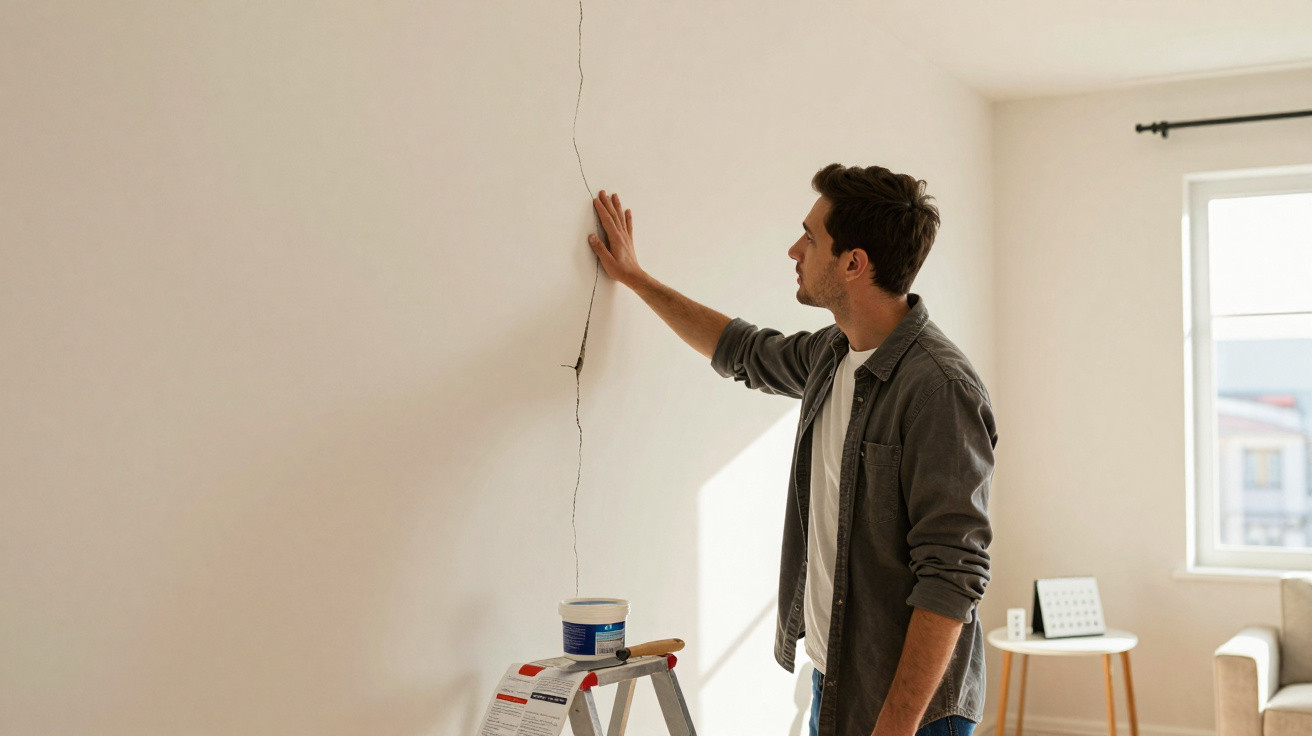
A homeowner believed they had dealt with a minor flaw in an outside wall. A few months later, the crack had returned - and it was worse.
A renovation professional told the online outlet behind the original report about a case that highlights the common mistakes homeowners make when dealing with cracks in façades. By filling it at the wrong time of year, the owner unintentionally sped up the deterioration of the wall. The story is a warning for anyone considering tackling this kind of defect themselves, in France or elsewhere.
A cracked wall hastily filled at the worst possible time
According to the account published by the news website that originated the article, the issue began with an ordinary crack in the outer wall of a detached house. There was nothing dramatic about it: it was a narrow vertical opening, and the homeowner chose to handle it without first obtaining a diagnosis.
At first, the approach seemed sensible: buy some filler from a DIY shop and fill the crack to restore the façade's neat appearance. The issue was not the product itself, but the timing of the work.
“The homeowner filled the crack during the bad season, while the wall was damp and the temperature unsuitable: the ideal conditions… for failure.”
The repair was carried out during a period of sharp temperature changes, with cold nights followed by relatively mild days. Exposed to rain and damp, the wall did not have sufficient time to dry properly. The filler applied to the surface bonded poorly to the substrate. The façade initially looked repaired, but the weakness was already there.
A few months later, the crack returns twice as wide
After winter, the homeowner noticed that something was wrong. The line that had seemingly disappeared became clearly visible again. This time, however, it looked very different: the crack had become much wider and more conspicuous.
The stresses placed on the wall throughout the cold season caused the masonry to move. In places, the poorly applied filler came away, allowing water to penetrate every weak point. When that water froze, it expanded and widened the opening.
“By trying to conceal the crack too soon, the homeowner trapped moisture inside the wall, which accelerated the widening of the split.”
For the professional interviewed by the original outlet, this is a typical example: carrying out a repair at the wrong time can turn a merely cosmetic crack into a structural problem. A surface-level repair does not address the underlying issue; it only temporarily hides a symptom that continues to develop.
Why the wrong time of year makes all the difference
For an external wall, temperature, humidity and freeze-thaw cycles are decisive factors. Manufacturers of fillers and mortars advise avoiding periods with:
- frost, or a risk of frost in the days after application;
- forecast rain that will soak the surface;
- extreme heat, which dries the product too quickly at the surface without allowing it to set properly at depth.
A wall that remains cold or waterlogged expands and contracts and is still unstable. Any repair undertaken at that point may crack again, sometimes worsening the original defect, as happened in the reported case.
Common homeowner mistakes when dealing with cracks
This homeowner's experience highlights several problematic habits identified by many building tradespeople.
Simply “filling the hole” without establishing the cause
A wall can crack for many different reasons: ground movement, foundation settlement, material expansion, water ingress or a design defect. Filling a crack without a diagnosis is like putting a plaster on an injury without examining its cause.
This sort of work can even make a professional's subsequent job harder, as they may have to remove unsuitable fillers or sealants before repairing the crack correctly.
Choosing a product that is unsuitable for the surface
Another frequent source of problems is using ordinary interior filler on an external crack exposed to the weather. Some products withstand neither water nor frost nor ultraviolet rays. They can crack, detach and sometimes trap moisture inside the wall.
For external façades, professionals favour mortars or fillers specifically designed for the surface involved, whether it is concrete, concrete block, brick, stone or old lime render.
Overlooking the signs of an “active” crack
A crack may be described as “active” when it is still changing. It can be identified by:
- noticeable widening over a few weeks or months;
- new hairline cracks appearing nearby;
- an opening that occasionally runs all the way through the wall, both inside and outside.
In such situations, several experts advise monitoring the crack with a tell-tale marker - a bonded plasterboard or glass plate, or a graduated crack monitor - before considering permanent repair work. Filling it immediately may conceal a structural issue that needs assessment.
How to repair a crack properly: the main stages
Building professionals set out a number of key steps for dealing with a façade crack safely and properly.
- Observe and measure: its length, width, direction, depth, and whether it is recent or old.
- Identify the likely cause: clay soil, a missing expansion joint, water ingress, impact damage or a construction defect.
- Choose the right period: dry weather, mild temperatures and no forecast frost.
- Prepare the crack: open the split slightly into a V-shape, remove dust, brush it clean and ensure the substrate is sound.
- Use a suitable material: mortar, resin or filler compatible with the substrate and external use.
- Allow it to dry thoroughly before applying paint or decorative render.
The following table offers a clearer overview of the right approach:
| Situation | Risky response | Recommended response |
|---|---|---|
| Small crack in winter | Fill it immediately in damp conditions | Monitor it, protect it from water and repair it in spring |
| A widening crack | Hide it with filler or paint | Obtain a diagnosis and fit a crack monitor |
| Damaged external substrate | Use standard interior filler | Use a product designed for façades |
What would happen in a similar case in France?
In France, dealing with house cracks follows principles similar to those outlined by the professional quoted in the source article. For a superficial, stable crack, many French homeowners attempt the repair themselves. Where cracks are wider or raise concerns, home insurers generally advise reporting the damage as soon as the issue appears.
When ground movement is responsible, particularly following drought in areas with clay soils, municipalities may be officially recognised as being in a natural disaster situation. Homeowners may then receive compensation for foundation underpinning work, provided they have reported the damage to their insurer in time.
The French counterparts to the professionals referred to in the source include masonry firms, façade specialists and building experts. They may be appointed by an insurance company to prepare a technical report. In the most serious cases, a structural engineering consultancy or civil engineer assesses the building's stability.
Why the timing of building work matters just as much in France
France's climate, with winters that can be severe and increasingly hot summers, makes choosing the right period crucial. Tradespeople generally avoid:
- façade work when temperatures approach 0 °C or overnight frost is forecast;
- applying render during the height of a heatwave, as this causes excessively abrupt drying;
- work on a waterlogged substrate after heavy rain.
The guidance therefore echoes the lesson implicit in the story reported by the original outlet: waiting for a spell of stable weather greatly reduces the risk of the crack returning.
The right steps for a homeowner faced with a crack
In light of this case, in which the crack returned twice as wide, several steps can help avoid a similar outcome:
- take dated photographs as soon as the crack appears;
- measure its width with a ruler or callipers and record any changes;
- avoid filling it during cold, very damp or heatwave conditions;
- seek professional advice if the crack is more than a few millimetres wide or runs across several levels;
- do not merely repaint the wall to conceal the defect.
A homeowner can also arrange a preventative assessment when purchasing an older property. Some building experts offer pre-purchase inspections to assess the condition of load-bearing walls, foundations and façades. Such an inspection has a cost, but it can reduce the risk of unpleasant surprises and rushed emergency repairs.
Understanding wall movement: an advantage in avoiding unwelcome surprises
A wall is never completely motionless. It is constantly subject to stresses: the weight of the structure, temperature changes, soil shrinkage or swelling, and moisture. When these movements remain slight, they result only in harmless hairline cracks. When they increase, openings widen, extend or multiply.
Being able to distinguish a crack in paint from a genuine masonry crack helps homeowners make appropriate decisions. In the case reported by the original outlet, the homeowner underestimated how the wall was moving and chose the wrong time to act. The message is clear: a crack is not merely an aesthetic issue, particularly when it is changing.





Comments
No comments yet. Be the first to comment!
Leave a Comment