
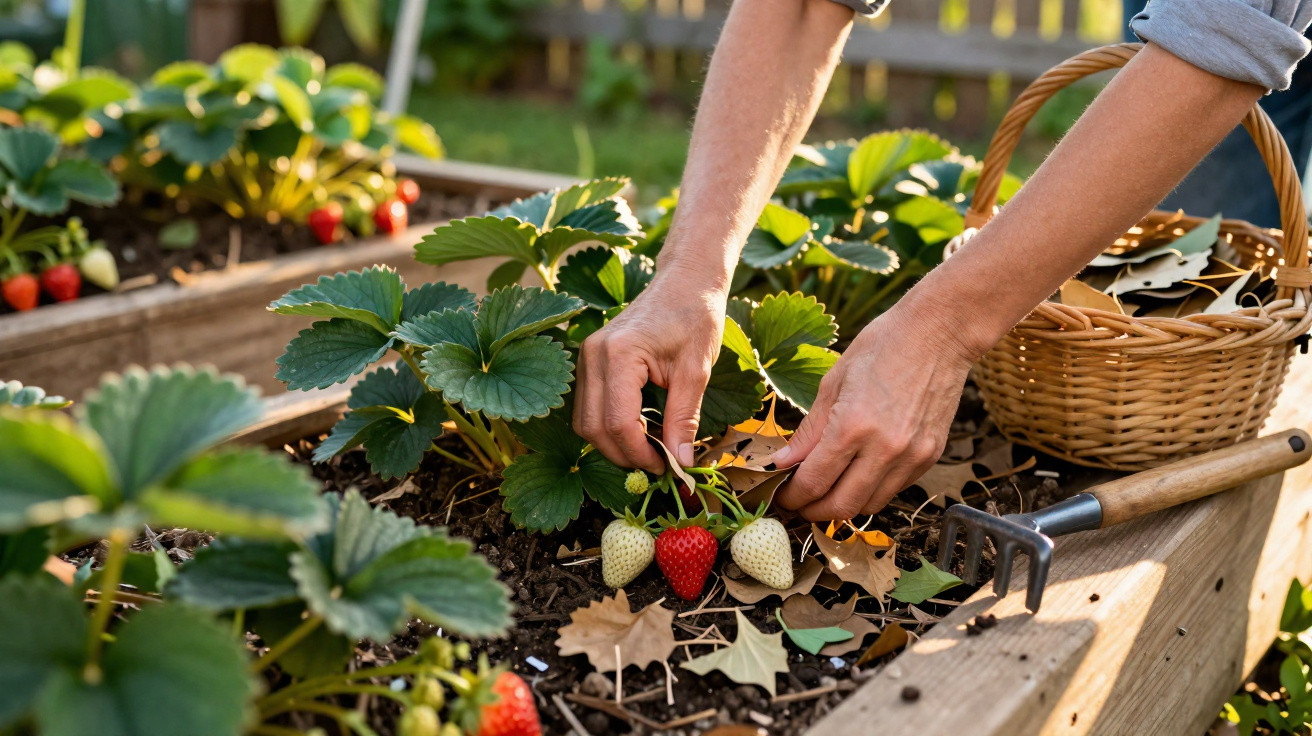
In spring, armfuls of wilted leaves are swept from beds and borders into the compost bin or garden-waste collection. What few people realise is that these apparently worthless plant remains can give strawberry plants a head start of several days – without a polytunnel, heating cables or specialist fertiliser.
Why dried ornamental plant leaves are so valuable
Spring bed tidy-up: an overlooked mistake
As temperatures rise, almost everyone reaches for the secateurs and rake in the garden. Spent tulips, irises, daffodils and other bulbous or perennial plants are cut back drastically. Their long brown leaves nearly always end up on the compost heap or in a bag of garden cuttings.
This is where the real loss begins: dry leaves are not waste, but a free, high-quality natural material – ideally suited to protecting and supporting sensitive crops such as strawberries.
“What looks like dead plant material is actually a natural high-tech raw material for your bed.”
Their distinctive structure is what matters
After winter, the leaves of tulips, irises and daffodils have dried out completely. This significantly changes their characteristics:
- Fibrous and durable: They do not tear immediately and can be layered together easily.
- Light and breathable: Unlike grass cuttings, they do not form a dense, wet layer.
- Permeable to water: Rain drains through quickly, so waterlogging and rot are unlikely.
- Long-lasting: They decompose slowly, remaining in place as a protective layer for a long time.
This makes them an ideal natural mulch, especially for low-growing crops such as strawberries.
How dry leaves help strawberries ripen sooner
A natural heat store around the base of each plant
Strawberries are sensitive to fluctuating spring temperatures. Cold nights slow growth and flower formation, delaying the start of the season.
When dried leaves are loosely placed around strawberry plants, they create a thin mulch layer. This works as a natural temperature buffer:
- During the day, the dry plant material absorbs warmth from the sun.
- At night, the layer prevents the soil from cooling too sharply.
- The roots stay within a more consistent, slightly warmer temperature range.
As a result, spring effectively feels a few days more advanced to the strawberry plant than it really is.
“Gardeners who mulch in this way observe, on average, that the first fruits ripen up to five days earlier.”
Faster flowering, earlier harvesting
A steadier soil temperature speeds up the plants’ metabolism. In practical terms, this means:
- stronger, earlier flowering
- improved pollination through more favourable flowering times
- quicker fruit development
This lead of several days can be very noticeable – particularly when you are impatiently waiting for every first red strawberry.
A protective barrier against wet conditions and fungal diseases
Why bare soil makes strawberries unhealthy
Wet, exposed soil is a major problem in a strawberry bed. When it rains, soil splashes onto low-hanging fruit. Fungal spores travel with this soil to the berries, where they find ideal conditions: moisture, little air movement and a delicate surface.
The result is soft fruit covered in grey fluff – usually caused by the dreaded grey mould (Botrytis). Once present in the bed, it spreads quickly and can destroy large parts of the crop.
How leaf mulch halves fungal infection
With a layer of dry leaves beneath the plants, the fruits no longer touch damp soil and instead rest on a dry cushion. The area affected by splashing water is dramatically reduced.
Agricultural research shows that organic mulch layers in strawberry crops:
- greatly reduce direct contact between fruit and damp soil
- consequently allow fewer fungal spores to reach the berries
- can therefore noticeably reduce the use of fungicides
“The combination of less contact with moisture and a surface that dries quickly makes strawberries considerably more resistant to rot.”
Because water drains rapidly through the airy weave of leaves and wind dries the surface quickly, fungi lack the constantly damp conditions they need to establish an infection.
How to collect and sort the ideal material
The right timing and the best leaf quality
When tidying beds in spring, it is worth doing a little sorting. The aim is to build up a supply of suitable leaves for strawberry mulch. The following are particularly suitable:
- fully dried leaves from irises, tulips, daffodils and similar plants
- long, flexible leaf strips that layer together well
- material in the colour of dry hay, with no green or juicy sections
Two containers are helpful: one for ordinary compost and one for mulching material. This lets you separate them as you cut.
What must never go into the mulch
Not every plant remnant is suitable for direct use beneath strawberries. Be sure to remove:
- leaves with black spots, white coating or mould
- very hard, thick stems that break down poorly
- damp plant material that has not yet dried thoroughly
Diseased material belongs in general waste or, where available, a separate waste stream. Thick stems can be chopped and added to the compost, but they are impractical for creating a fine mulch covering.
Building the mulch layer correctly in a strawberry bed
Keep it thin: one to two centimetres is enough
For a strawberry bed, less is more. The layer should be:
- spread loosely
- only around one to two centimetres deep
- not heavily compacted
Arrange the dry leaves in a ring around each plant. Leave a small circle clear in the centre, directly around the crown of the strawberry plant – roughly the size of a coin. This allows air to reach the base of the plant, helps water drain away and lets the root zone breathe.
“Mulch should act like a breathable fabric – not like a plastic sheet.”
The number-one mistake: layers that are too thick and dense
If mulch is applied too deeply and packed down too firmly, moisture can build up beneath it. This may lead to root rot, causing plants to suddenly look weak and partially collapse.
If you are unsure, gently loosen the layer by hand from time to time and check the soil. A fresh, earthy smell means it is right. If it smells musty, the layer should be reduced slightly.
Everyday financial and environmental benefits
Save money instead of buying expensive mulch
Many strawberry enthusiasts buy straw, hemp mulch or coconut mulch from garden centres every year. These products work, but they cost money, often travel long distances and come wrapped in plastic.
Using your own ornamental beds as a source of raw material makes you independent of such products. The mulch is produced right outside your door, free of charge and without transport routes.
More yield, fewer chemicals and healthier soil
This method delivers benefits on several fronts:
- an earlier and usually more abundant strawberry harvest
- significantly less damage from rot
- little need for fungicides or specialist treatments
- less garden waste requiring disposal
At the same time, soil remains more active beneath the mulch layer. Earthworms and other soil organisms receive food, the soil stays looser and it dries out less rapidly during warm periods.
Practical tips and combinations for even better beds
Combine intelligently with other mulch materials
If you do not have enough ornamental plant leaves, you can combine them with other materials. Suitable options include:
- finely chopped straw
- thin layers of leaves that are well dried and not applied too thickly
- very fine woodchip as a base layer
The dry bulb plant leaves are then added as the top layer, free from direct soil contact and directly beneath the fruit.
Minimising risks: points to watch
Despite all the advantages, a few aspects need attention:
- Check regularly that slugs are not hiding beneath the layer.
- After heavy rain, briefly make sure that the fruits are still resting dry.
- Where strawberries are planted very close together, use a little less mulch to maintain sufficient air circulation.
Anyone who follows these simple rules can turn supposed garden waste into an effective ally. The dried leaves that once ended up carelessly in the garden-waste bin become the reason why the first sweet strawberries are ripe in your garden while everything is still green next door.
Comments
No comments yet. Be the first to comment!
Leave a Comment