
Countless homes have a magnificent Phalaenopsis orchid sitting on the windowsill, only for it eventually to produce leaves and not a single fresh flower. People are quick to say: “It’s fussy” or “It doesn’t like me”. In fact, the plant is simply responding honestly to its surroundings. Anyone who understands where it comes from and is willing to move it somewhere entirely different for part of the year can encourage orchids to flower year after year – without specialist fertiliser or esoteric tricks.
Why the usual windowsill rarely suits an orchid
The popular Phalaenopsis originates in tropical forests. In its natural habitat, it grows high up on tree trunks, surrounded by humid air, gentle airflow and marked differences between daytime and night-time temperatures. Our living rooms provide almost none of this.
A typical routine for a house orchid looks like this:
- It remains in the same spot throughout the year.
- The heating runs for long periods and keeps temperatures steady.
- The air is dry, particularly in winter.
- Light levels barely change – or are far too intense.
As a result, the plant receives no clear “starting signal” to make fresh flowers. Phalaenopsis orchids are especially likely to produce flower spikes when days are a little warmer than nights – roughly 18 to 22 °C during the day and 12 to 15 °C overnight. Many windowsills simply do not offer this difference.
There is also the issue of light. If an orchid stands too far from the glass, it will merely continue growing without flowering. Yet leaves may scorch when it is placed directly behind a south-facing window. Bright but filtered light is ideal, such as the area around an east-facing window with gentle morning sun.
Without changing temperatures and varying light, the orchid lacks the signal: “Now is flowering time!”
The unusual professional tip: hang orchids outdoors in summer
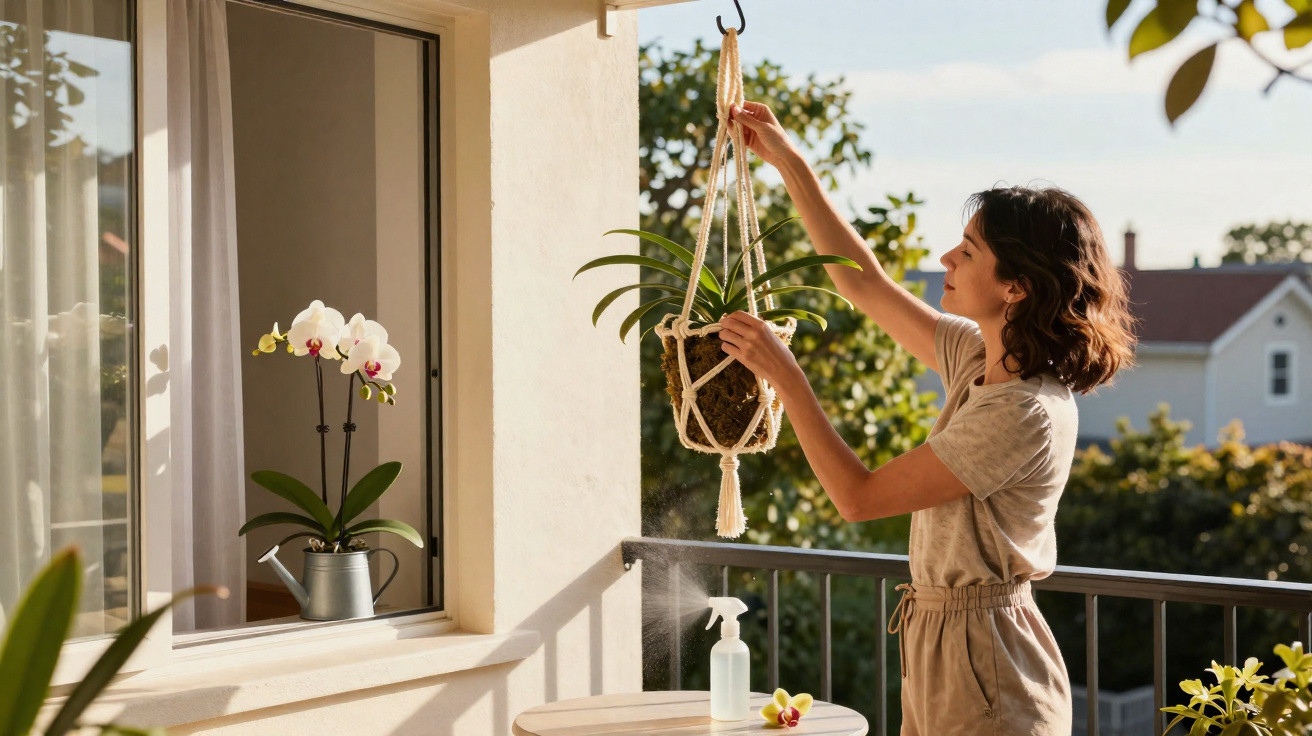
An experienced landscape planner from Northern Europe relies on a dramatic change of location. During summer, she does not keep her Phalaenopsis by the window but moves them outdoors – not simply onto a table, but into a hanging basket.
The method sounds straightforward, but it can make a major difference. The orchids remain in their pots, which are then placed together in a sturdy hanging basket and suspended outside in partial shade. They receive no blazing midday sun and no relentless rain, but benefit from plenty of fresh air and noticeably higher humidity than they would indoors.
The basket should hang high enough to keep slugs and other ground-dwelling creatures away from the plants. This matters particularly after rain, when these animals become active. In Central European regions, the suitable period is around June to late August or early September, depending on the weather.
What happens to the orchid outdoors
Outside, the plant automatically receives what would be difficult to recreate indoors:
- Nights are noticeably cooler than days.
- Humidity increases, especially after rain or when there is dew.
- Light changes more naturally over the course of the day than it does beside a window.
- Air movement prevents water from lingering on leaves and roots.
This combination works rather like a reset. After spending the summer outdoors, many orchids begin forming new buds – sometimes while still hanging outside, and sometimes only a few weeks after being brought back in.
Summer in a hanging basket provides precisely the natural stimuli missing from an orchid’s living-room environment.
How to move orchids into a hanging basket step by step
- Choose a suitable spot: Pick a sheltered place in the garden or on a balcony that is bright but protected from direct midday sun. A position beneath a tree or on a covered terrace is ideal.
- Get a sturdy hanging basket: Metal or plastic baskets with hooks are practical. The basket must support the weight of several pots.
- Put the pots straight into the basket: Keep the orchids in their existing growing medium. No repotting is required; simply arrange them securely so that nothing moves about.
- Keep an eye on rain: Light rain is not a problem, but prolonged rain is. If necessary, hang the basket beneath an overhang.
- Adjust watering: Growing medium dries more quickly outdoors. Check regularly that the roots are still slightly moist, and preferably water in the morning.
- Bring them indoors in good time: Move the orchid back inside once nights become noticeably cooler or temperatures begin to approach single figures.
The best indoor spot for the rest of the year
After its outdoor season, an orchid should not return to stale heated air. Anyone taking the summer treatment seriously should also give it an appropriate position during winter:
- A bright east-facing window: Morning sun followed by bright indirect light is ideal for leaves and flowers.
- Cooler conditions at night: A room that becomes slightly cooler overnight, such as a bedroom, a hallway with a window or a study that is not fully heated.
- No close proximity to radiators: Keep it away from the radiator or place it on a higher shelf.
- Allow air to circulate: Air the room briefly and regularly, without directing draughts straight at the plant.
Those without a house and garden can use a sheltered balcony instead. A small hanging basket can also be installed there, provided the position is protected from wind and not in full sun.
Watering, feeding and care: less intervention, more routine
Most orchids suffer not from too little attention, but from too much. Constant watering and fertilising puts plants under stress. A calm, consistent routine is better:
| Care task | Recommendation |
|---|---|
| Watering | Wait until the growing medium is almost dry; water more often in summer and less often in winter. |
| Fertilising | Apply a weak dose every 2–4 weeks during growth, and considerably less in winter. |
| Humidity | Use a saucer containing pebbles and a little water, or occasionally mist the air around the plant. |
| Repotting | Every two to three years, when the growing medium breaks down or smells musty. |
Signs that the new location is working
An orchid does not shout when something is missing – it sends signals that need to be recognised. When the location strategy and summer basket are working well, several signs usually appear:
- Leaves look firm and deep green, without yellow patches or shrivelling.
- Aerial roots are silvery green rather than soft and mushy.
- New flower spikes or side shoots emerge from the leaf axils.
- During quieter periods, the plant produces new leaves instead of becoming dormant.
Anyone who views their orchid as a living thing with needs – rather than a decoration – is often rewarded with years of magnificent flowers.
Common mistakes that prevent abundant flowering
The same problems crop up repeatedly in households. A brief look at the usual culprits can help prevent them in future:
- A permanent position above a radiator: This dries out roots and leaves.
- Standing water in the cachepot: This causes root rot, which stops flower production.
- The wrong compost: Ordinary potting compost suffocates the roots; orchids need a coarse growing medium.
- A location that is too dark: The plant keeps itself going with leaves but does not form buds.
- No temperature difference: When day and night are equally warm, there is no stimulus for flowering.
Why the “unusual location” works so well – behind the scenes
What appears to be a simple change of position is actually a biological trick. Tropical orchids respond very sensitively to temperature, day length and humidity. In the tree canopy of their natural habitat, these conditions fluctuate every day. A hanging basket outdoors recreates exactly this: slightly cool nights, humid air and gentle morning or evening light.
Anyone with several Phalaenopsis can observe the effect particularly well: leave some by the window and move others outdoors for summer. The “outdoor guests” will often produce fresh flower spikes more quickly and in greater numbers. For people who believe they do not have green fingers, this experiment can be a surprisingly encouraging experience.
Interestingly, this approach does not work only for expensive specialist varieties. Even inexpensive supermarket orchids that seem unremarkable after their first flowering can be properly revived with this method. Those who do not throw the plants away but give them this change of location save money while also developing an understanding of plant physiology – without a textbook, using only a hanging basket and a little patience.
Comments
No comments yet. Be the first to comment!
Leave a Comment