
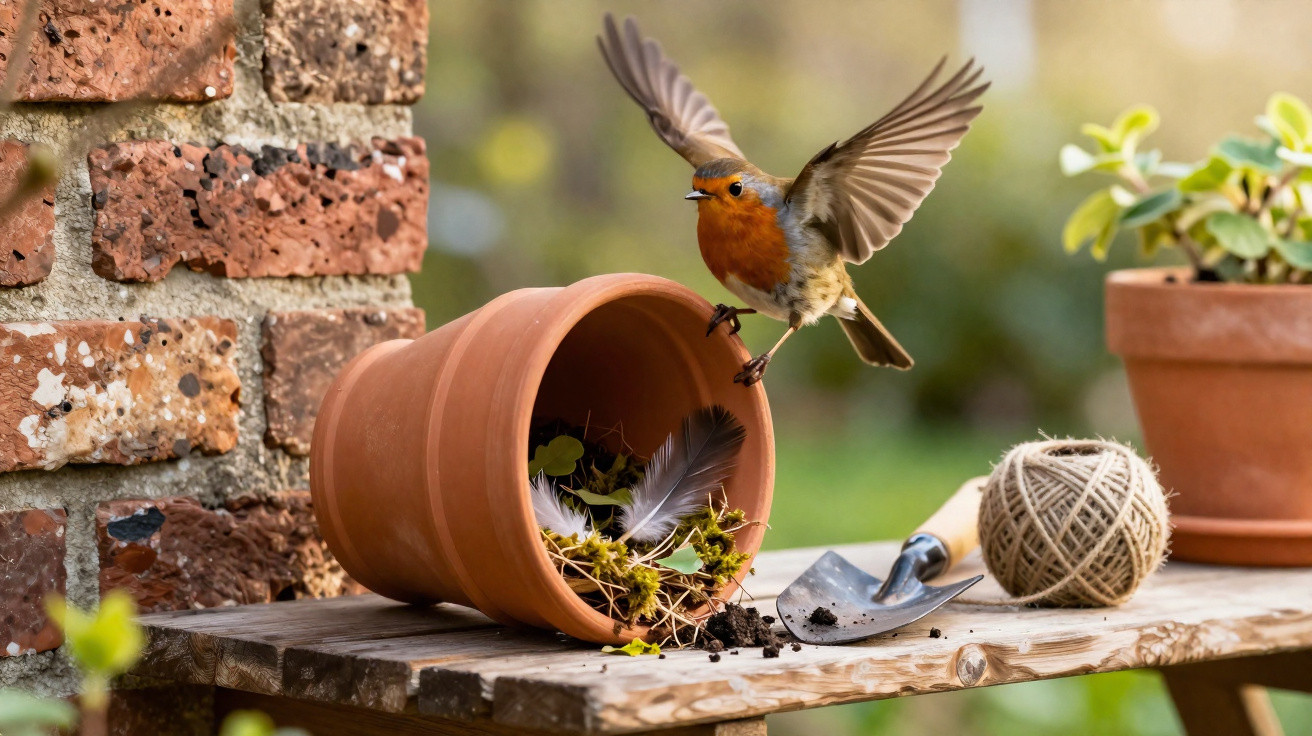
But anyone who genuinely wants to help robins needs to understand their nesting secret.
Many gardeners put up costly nest boxes, then wonder why the robin ignores them. This small bird with its orange-red breast behaves differently from tits or sparrows. Rather than a high box with a small entrance hole, it seeks an open hideaway close to the ground. This is where an unremarkable helper comes in: an old terracotta flowerpot, positioned and prepared correctly.
Why robins have little use for conventional nest boxes
The European robin (Erithacus rubecula) may seem familiar: it follows a spade, picks up insects and perches very close to people. Yet it is selective when choosing somewhere to breed. Many standard wooden nest boxes are intended for species such as tits, sparrows or starlings – not robins.
Robins are regarded as semi-cavity nesters. They do not use narrow cavities with a small entrance hole positioned 2–3 metres high. Instead, they favour:
- open but well-sheltered niches
- low locations, up to roughly chest height
- dense shrubs, ivy, woodpiles and banks
- hiding places that are barely noticeable from outside
A typical tit box fixed to a house wall is simply of no interest to them. The bird looks for cover near ground level, rather than a commanding view at height.
What matters to a robin is not the price of the nesting site, but the logic of its position: low, concealed, open and dry.
Terracotta pot rather than a luxury nest box: why this trick works so well
A basic unglazed terracotta flowerpot meets a surprising number of a robin’s requirements. It is sturdy, inexpensive and found in almost every garden – while, when used properly, providing a microclimate that benefits young birds.
The benefits of unglazed terracotta
The material is crucial. An unglazed clay pot is porous and manages moisture more effectively than painted wood or plastic:
- Less condensation: Moisture does not collect as heavily on the inside, reducing the chance of chicks becoming chilled.
- Gentle heat retention: Clay absorbs some warmth during the day and releases it gradually, creating a more stable climate.
- Natural appearance: Its colour blends discreetly into beds and hedges – perfect for a bird that relies on camouflage.
A wide opening is important. Whereas tits need only a small entry hole, a robin appreciates a broad, semi-open “cave”. A pot around 15 centimetres in diameter is a good starting point.
Turning a flowerpot into a robin nesting site
An old pot can become a practical shelter with just a few simple steps. It costs virtually nothing, although it does require some care.
Choosing and preparing the right pot
- Choose the pot: Use an unglazed terracotta pot measuring 15–20 centimetres across. Do not use plastic, painted or glazed pots.
- Clean it: Rinse it with plain water, removing soil and moss residues. Avoid washing-up liquid, vinegar cleaner and disinfectant altogether.
- Remove labels: Take off stickers and tags so that nothing rubs or catches inside.
The pot should not be set upright. Position it on its side or with a slight downward tilt, so rainwater cannot collect inside.
Preparing the interior: making the pot look “already used”
Robins like to build nests within existing structures rather than on bare ground. It is therefore fine for the pot to look slightly pre-lined:
- Put in a thin layer of dry, clean leaves.
- Add a few small clumps of dry moss.
- Do not use feathers or hay from animal housing, to avoid parasites and germs.
The interior does not need to look perfect. More importantly, it must remain dry, loose and natural.
Positioning the terracotta pot correctly for robins
Even the best terracotta pot is of no use if it is put in the wrong place. Robins follow a clear pattern when selecting a site.
Height, direction and surroundings
Recommended location criteria:
| Criterion | Recommendation |
|---|---|
| Height | Around 1–1.5 metres above the ground |
| Direction of opening | Facing south-east, away from prevailing strong winds |
| Surroundings | A dense hedge, ivy, a bank or an untidy corner |
| Light | Morning sun, but not a spot in full sun all day |
| Disturbance | Away from paths, front doors and play areas |
Set the pot into the vegetation so it is barely visible from outside. A few twigs or tall grasses in front of the entrance are even beneficial, provided the bird can still fly in and out.
For a robin, balance is everything: well hidden from predators, yet quickly accessible in an emergency.
Stability: nothing must wobble
The pot must be completely secure. A shelter that moves is seldom accepted. It can be stabilised using:
- wire to secure the pot to a branch or fence
- pieces of wood or stones to prevent it rolling away
- twigs that wedge the pot in place without blocking the opening
Decorative touches, bright colours and garlands tend to deter most wild birds. A subdued, natural look is the better approach.
The right time: when the terracotta pot should be available
Robins begin preparing to breed early in the year. Anyone wishing to help should act in good time. The ideal period is from late February to mid-March. By then, many birds are already looking for a location but have not yet settled on one.
If the pot is put out much later, it may still serve as a hideaway or daytime shelter, but is less likely to be used for breeding. Planning early considerably improves the chances.
Alternatives and additions: other options that work in the garden
The terracotta pot is not the only possibility. In gardens, robins may also use:
- old watering cans laid on their sides
- upturned buckets with a side opening
- discarded window boxes, half concealed beneath shrubs
- gaps in woodpiles or dense ivy
All of these options should follow the same principle: a low position, partial vegetation cover, a large entrance and protection from prolonged rain. Providing several shelters increases the choice available and reduces reliance on a single nesting site.
Practical tips for greater success with robins in the garden
A pot alone does not make a garden a robin hotspot. The rest of the garden design also matters. A few straightforward adjustments can make a substantial difference:
- Less tidiness: An area of “wilder” perennials and grasses provides insects and cover.
- No pesticides: Poisons reduce the food supply and may harm young birds.
- Protection from cats: Thorny shrubs or densely branched hedges in front of the entrance make access more difficult for predators.
- Quiet areas: Children, dogs and regularly used paths should be kept several metres away.
Anyone who has already created a pot nesting site but sees no activity can review it critically the following year: is there sufficient cover? Are light, noise or pets causing disruption? Sometimes moving it just a few metres within the same hedge is enough.
Useful knowledge: behaviour, risks and opportunities
Robins are loyal to a location. If a pair feels at home in a garden, it often returns year after year. A convincing nesting site can therefore have a long-term effect. At the same time, the birds are sensitive to disturbance while breeding. If successful, leave the terracotta pot completely undisturbed and observe only from a distance.
One often underestimated issue is the risk posed by heavy rainfall and heatwaves. Open nests can fill with water during cloudbursts or overheat when heat builds up. This is exactly where the terracotta pot shows its strengths: the slight tilt prevents standing water, the material buffers temperature extremes, and its sheltered position in a hedge reduces direct sunlight.
Combined with a bird-friendly garden – plentiful insect food, richly structured planting and no poisons – the modest flowerpot can quickly become a vital component. Anyone who has watched a pair of robins approach this improvised shelter, carry in moss and later lead out their young will see the old terracotta pot in the shed in an entirely different light.
Comments
No comments yet. Be the first to comment!
Leave a Comment