
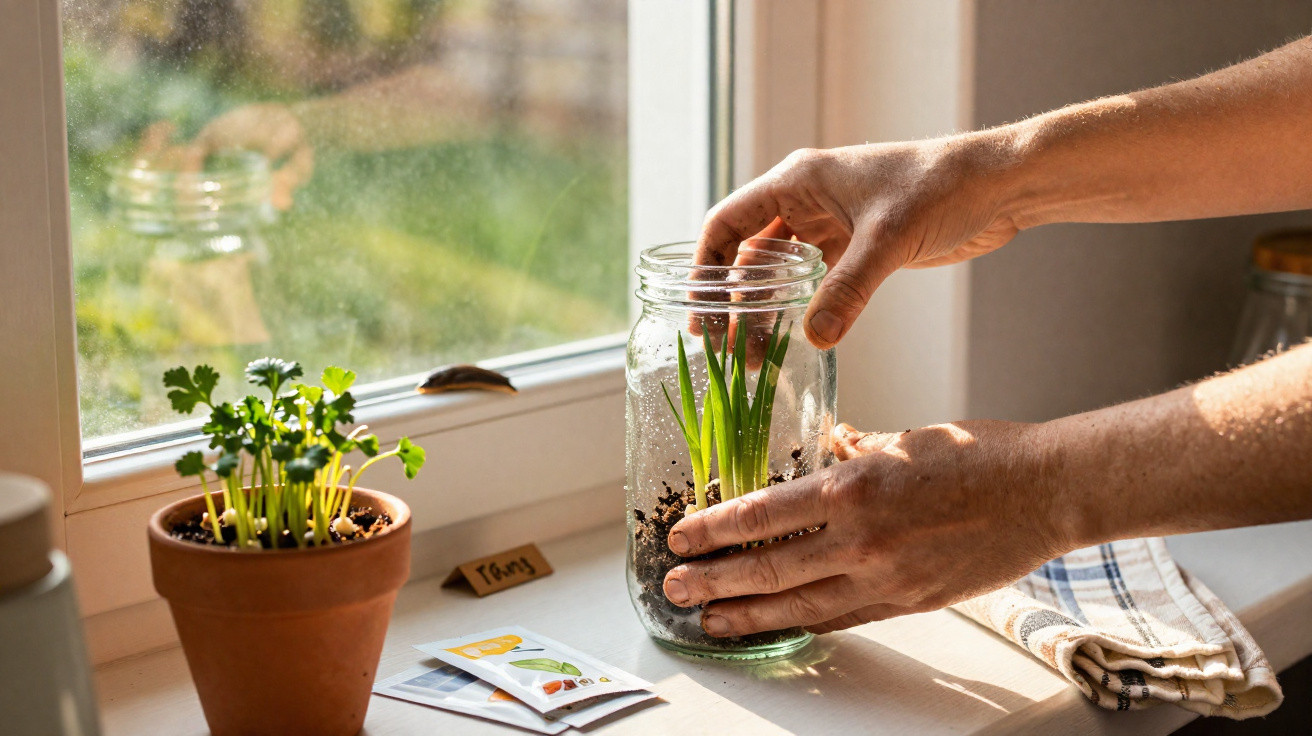
In March, temperatures can swing repeatedly between spring-like warmth and freezing conditions. This very rollercoaster holds many garden herbs back. An ordinary jar can remove that obstacle: chives, parsley and even rhubarb get going sooner, becoming denser, stronger and more aromatic. No professional greenhouse or specialist kit is needed – just one almost cost-free step.
How a glass jar works as a mini greenhouse
The idea is straightforward yet highly effective. Place a large glass jar upside down over young herbs like a cloche. This creates a small sheltered area with conditions that differ noticeably from the outside air.
“A warm, humid microclimate develops beneath the jar – exactly what chives and parsley love in spring.”
The key benefits at a glance:
- Extra warmth: Sunlight warms the air inside the jar, while the soil beneath it retains additional heat.
- Protection from cold: Night frosts and chilly winds affect the tender shoots far less severely.
- Greater humidity: Water condenses on the inside of the glass and slowly drips back down, creating a small water cycle.
- A longer growing period: Plants begin earlier and grow in a comfortable “spring sauna”.
A conventional greenhouse uses the same principle, simply on a larger scale. An old gherkin jar or preserving jar is enough to produce the same miniature effect directly in a bed or raised bed.
How to use the glass jar trick properly
For this simple approach to genuinely benefit your herbs, it needs to be used correctly. It is particularly suited to plants already growing in the ground that start producing new shoots again from February or March.
Step-by-step instructions
- Choose a suitable jar: Large, preferably rounded jars with wide openings are ideal, such as gherkin jars or thick-walled preserving jars.
- Loosen the soil: Gently crumble the soil around the plant with your hand so that air and water can circulate more effectively.
- Position the jar: Carefully place the jar upside down over the shoots and press it slightly into the soil so that it stands securely.
- Watch the ventilation: On very sunny days, tilt the jar slightly from time to time or remove it for a few hours to prevent excessive heat.
- Remove it in good time: Take the glass cloche away as soon as the herbs reach the top or the nights become milder.
In very windy positions, secure the jar with a stone or bank up a little soil around its edge. It is important to avoid permanently trapped moisture, otherwise fungal diseases may develop.
Which herbs benefit most from the glass jar trick
It is especially suitable for perennial, hardy plants that survive in the soil and send up new growth as temperatures rise. The glass jar trick simply gives them a small head start.
| Crop | Suitable for a glass cloche? | Typical effect |
|---|---|---|
| Chives | Yes, ideal | Noticeably earlier and thicker stems, with a stronger flavour |
| Parsley (perennial in a bed) | Very good | Faster new growth and more compact leaves |
| Rhubarb | Surprisingly good | Earlier, more tender stalks in spring |
| Lettuce seedlings | Good | Better establishment, plus protection from cold and slugs |
| Young kohlrabi plants | Also suitable | More resilient plants, with less stress from temperature fluctuations |
A jar therefore works not only as a “turbo booster” for chives and parsley, but also as a small insurance policy for young vegetable plants planted out early in the bed.
How the jar also protects against slug attacks
One side benefit that many gardeners only notice later is that the glass cloche acts as a physical barrier against slugs. They simply cannot reach the plant while the jar is sitting securely in place.
“Gardeners who protect young plants with glass often need considerably fewer slug pellets, or can manage without them altogether.”
Early lettuce and kohlrabi seedlings can otherwise disappear overnight. The jar gives them a window in which they can root undisturbed and grow stronger. Later on, robust plants cope with slug damage better than weak, tiny seedlings.
Save money by upcycling jars from the kitchen cupboard
Ready-made cold-frame cloches are available commercially, sometimes costing €30 to €40 each. However, anyone who regularly preserves food or buys gherkins in jars is likely to have suitable material already at home. Large screw-top jars, old preserving jars and even thick-walled sprouting jars can quickly be repurposed.
A few points are useful when choosing one:
- Keep the glass as clear as possible: Slightly tinted jars are acceptable, but heavily coloured glass blocks too much light.
- Choose a wide opening: The larger the diameter, the more air volume and room the plant has.
- Look for sturdy glass: Thin glass is more likely to break during everyday gardening, especially in frost and changing temperatures.
By placing several such glass cloches around the bed, you can effectively turn your own kitchen cupboard into a free garden upgrade. Many amateur gardeners report that herbs are ready to harvest one to two weeks earlier this way – a noticeable advantage at a time of year when little else is growing.
Mini vegetables and microgreens on the windowsill
The glass jar trick is not limited to outdoor beds. Similar effects can be achieved on a windowsill with cress, radish leaves or broccoli sprouts. Soil is not even required here in many cases; a low-nutrient growing medium or a fleece mat is often enough.
Anyone with little experience of microgreens should begin with small, robust seed mixes that are ready to harvest within a week. The benefit is that success comes very quickly, which is encouraging – and the fresh greens can go straight onto bread, into salads or into smoothies.
What to watch for with the glass jar trick in March
Although the method is practical, it also has a few potential pitfalls. The good news is that most can easily be avoided with a little routine.
Common mistakes and how to avoid them
- Too much heat: If the jar stands in full sun for hours, conditions beneath it can become extremely hot. Ventilate it on warm days or remove it temporarily.
- Constant wetness: When the soil remains permanently wet and little air can reach it, the risk of mould increases. Allow the soil to dry out a little between watering.
- Using it for too long: If the jar remains in place once temperatures are milder, plants can become accustomed to the sheltered conditions and be more vulnerable later.
A simple guide is this: cool but sunny days favour using the jar. Mild nights, consistently high temperatures or very intense sunshine are signs that it should gradually be left off.
Why chives and parsley respond so strongly to warmth
Chives and parsley are classic herb-bed plants, which is precisely why their behaviour early in the year is worth considering. Both are relatively undemanding species, but they respond well to a slight rise in soil temperature.
Chives repeatedly produce new hollow stems from numerous individual clumps. The sooner they begin, the more harvests are possible before summer. Parsley is usually at its strongest in its first year, while flowering often follows in the second. A good early start provides plenty more aromatic greenery before the plant directs its energy into seed production.
“Anyone who gives plants a helping hand with a jar in March can reliably fill herb bunches in the kitchen by April and May.”
In everyday terms, this means more fresh greenery on the plate, less reliance on dried herbs from a jar and, as an added benefit, one or two fewer purchases at the supermarket.
Comments
No comments yet. Be the first to comment!
Leave a Comment